In this article6 sections
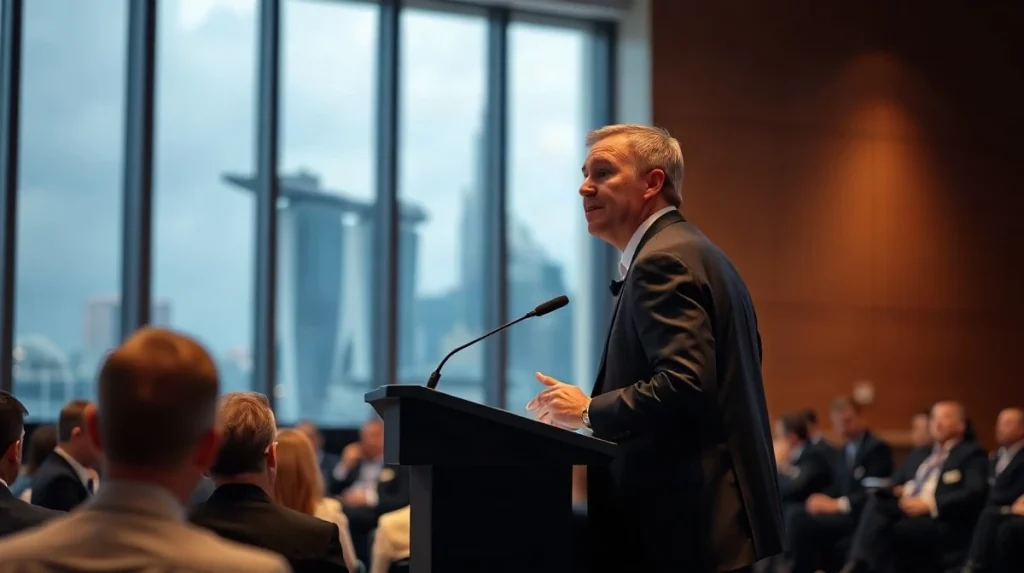
Ripple chief executive Brad Garlinghouse told Bloomberg’s Haslinda Amin at Singapore FinTech Festival 2026 on November 19 that digital assets backed by real demand should increasingly pull away from tokens driven by speculation, Bitcoinist reported. The interview landed as XRP was still trading below $1 during a weak November for crypto broadly.
The same week, the XRP Ledger Foundation finished an independent assessment tied to institutional standards, giving Ripple a second talking point on adoption. Crypto Briefing reported that Garlinghouse’s remarks were also carried by Bloomberg Technology, and it noted that Ripple’s US Securities and Exchange Commission case was resolved in 2025 with a civil penalty, while exchange-based XRP sales were cleared of being securities transactions.
 Also readXRP Holders Push Ripple to Burn 31.1 Billion Tokens by March 2027
Key facts
- Garlinghouse made the comments in a Bloomberg interview with Haslinda Amin on November 19 at Singapore FinTech Festival 2026.
- On November 18 the XRP Ledger Foundation completed a self-attestation against the ten principles of the Global Layer One (GL1) Market Infrastructure Toolkit.
- Blockchain security firm CertiK independently reviewed the Foundation’s responses under the framework’s Architecture and Resiliency principles.
- According to Bitcoinist, XRPL became the first public, permissionless Layer 1 blockchain to complete this independently verified assessment.
- Bitcoinist reported XRP struggling around the $1 psychological level during November, while Crypto Briefing cited a current range near $0.96–$0.98.
What the Ripple CEO argued
Garlinghouse said crypto assets have usually traded in lockstep, especially in volatile periods, and that this link could loosen. Assets with financial applications and steady demand may start to outpace tokens whose value comes mostly from speculative trading.
He acknowledged that 2026 has been a hard year for crypto and floated a reason for recent selling: capital rotating toward large technology IPOs. Even so, he kept a constructive longer-term view, saying blockchain can make financial settlement faster and cheaper, with uses extending into tokenization, insurance and other financial services.
 Also readEvernorth picks Ripple, Kraken, Coinbase, BitGo for 473M XRP treasury
For XRP the distinction matters because the token’s price is still tied closely to wider crypto sentiment, even though it was built to move value efficiently. The open question is whether Ripple’s growing institutional work will produce enough XRP-specific demand to affect its valuation.
The XRP Ledger’s GL1 assessment
The Foundation’s self-attestation covers governance, settlement finality, operational resilience, cybersecurity and institutional access, areas banks and asset managers weigh when evaluating blockchain infrastructure for tokenized assets. Bitcoinist reported that Ripple publicised the milestone through its official X account, stressing infrastructure that financial institutions can measure against established standards.
Bitcoinist also noted a limit: the assessment is not a regulatory approval, certification or endorsement by GL1, and verified technical controls do not by themselves create more XRP demand.
Institutional links and the token-demand gap
Ripple has announced expanded relationships with major financial institutions including BNY and Robinhood, covering payments, stablecoins, treasury services and other blockchain-based financial applications. Bitcoinist previously reported that Aviva Investors expanded tokenization on XRPL with a tokenized share class of its Sterling Liquidity Fund.
Those relationships sit alongside, not on top of, XRP demand. A company using Ripple’s software or the RLUSD stablecoin does not necessarily need to buy large amounts of XRP. Dollar-denominated assets such as RLUSD can also serve institutions that want stable value rather than a volatile bridge asset, so XRP’s case rests on whether its liquidity and settlement speed offer measurable advantages in specific cross-border corridors.
Why it matters
Garlinghouse’s argument sets up a test that holders can check directly: whether adoption shows up in XRP-based settlement activity, liquidity demand and network participation, rather than in announcements alone. That is a shift from earlier cycles, when Ripple’s corporate news and XRP’s price often moved together on sentiment. For institutions weighing tokenized assets, the GL1 review gives them a comparable checklist, even without any regulatory status attached.
What to watch
Bitcoinist points to XRP reclaiming $1 and then holding above its 50-day and 200-day moving averages as a sign of improving momentum, and to higher lows and stronger volume as confirmation. Crypto Briefing flags whether XRP can hold its $0.96–$0.98 range and how price and volume respond to institutional or regulatory news.
This is not financial advice, and crypto markets are volatile and uncertain.
Sources: Bitcoinist, Crypto Briefing