
In this article5 sections
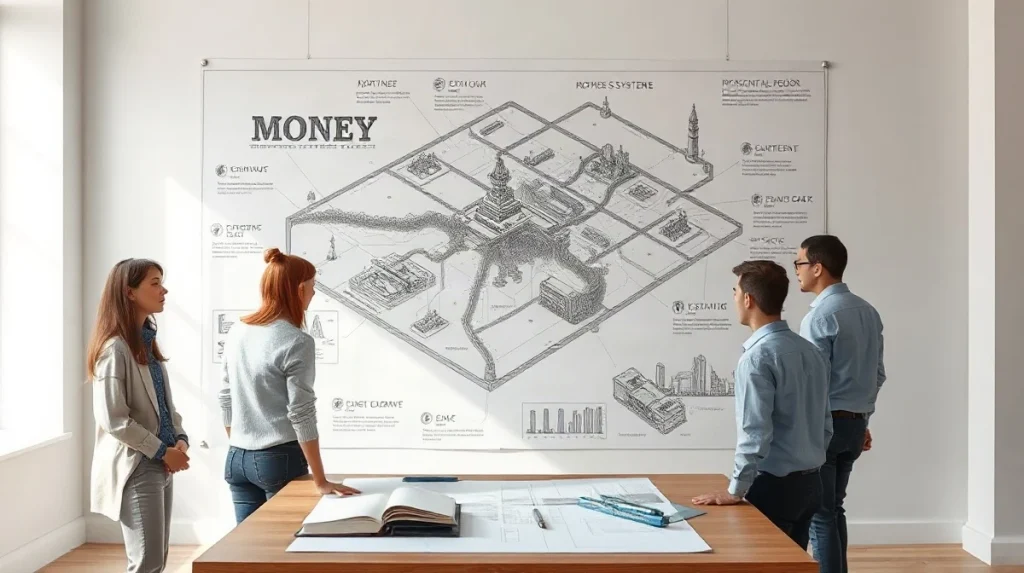
The creators behind The Waterworks of Money say bitcoin has gained as an investment while losing part of its original role as an alternative payment system, a tension they trace through the broader architecture of money creation. Speaking with Bitcoinmagazine, artist Carlijn Kingma, financial journalist Thomas Bollen and monetary researcher Martijn Jeroen van der Linden discussed their project, which renders the financial system as a network of reservoirs, channels and pumps.
The work emerged from two years of research, including interviews with more than 100 experts in banking, government, academia and monetary reform. Kingma spent more than 2,200 hours translating that research into an intricate architectural drawing. Bollen and van der Linden developed the economic research and narratives behind it.
 Also readCalamos CEO John Koudounis Keeps $1M Bitcoin Call for 2030
Key facts
- The project involved interviews with more than 100 experts over two years of research, and Kingma spent more than 2,200 hours on the drawing.
- Kingma said a bitcoin future scenario, The Republic of a Thousand Coins, includes jokes aimed at central bankers, such as Alan Greenspan depicted as an inflatable doll.
- Van der Linden said US authorities guaranteed all Silicon Valley Bank deposits in 2023, including the more than 90 percent above the insured limit, and Switzerland backed UBS’s rescue of Credit Suisse.
- Bollen will join two panels at Bitcoin Amsterdam on November 6, 2026, on the Treasury Stage: one at 11:00-11:30 AM with Rahim Taghizadegan and Willem Middelkoop, and another at 1:55-2:25 PM with Paul Buitink and Simon Lelieveldt.
Banks create money, and few inside the system know it
Bollen said his biggest surprise during the research was how narrowly specialists understand their own corner of finance while few grasp the whole system. He pointed to the fact that banks create new money when they lend rather than simply passing on depositors’ savings, and said some bankers, including a major bank CEO, did not know they worked for a money-creating institution. He argued that economics teaching still underplays the point.
Asked how much inequality comes from monetary design, Bollen said no precise number can capture it but that the system worsened inequality during years of very cheap credit. He cited Ray Dalio’s 2019 remark that money is free for those who are creditworthy, and said cheap credit for wealthy households and large multinationals drove up share and house prices, producing a specific form of asset inflation.
 Also readBitcoin Tops $87,000 After Soft September Jobs Report
Illustrating money, and planning for a bitcoin future
Kingma said the hardest challenge was showing how all parts of the system connect. Water served as the metaphor because liquidity and cash flows already appear in financial language, and pipes and canals could link different sections. But she said money comes in many forms, including commodity money, public money and private credit money, plus short-term debt and repo contracts as near-money, and that drawing so many kinds of water was not possible. She also noted that financially knowledgeable visitors laugh more at the work, since they catch references such as renaming Basel III as “Babel III”.
Van der Linden said post-2008 repair efforts brought stricter rules and coordinated supervision but left the underlying architecture unchanged. He pointed to 2023, when post-crisis playbooks stayed in the drawer during the failures at Silicon Valley Bank and Credit Suisse, and argued that reliance on runnable deposits still makes banks fragile even with regulation in place. He distinguished new large non-banks, which he said do not play a pivotal role in money and payments.
Why it matters
The interview places bitcoin inside a debate about who controls money creation, not outside it. If bitcoin is mostly held through investment funds and traditional institutions, the project’s collaborators suggest it may reinforce the same concentrations of power it was designed to avoid, even as stablecoins and bank payment tools such as Wero push payments away from established rails. Bollen compared bitcoin’s design to full reserve banking, noting a bitcoin is not a claim on anything else, while pointing to the Amsterdamsche Wisselbank’s slide after it lent to the Dutch East India Company and to FTX’s collapse as warnings about monetary experiments going wrong.
What to watch
Bollen’s two Bitcoin Amsterdam sessions on November 6, 2026, will put these arguments before a bitcoin audience at a conference running November 5-6. The project’s organizers are also promoting a two-part animated exploration and a limited-edition print to fund continued research.
The views above concern the design and structure of monetary systems; this is not financial advice, and crypto markets are volatile and uncertain.
Source: Bitcoin Magazine