TAO Price Under Pressure: Analyzing Bitcoin Dominance and Persistent Covenant Aftershocks
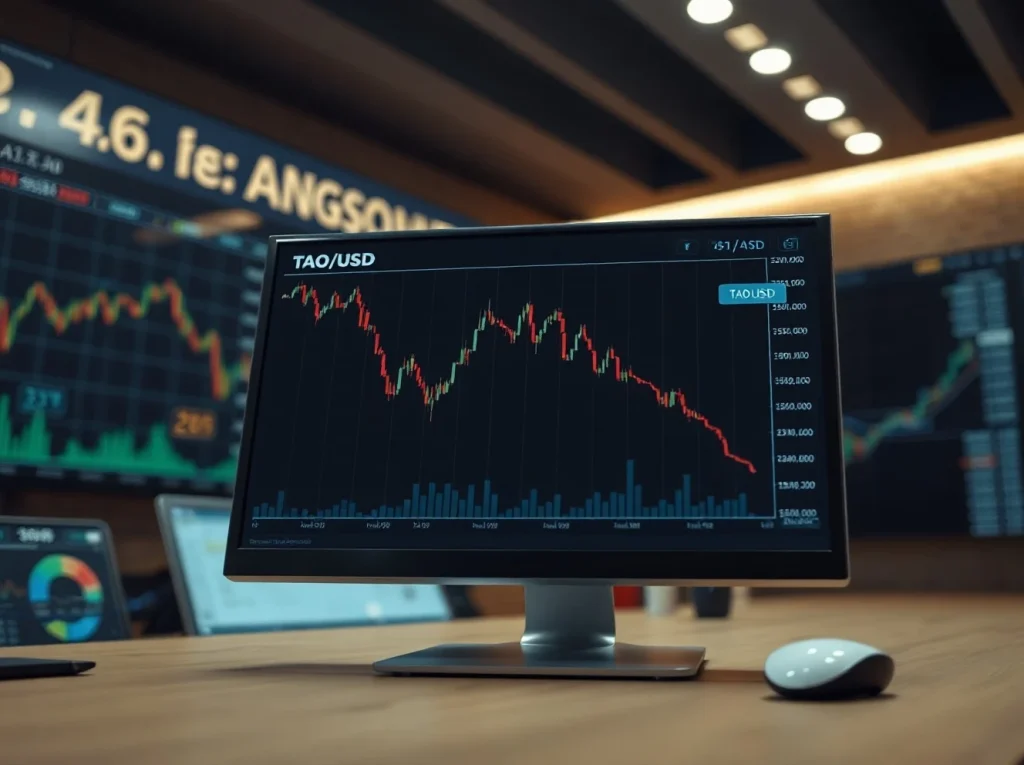
The price of Bittensor’s TAO token faces significant selling pressure in mid-April 2026. This decline coincides with Bitcoin reasserting its market dominance and ongoing technical concerns from recent network covenant changes. Data from CoinGecko shows TAO has fallen approximately 18% over the past week, underperforming against major benchmarks.
TAO Price Technical Breakdown
According to trading data from April 15, 2026, TAO trades around $420, a notable drop from its monthly high near $515. The 50-day moving average has crossed below the 200-day average—a bearish signal technical analysts watch closely. Trading volume has increased by 35% during the decline, suggesting strong selling interest.
Also read: Telegram-Linked TAC Token Crashes 90% in 15 Minutes: What Happened?
Market analysts point to several key support levels. “The $400 level represents critical psychological and technical support,” noted a report from CryptoQuant on April 14. “A break below this could trigger another wave of selling.” The relative strength index (RSI) sits at 32, indicating oversold conditions but not yet extreme.
Bitcoin’s Resurgent Dominance
Bitcoin’s market dominance has climbed to 54.2% as of April 14, 2026, its highest level since January. This metric measures Bitcoin’s share of the total cryptocurrency market capitalization. When dominance rises, capital often flows from altcoins like TAO back into Bitcoin.
Also read: XRP Scarcity Index on Binance Hits Highest Level Since Mid-2024, So Where Did the Coins Go?
This shift typically occurs during periods of market uncertainty. “Investors are showing a clear flight to quality,” observed Marcus Thielen, head of research at Matrixport, in an April 13 market note. “Bitcoin’s established network effects and liquidity make it the default safe haven during crypto market stress.”
The implication for TAO and other altcoins is direct. As Bitcoin strengthens, it absorbs capital that might otherwise support alternative projects. This dynamic creates headwinds for TAO’s price recovery.
Covenant Changes and Network Uncertainty
Bittensor’s recent implementation of subnet covenants continues to affect market sentiment. These technical governance mechanisms, designed to regulate subnet creation and participation, underwent significant modifications in March 2026.
While intended to improve network quality, the changes created uncertainty. Some validators expressed concerns about implementation timelines and technical requirements. This suggests the network is experiencing growing pains as it scales.
On-chain data reveals measurable effects. According to Subscan analytics, new subnet registration slowed by 22% in the two weeks following the covenant updates. Active addresses on the Bittensor network also declined slightly during this period.
What this means for investors is continued caution. Network development changes, while potentially positive long-term, often create short-term volatility. Market participants appear to be pricing in this transitional risk.
Comparative Market Performance
TAO’s performance must be contextualized against broader market movements. The following table shows how TAO has fared against other AI-focused tokens and major cryptocurrencies over the past seven days, ending April 15, 2026:
| Asset | 7-Day Performance | Key Driver |
|---|---|---|
| TAO (Bittensor) | -18.2% | Bitcoin dominance, covenant concerns |
| RNDR (Render) | -12.4% | Broader AI token correction |
| FET (Fetch.ai) | -14.7% | Profit-taking after Q1 rally |
| Bitcoin (BTC) | -3.1% | Relative strength vs. altcoins |
| Ethereum (ETH) | -8.5% | Follows Bitcoin trend |
The data shows TAO underperforming its AI sector peers significantly. This could signal specific concerns beyond general market weakness. Industry watchers note that Bittensor’s unique staking and validation model might make it more sensitive to technical changes than other projects.
Institutional Sentiment and On-Chain Metrics
Institutional flows provide another perspective. Data from CoinShares shows digital asset investment products experienced outflows of $206 million for the week ending April 11, 2026. However, Bitcoin products saw minor inflows of $18 million during the same period.
This pattern reinforces the Bitcoin dominance narrative. Institutions appear to be reallocating within crypto rather than exiting completely. For TAO, the lack of dedicated institutional products means it misses this potential support.
On-chain metrics for TAO show mixed signals:
- Staking participation remains high at 68% of circulating supply, indicating core network commitment.
- Exchange netflow turned positive in early April, suggesting more tokens moving to exchanges for potential selling.
- Network growth metrics have stalled, with new address creation flat for three consecutive weeks.
These metrics paint a picture of a network in a consolidation phase. Strong staking suggests believers remain, but weak growth and exchange flows create selling pressure.
Historical Context and Potential Scenarios
TAO has experienced similar corrections before. In November 2025, the token declined 25% over three weeks before recovering to new highs by February 2026. The current downturn resembles that pattern in duration and magnitude.
However, the market context differs. Bitcoin dominance was below 50% during the 2025 correction. The current higher dominance level may prolong TAO’s recovery timeline. This could signal a longer period of underperformance relative to Bitcoin.
Analysts outline two primary scenarios for the coming weeks:
- Quick recovery if Bitcoin dominance peaks and begins to decline, releasing capital back into altcoins.
- Extended consolidation if Bitcoin maintains or increases its dominance, keeping pressure on TAO and similar tokens.
The covenant implementation represents a wild card. Successful adaptation by validators could restore confidence quickly. But prolonged technical issues would likely extend the price pressure.
Conclusion
The TAO price faces pressure from two primary sources: Bitcoin’s resurgent market dominance and aftershocks from recent network covenant changes. Technical indicators show the token in a clear downtrend, though approaching oversold levels. Historical patterns suggest recovery is possible, but the current market structure with strong Bitcoin dominance creates headwinds. Network fundamentals through staking remain solid, but growth metrics need improvement. For TAO to regain momentum, market conditions must shift or the network must demonstrate successful adaptation to its new covenant framework. The coming weeks will test both the token’s technical support levels and the Bittensor community’s ability to address this transitional phase.
FAQs
Q1: What are covenant aftershocks in the context of Bittensor?
Covenant aftershocks refer to the ongoing market and network effects following Bittensor’s implementation of new subnet governance rules in March 2026. These technical changes created uncertainty among validators and developers, affecting sentiment.
Q2: How does Bitcoin dominance affect TAO price?
Bitcoin dominance measures Bitcoin’s share of the total crypto market capitalization. When it rises, capital often flows from altcoins like TAO into Bitcoin. This reduces buying pressure on TAO and can push its price lower relative to Bitcoin.
Q3: What is the key support level for TAO price?
Technical analysts identify the $400 level as critical support. This represents both a psychological round number and a previous area where buying interest emerged. A break below this level could trigger further selling.
Q4: Are institutional investors selling TAO?
Direct institutional data is limited since TAO lacks dedicated investment products like ETFs. However, broader crypto fund flows show institutions moving toward Bitcoin and away from altcoins generally, which indirectly affects TAO.
Q5: What would signal a turnaround for TAO price?
Analysts would look for two developments: a decline in Bitcoin dominance below 52%, indicating capital returning to altcoins, and clear on-chain evidence that Bittensor’s network activity is recovering post-covenant changes.