South Korea Stock Market Crash Wipes Out ₩2.5 Quadrillion in 40 Days
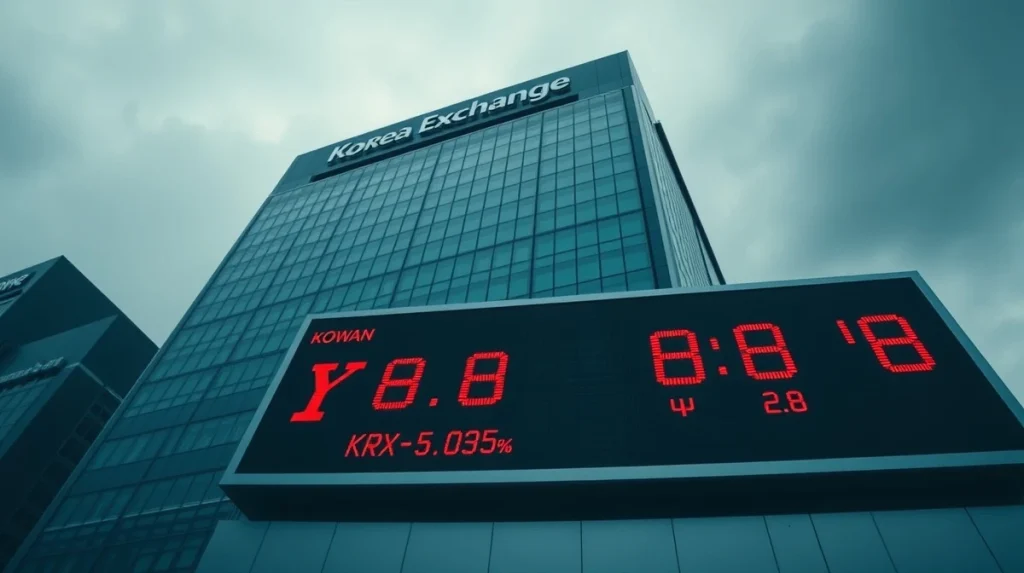
South Korea’s stock market has lost approximately ₩2.5 quadrillion (roughly $1.8 trillion USD) in market capitalization over the past 40 trading days, marking one of the most severe sustained sell-offs in the country’s financial history. The crash, which has driven the benchmark KOSPI index to its lowest levels since the 2020 pandemic crash, reflects a convergence of domestic political turmoil and global economic headwinds.
Political Crisis and Market Panic
The sell-off accelerated sharply after the National Assembly voted to impeach President Yoon Suk Yeol in late November on charges related to abuse of power and corruption. The political vacuum has paralyzed policymaking at a time when the economy faces significant external pressures. The Korea Composite Stock Price Index (KOSPI) fell below the 2,200 mark for the first time in four years, while the junior KOSDAQ index, heavily populated by smaller tech and biotech firms, dropped over 30% from its peak earlier this year.
Also read: Treasury's Stablecoin Rule Puts New Compliance Burden on Exchanges, Brokers, and Wallets
Foreign investors have been net sellers for 28 consecutive trading sessions, pulling out more than ₩15 trillion ($10.8 billion) from Korean equities, according to data from the Korea Exchange. This flight of foreign capital has compounded the selling pressure, creating a negative feedback loop that has drawn comparisons to the 1997 Asian Financial Crisis in terms of velocity, if not yet in systemic risk.
Semiconductor Rout and Trade War Fears
The crash has been particularly brutal for South Korea’s dominant semiconductor sector. Samsung Electronics, the country’s largest company by market cap, has lost over 35% of its value during the 40-day window, while SK Hynix has fallen by more than 40%. These two stocks alone account for roughly a third of the KOSPI’s weighting, meaning their decline has dragged down the entire index.
Also read: Bitcoin Faces $7B Liquidity Trap Between $62K and $65K Ahead of CLARITY Act Vote
The semiconductor rout is tied directly to escalating US-China trade tensions. The Biden administration’s latest round of export controls on advanced chipmaking equipment, announced in early December, has raised fears that South Korean chipmakers will be caught in the crossfire. China is the largest export market for Korean semiconductors, and any further restrictions could severely impact revenue. The Korea Customs Service reported a 12% drop in semiconductor exports to China in November, the steepest monthly decline in three years.
Currency Pressure and Contagion Risk
The Korean won has weakened sharply against the US dollar, falling to 1,480 won per dollar, its lowest level since the 2008 global financial crisis. A weaker won makes imported raw materials more expensive for Korean manufacturers, squeezing profit margins at a time when global demand is already softening. The Bank of Korea has intervened in the foreign exchange market to stabilize the currency, but analysts say the central bank’s reserves, while substantial, are not infinite.
The sell-off has also spilled over into other Asian markets. Japan’s Nikkei 225 and Taiwan’s Taiex have both declined by more than 10% over the same period, as investors have broadly reduced exposure to Asian export-oriented economies. The MSCI Asia ex-Japan index has fallen into bear market territory, defined as a 20% decline from its recent peak.
What to Watch Next
The immediate focus is on the Constitutional Court’s decision on President Yoon’s impeachment, which could take up to 180 days. If the court upholds the impeachment, a snap presidential election would be held within 60 days, potentially bringing a new government with a different economic policy direction. Markets will also be watching for any emergency stimulus measures from the finance ministry, which has so far been limited to verbal intervention.
On the global front, the outcome of US-China trade negotiations in January will be critical. A de-escalation could provide a powerful catalyst for a rebound in Korean tech stocks, while further escalation could push the KOSPI toward the 2,000 level, a threshold not seen since the early days of the COVID-19 pandemic. For now, the combination of political uncertainty and trade headwinds suggests that volatility is likely to persist in the weeks ahead.
Frequently Asked Questions
What caused the South Korea stock market crash in 2025?
The crash was triggered by a combination of political instability after President Yoon Suk Yeol’s impeachment, fears of a US-China trade war escalation, and a global sell-off in semiconductor stocks, which are heavily weighted on the KOSPI.
How much value was lost in the South Korean market?
Approximately ₩2.5 quadrillion (roughly $1.8 trillion USD) in market capitalization was wiped out from the KOSPI and KOSDAQ exchanges over a 40-day period.
Which sectors were hit hardest?
Technology and semiconductor stocks, including market heavyweight Samsung Electronics and SK Hynix, led the decline. Financial and export-oriented sectors also suffered significant losses.
Is the South Korean economy at risk of recession?
While the stock market crash does not automatically mean a recession, it signals deep investor concern. Combined with political uncertainty and trade headwinds, the Bank of Korea has warned of increased downside risks to economic growth.