How Much XRP Do You Really Need to Retire? A 2026 Reality Check
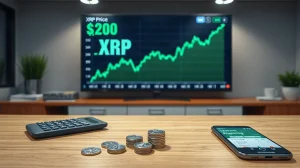
In the volatile world of cryptocurrency, the question of retirement planning has shifted from theoretical to urgent. For XRP holders, the math is deceptively simple — and brutally uncertain. With XRP trading around $0.60 in early 2026, the gap between a comfortable retirement and a costly gamble hinges on price projections, withdrawal strategies, and the outcome of Ripple’s long-running legal battle with the U.S. Securities and Exchange Commission (SEC).
The Baseline Math: How Many XRP Do You Need?
Financial planners often use the 4% rule — withdrawing 4% of your portfolio annually — as a starting point for retirement income. To generate $40,000 per year, you need a portfolio worth $1 million. At $5 per XRP, that requires 200,000 tokens. At $8, it drops to 125,000. At $10, it falls to 100,000.
Also read: Cardano (ADA) Jumps 27%: Network Records, ETF Hopes, and the Road to $1.50
But XRP’s price history is anything but linear. In 2018, it peaked near $3.84 before crashing. In 2021, it hit $1.96. As of early 2026, it remains below $1, reflecting ongoing regulatory uncertainty and market competition. The SEC’s lawsuit, filed in December 2020, has cast a long shadow over XRP’s price and liquidity.
Price Predictions for 2026: A Wide Spectrum
Analyst forecasts for XRP in 2026 range from conservative to highly optimistic. Finder’s panel of fintech experts projected an average price of $3.61 by the end of 2025, with some seeing $5 by 2026. CoinPriceForecast uses algorithmic modeling to predict around $2.80 by year-end 2026. On the high end, some retail-focused analysts have floated $10–$15, assuming Ripple wins its legal cases and XRP gains widespread adoption as a cross-border settlement token.
Also read: Chainlink Price Rally Accelerates: Can LINK Bulls Flip $12 Into Support?
Even the most bullish projections, however, carry significant risk. Cryptocurrency markets are driven by sentiment, regulation, and macroeconomic factors — none of which are reliably predictable three years out.
What Realistic Returns Look Like
Instead of chasing a single price target, consider a range of scenarios:
- Conservative scenario ($2 XRP): You’d need 500,000 XRP to reach $1 million. At current prices, that’s roughly $300,000 in capital — a sum most retail investors cannot commit.
- Moderate scenario ($5 XRP): 200,000 XRP required, or about $120,000 at today’s prices.
- Optimistic scenario ($10 XRP): 100,000 XRP needed, requiring a $60,000 investment today.
These numbers exclude transaction fees, taxes, and the impact of inflation over a 30-year retirement. They also assume you sell XRP gradually — which could itself depress prices if many holders do the same.
The Role of Passive Income: Staking and Yield
Unlike Ethereum or Cardano, XRP does not support native staking. Ripple’s ledger uses a consensus protocol that does not reward holders for participation. Some centralized exchanges and DeFi platforms offer yield on XRP deposits, but these rates are typically low — 1–3% annually — and carry counterparty risk. A 2% yield on 100,000 XRP at $5 would generate just $10,000 per year, far below the $40,000 target.
For comparison, a diversified portfolio of dividend stocks or bonds could yield 4–6% with lower volatility. Relying solely on XRP for passive income is mathematically challenging without substantial price appreciation.
What to Watch Next
Three factors will shape XRP’s retirement viability between now and 2030:
1. The SEC lawsuit resolution. A final ruling or settlement could remove the biggest cloud over XRP’s price. In July 2023, a judge ruled that XRP is not a security when sold to retail investors on exchanges — a partial victory — but the case continues. A complete resolution could unlock institutional investment and improve price stability.
2. Adoption as a payment bridge. Ripple’s network is used by financial institutions for cross-border payments. If adoption scales significantly, demand for XRP as a bridge currency could increase, supporting higher prices. However, competition from stablecoins and central bank digital currencies (CBDCs) poses a threat.
3. Macroeconomic conditions. Like all cryptocurrencies, XRP is sensitive to interest rates, inflation, and risk appetite. A recession or regulatory crackdown could suppress prices for years.
Retirement planning with XRP is not impossible, but it requires a realistic understanding of the risks. A single-asset crypto retirement is a high-stakes bet — one that may pay off, but could also fall short. For most investors, a balanced portfolio that includes XRP as a satellite holding — not the core — remains the more prudent path.