South Korea Crypto Trading Volume Plunges 88% as Retail Excitement Fades
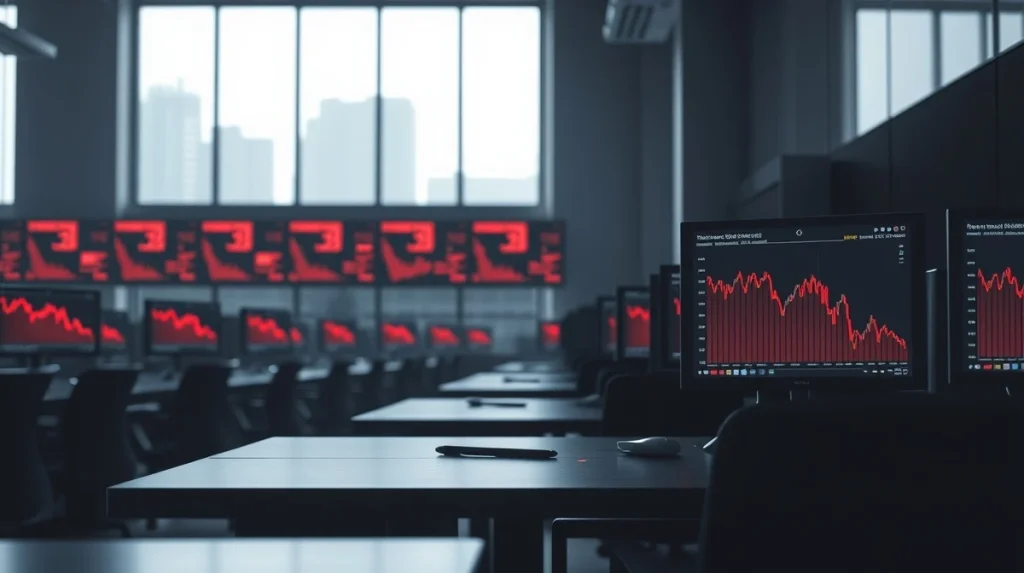
South Korea’s cryptocurrency trading volume collapsed 88% in the first quarter of 2026, falling to roughly $12 billion from over $100 billion in the same period a year earlier, according to data from CoinGecko. The dramatic decline marks one of the steepest contractions in any major digital asset market and signals a fundamental shift in retail behavior in what was once the world’s most speculative crypto trading environment.
Regulatory Crackdown and Political Turmoil
The volume plunge follows a series of enforcement actions by South Korea’s Financial Services Commission (FSC), which began requiring all registered exchanges to implement stricter know-your-customer (KYC) procedures and real-name verification for every transaction in mid-2025. The FSC also expanded its oversight of so-called “kimchi premium” arbitrage trades, where traders exploited price differences between Korean exchanges and global platforms. These measures effectively chilled the rapid-fire retail trading that had characterized the market since 2021.
Also read: Uber Cuts 3,300 Jobs in Largest Workforce Reduction Since 2020
Compounding the regulatory pressure, South Korea experienced a period of political instability after President Yoon Suk Yeol’s impeachment in December 2025. The ensuing leadership vacuum delayed several planned blockchain industry initiatives, including a proposed framework for institutional crypto investment that had been expected to launch in early 2026. Uncertainty over the new administration’s stance on digital assets further discouraged both retail and institutional participation.
What the Volume Drop Means for Global Markets
South Korea has historically punched above its weight in crypto markets. At its peak in early 2025, the Korean won accounted for nearly 15% of global Bitcoin trading volume, second only to the US dollar. The current decline reduces that share to under 3%, according to CCData. For global traders, the disappearance of Korean volume removes a significant source of liquidity and price discovery, particularly during Asian trading hours.
Also read: Solana Confirms September 9 Transaction V1 Upgrade, Alpenglow Set for October
Retail investors in South Korea, who once drove parabolic rallies in altcoins like Terra (LUNA) and Klaytn (KLAY), have largely retreated to the sidelines. Search interest for crypto-related terms on Naver, the country’s dominant search engine, fell to its lowest level since 2023 in February 2026. Local media reports indicate that many small investors have rotated capital into US equities and domestic real estate instead.
Upbit Dominance and Market Concentration
The volume decline hit all four major Korean exchanges — Upbit, Bithumb, Coinone, and Korbit — but Upbit bore the brunt. The exchange, operated by Dunamu, controlled approximately 82% of domestic won trading pairs at the start of 2026. Its average daily volume dropped from $3.2 billion in Q1 2025 to under $400 million in Q1 2026. Bithumb, the second-largest exchange, saw volumes fall by a similar proportion, though from a smaller base.
Industry analysts point to a structural problem: South Korea’s crypto market is unusually dependent on a narrow base of highly active retail traders. Data from the Korea Financial Intelligence Unit (KoFIU) showed that just 3% of accounts generated over 70% of trading volume in 2025. When those power users withdrew, the market hollowed out quickly.
What to Watch Next
The next catalyst for South Korean crypto markets could come from the new administration, which is expected to announce its digital asset policy framework by June 2026. Early signals suggest a more balanced approach — potentially permitting spot Bitcoin exchange-traded funds (ETFs) while maintaining strict consumer protection rules. Separately, the FSC is reportedly considering a pilot program for institutional crypto custody services, which could bring dormant capital back into the market.
For now, the 88% volume drop serves as a cautionary tale about the fragility of retail-driven markets and the speed at which regulatory and political factors can reshape even the most enthusiastic trading environments.