Prediction Markets Could Reach $1 Trillion by 2030: Analysts Cite Regulatory and Tech Drivers
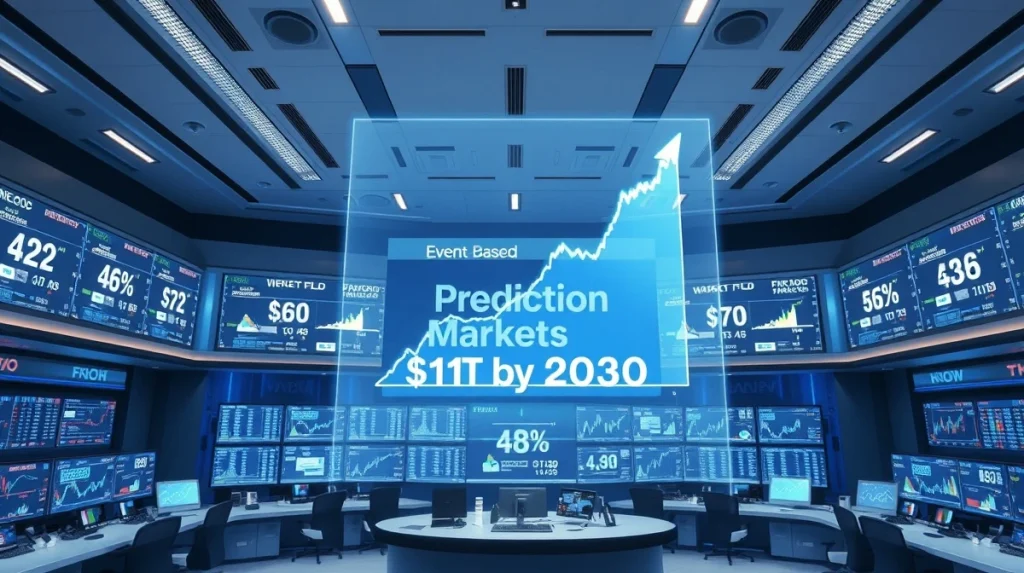
A new wave of analyst reports projects that global prediction markets could reach $1 trillion in trading volume by 2030, up from roughly $5 billion in 2024. The forecast, driven by regulatory clarity, blockchain adoption, and expanding use cases, signals a shift in how financial markets and everyday users engage with event-based trading.
Prediction markets — platforms where participants trade contracts tied to the outcome of future events — have historically been niche, dominated by political betting and sports wagering. But a convergence of technological and regulatory developments is broadening their appeal.
Also read: Telegram's .gram Domain Bid Could Reshape Web3 Identity
Regulatory Tailwinds and Institutional Interest
In the United States, the Commodity Futures Trading Commission (CFTC) has signaled a more structured approach to event contracts. In 2024, the agency proposed new rules that would allow certain types of prediction market contracts while maintaining consumer protections. Meanwhile, platforms like Kalshi have secured regulatory approval to operate as designated contract markets, offering event contracts on everything from Federal Reserve interest rate decisions to weather outcomes.
“The regulatory framework is evolving to accommodate these markets, which is unlocking institutional capital,” said a research note from Messari, a crypto analytics firm. “We’re seeing hedge funds and asset managers explore prediction markets as alternative data sources and hedging tools.”
Also read: Cuomo Urges Congress to Pass CLARITY Act, Warns U.S. Is 'Way Behind' on Crypto Rules
In Europe, the Markets in Crypto-Assets (MiCA) regulation provides a legal framework for blockchain-based prediction platforms, reducing uncertainty for operators and users alike. Japan and Singapore are also exploring sandbox programs for event-based trading.
Blockchain Infrastructure and User Growth
Blockchain technology has been a key enabler. Platforms like Polymarket, built on the Ethereum layer-2 Polygon, offer transparent, non-custodial trading with lower fees than traditional alternatives. Polymarket processed over $1 billion in trading volume in 2024 alone, driven by the US presidential election and Super Bowl outcomes.
The total addressable market extends far beyond politics and sports. Analysts at CoinShares and Delphi Digital point to emerging categories: corporate earnings forecasts, climate event outcomes, disease outbreak predictions, and even film box office results. Each category could attract billions in liquidity as the user base grows.
“Prediction markets are becoming a general-purpose information aggregation tool,” said a report from Delphi Digital. “Their ability to surface accurate probabilities on virtually any question has value for businesses, governments, and researchers.”
Implications for Traders and the Broader Market
For cryptocurrency traders, prediction markets offer a new asset class with low correlation to Bitcoin and Ethereum. They also provide a venue for hedging real-world risks — a farmer could hedge against drought, or a logistics company could bet on shipping delays.
However, risks remain. Regulatory reversals, platform security breaches, and market manipulation are real concerns. The CFTC has warned that some prediction contracts may violate anti-gambling laws, and enforcement actions are possible.
“The path to $1 trillion is not guaranteed,” cautioned a note from JPMorgan. “It depends on consistent regulatory treatment and the development of reliable oracle infrastructure to settle outcomes fairly.”
Despite these hurdles, the trajectory is clear. With institutional interest rising, regulatory frameworks maturing, and blockchain technology enabling global, low-cost participation, prediction markets are poised for exponential growth over the next decade. Traders and investors should watch for key milestones: CFTC final rules, the launch of major platform tokens, and the entry of traditional exchanges like CME or ICE into event-based contracts.