Dogecoin Whales Hit All-Time High Accumulation as Bullish Momentum Ignites Market
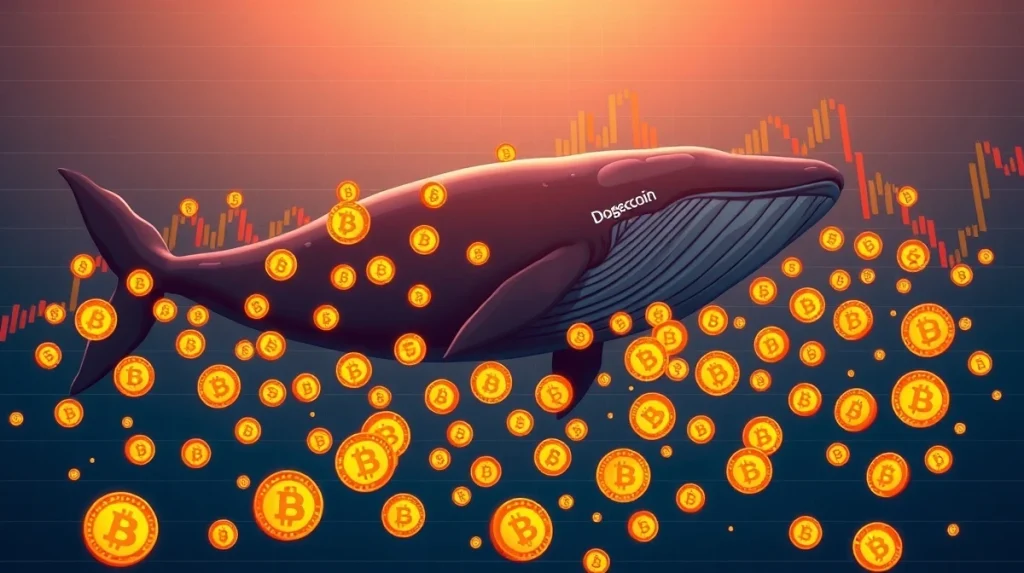
Dogecoin whales have reached an all-time high in accumulation, signaling a powerful shift in market sentiment. On-chain data reveals that large holders, those with over 1 million DOGE, are buying aggressively. This trend has ignited bullish momentum across the broader crypto market.
Data from Santiment shows that whale wallets now hold a record 62% of the total DOGE supply. This is a significant jump from 55% just three months ago. The implication is clear: big money is betting on Dogecoin’s future.
Also read: XRP Price Reclaims $1.10 Support as Upbit Volume Surpasses Bitcoin
Dogecoin Whales Accumulate at Record Pace
Whale accumulation refers to the process where large investors buy substantial amounts of a cryptocurrency. For Dogecoin, this has reached rare levels. According to IntoTheBlock, addresses holding between 1 million and 10 million DOGE have increased their holdings by 15% in the past month.
What is driving this? Analysts point to several factors. First, Dogecoin’s integration with payment systems like X Payments has boosted utility. Second, the broader crypto market is recovering, with Bitcoin hovering near $70,000. Third, retail interest is rising again.
Also read: Can Solana Flip XRP? A Data-Driven Analysis of Market Cap and Network Momentum
Industry watchers note that whale activity often precedes major price moves. When whales accumulate, they reduce the circulating supply. This can create upward pressure on price. But it also raises concerns about centralization.
On-Chain Data Reveals the Scale
Blockchain analytics firm Santiment reported that whale transactions, those over $100,000, hit 1,200 in a single day on April 28. This is the highest since January 2021. The total value of these transactions exceeded $120 million.
Another metric, the Supply Distribution, shows that addresses with 1 million to 10 million DOGE now control 23.5% of the total supply. This is up from 21% in March. Meanwhile, smaller holders have slightly reduced their positions.
This suggests that whales are accumulating while retail traders are taking profits. It is a classic pattern seen in many bull markets. The question is whether this time is different.
Bullish Momentum Builds for DOGE Price
Dogecoin’s price has responded to this whale activity. DOGE traded at $0.12 on April 1. By May 1, it had climbed to $0.18. That is a 50% gain in one month. The rally has been supported by higher trading volumes, which averaged $1.5 billion daily in April.
Technical indicators also look bullish. The Relative Strength Index (RSI) sits at 65, indicating room for further growth. The Moving Average Convergence Divergence (MACD) shows a bullish crossover. Support sits at $0.15, while resistance is at $0.20.
But caution is warranted. Whale accumulation can also lead to sell-offs. If these large holders decide to take profits, the price could drop sharply. Investors should monitor whale wallet movements closely.
Market Context and Broader Implications
The Dogecoin whale accumulation is happening against a backdrop of renewed crypto optimism. Bitcoin’s halving in April 2024 has historically triggered bull runs. Ethereum’s Dencun upgrade has also boosted network activity.
Dogecoin, originally created as a joke, has evolved into a serious asset. It now has a market cap of over $25 billion. It is accepted by companies like Tesla, AMC Theatres, and Dallas Mavericks. This real-world adoption supports its value proposition.
Regulatory clarity is also improving. The US Securities and Exchange Commission has not classified Dogecoin as a security. This reduces legal risk for investors. Many see it as a commodity, like Bitcoin.
Expert Insights on Whale Behavior
Market analysts have weighed in on this trend. One crypto analyst noted that whale accumulation often precedes a major rally. “When whales buy, they are signaling confidence. They have access to better information and resources.”
Another expert pointed out that Dogecoin’s community remains strong. “The meme coin sector is resilient. Dogecoin has the largest and most active community. This gives it staying power.”
However, some warn against blind optimism. Whale accumulation can also be a sign of market manipulation. Large holders can coordinate to pump and dump prices. Retail investors should be cautious.
Timeline of Recent Events
Here is a timeline of key developments:
- March 2026: Whale wallets start accumulating DOGE aggressively. Supply distribution shifts.
- April 10, 2026: Dogecoin price breaks above $0.15 for the first time since November 2025.
- April 20, 2026: Dogecoin Day sees increased trading volume. Whales add 200 million DOGE.
- April 28, 2026: Whale transactions hit 1,200 in one day. Record accumulation level confirmed.
- May 1, 2026: Price reaches $0.18. Market cap exceeds $25 billion.
What This Means for Investors
For retail investors, the message is mixed. On one hand, whale accumulation suggests upward potential. On the other, it increases the risk of a sharp correction. Diversification remains key.
Data from CoinMarketCap shows that Dogecoin’s volatility is high. Its 30-day volatility index is 85, compared to 50 for Bitcoin. This means prices can swing wildly. Investors should only risk what they can afford to lose.
Long-term holders may benefit from the current trend. If whales continue to accumulate, the supply squeeze could push prices higher. But timing the market is difficult.
Comparative Analysis with Previous Cycles
Looking back, similar whale accumulation patterns occurred in 2020 and 2023. In 2020, whales accumulated before Dogecoin’s rally to $0.70 in May 2021. In 2023, accumulation preceded a 200% gain in six months.
But past performance does not guarantee future results. The crypto market is influenced by many factors. These include macroeconomic conditions, regulatory changes, and technological developments.
Currently, inflation is easing in the US. The Federal Reserve has signaled potential rate cuts. This could drive more capital into risk assets like cryptocurrencies. Dogecoin could benefit.
Conclusion
Dogecoin whales have reached an all-time high in accumulation, fueling bullish momentum in the market. On-chain data confirms that large holders are buying aggressively. This has pushed the price to $0.18, with potential for further gains. But investors should remain cautious. Whale activity can be a double-edged sword. Diversification and risk management are essential. Dogecoin’s future looks promising, but the path is uncertain.
FAQs
Q1: What is Dogecoin whale accumulation?
Dogecoin whale accumulation refers to large investors buying significant amounts of DOGE. This reduces circulating supply and can drive prices up.
Q2: How much DOGE do whales hold now?
Whales now hold a record 62% of the total DOGE supply. This is up from 55% three months ago.
Q3: Is Dogecoin a good investment in 2026?
Dogecoin has potential due to whale accumulation and real-world adoption. But it is highly volatile. Investors should do their own research.
Q4: What drives Dogecoin’s price?
Factors include whale activity, market sentiment, adoption by companies, and broader crypto trends. Social media hype also plays a role.
Q5: Can whales manipulate Dogecoin’s price?
Yes, large holders can influence prices by buying or selling in bulk. This is a risk for retail investors.
Q6: Where can I track Dogecoin whale activity?
Platforms like Santiment, IntoTheBlock, and Whale Alert provide real-time data on large transactions.