Urgent: CFTC Chief Demands Congress Pass CLARITY Act for Crypto Market Clarity
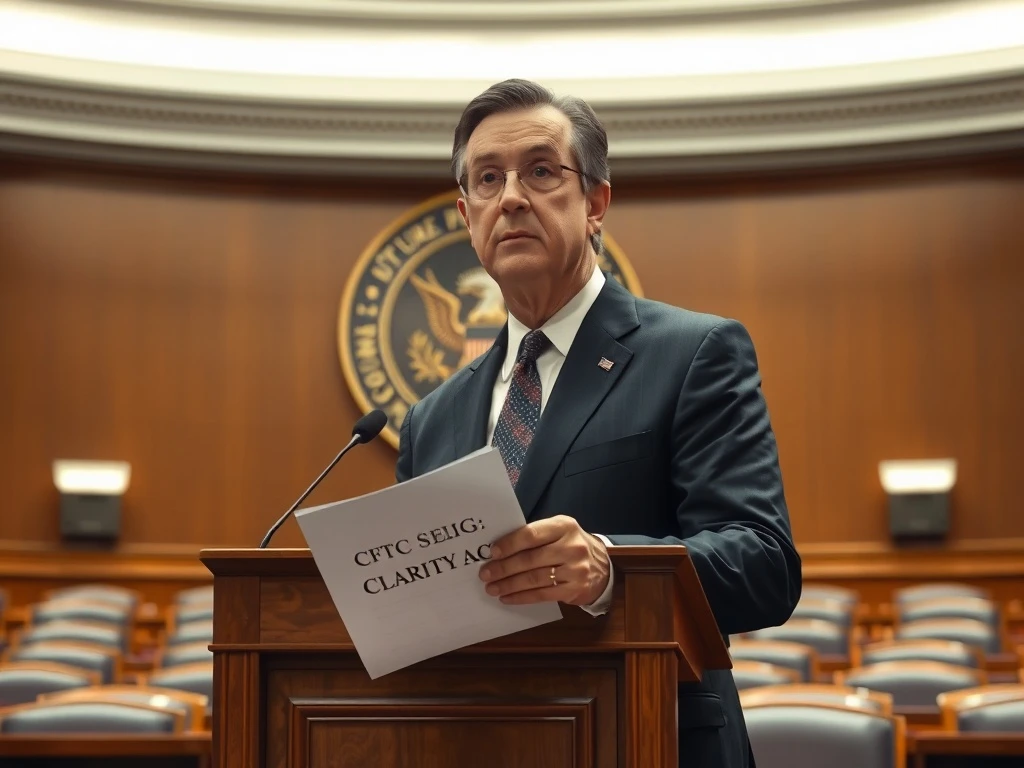
WASHINGTON, D.C. — In a major development for the United States cryptocurrency industry, Commodity Futures Trading Commission (CFTC) Chair Mike Selig issued a direct and urgent plea to lawmakers on March 18, 2026. Selig called for the swift passage of the CLARITY Act, legislation designed to finally establish a definitive regulatory framework for digital asset markets. His appeal comes amid heightened political pressure, including public support from former President Donald Trump, who has criticized traditional banks for obstructing progress. However, deep-seated disagreements among lawmakers, particularly concerning the regulation of stablecoin yield programs, continue to stall consensus and delay critical legislation that the industry has sought for nearly a decade.
CFTC Chair Makes Urgent Case for the CLARITY Act
Chairman Selig’s testimony before the House Financial Services Committee framed the CLARITY Act as a national economic imperative, not merely a regulatory update. He argued that the current patchwork of state regulations and conflicting guidance from the CFTC and Securities and Exchange Commission (SEC) creates dangerous uncertainty. This environment, Selig stated, pushes innovation offshore and leaves American consumers unprotected. “We are at an inflection point,” Selig told lawmakers, his remarks transcribed and released by the committee. “Every day of delay is a day where market integrity is challenged and U.S. leadership cedes ground.” His position aligns with a growing bipartisan recognition that the U.S. risks falling behind jurisdictions like the European Union, which implemented its comprehensive Markets in Crypto-Assets (MiCA) framework in 2024.
Also read: CZ Says Binance KYC Compliance Led to His Prison Term, While Hyperliquid Operates Without KYC
The core of the CLARITY Act involves drawing clear jurisdictional lines between the CFTC and the SEC. Historically, the SEC has claimed authority over most digital assets as securities, while the CFTC oversees Bitcoin and Ethereum futures. The proposed bill would formally grant the CFTC spot market authority over cryptocurrencies classified as commodities, a category expected to include major assets like Bitcoin. This division of labor is seen by proponents as the only way to end the regulatory paralysis that has plagued the sector. A 2025 report from the Chamber of Digital Commerce found that 73% of crypto firms cited “regulatory uncertainty” as their top barrier to growth in the U.S.
Political Pressure and Banking Industry Resistance
The push for the CLARITY Act has become unexpectedly entangled in the 2026 election cycle, adding a layer of political urgency. Former President Donald Trump has publicly urged Republican lawmakers to approve the bill, framing it as a blow against the traditional financial establishment. “The banks are trying to kill this because they fear competition,” Trump stated at a rally in Ohio last week. “We need to pass this bill now and ensure America, not Singapore or Switzerland, leads the future of finance.” This endorsement has galvanized support among his base but has also drawn criticism from some Democrats who warn against rushing complex financial legislation.
Also read: Hyundai Card Tests Stablecoin Payments Between US and Mexico Subsidiaries
Simultaneously, lobbying efforts from major banking institutions have intensified. Groups like the American Bankers Association and the Securities Industry and Financial Markets Association (SIFMA) have voiced strong reservations. Their primary concern is that the bill creates a two-tiered system, allowing crypto firms to offer bank-like services—such as lending and yield generation—without adhering to the same capital and consumer protection requirements as chartered banks. This clash represents a fundamental battle over the future architecture of finance. Consequently, the political field is fractured: pro-innovation Republicans, consumer-protection-focused Democrats, and an influential banking lobby all pulling in different directions.
- Market Stability: Proponents argue clear rules prevent another FTX-style collapse by mandating custody, reporting, and conflict-of-interest standards.
- Consumer Protection: The Act would establish first-of-their-kind federal disclosures for crypto investments and formalize anti-fraud enforcement powers.
- Global Competitiveness: Failure to act could cement the EU’s and UK’s regulatory hubs as the global default, costing the U.S. an estimated 10,000 high-tech finance jobs over five years, according to a Brookings Institution projection.
Expert Analysis on the Regulatory Stalemate
Legal and policy experts point to the stablecoin issue as the most technically complex and politically charged hurdle. “The debate over whether stablecoin yields constitute unregistered securities is the bill’s poison pill,” explained Dr. Sarah Bloom, a former Treasury official and current director of the Georgetown University Law Center’s Fintech Program. “The SEC views most yield programs as securities offerings requiring registration. The CLARITY Act’s current draft attempts to create a safe harbor for certain bank-partnered models, but that language is satisfying no one.” This expert perspective underscores the technical gridlock. For authoritative context, the official text of the bill and related amendments are tracked and published by Congress.gov, providing a primary source for the evolving debate.
Meanwhile, think tanks are weighing in on the economic implications. A recent study from the Coin Center research group estimated that a clear federal framework could attract over $50 billion in institutional investment to the U.S. digital asset ecosystem within two years. Conversely, a report from the left-leaning Americans for Financial Reform warned that overly permissive rules could exacerbate systemic risk. These competing analyses are being cited by lawmakers on both sides of the aisle, illustrating the high-stakes, data-driven nature of the fight.
Comparing Global Approaches to Crypto Regulation
The U.S. debate occurs within a global context where other major economies have already moved decisively. The lack of a U.S. framework has created a regulatory arbitrage opportunity, with firms relocating operations to clearer jurisdictions. This exodus of talent and capital is a primary motivator for proponents of the CLARITY Act. The following table contrasts the U.S. situation with other key regulatory regimes, highlighting what is at stake.
| Jurisdiction | Regulatory Framework | Key Feature | Status |
|---|---|---|---|
| United States | Patchwork (SEC/CFTC/State) | Regulatory uncertainty; enforcement-driven | Pending (CLARITY Act) |
| European Union | Markets in Crypto-Assets (MiCA) | Unified, comprehensive rulebook for 27 nations | Fully implemented (2024) |
| United Kingdom | Financial Services and Markets Act 2023 | Phased approach bringing crypto into existing financial law | Ongoing implementation |
| Singapore | Payment Services Act | Licensing regime focused on payments and custody | Active, with strict licensing |
| United Arab Emirates | Virtual Assets Regulatory Authority (VARA) | Dedicated, standalone regulator in Dubai | Active, attracting major firms |
The Path Forward and Potential Compromises
The immediate next step for the CLARITY Act is a mark-up session in the House Financial Services Committee, scheduled for April 8, 2026. This session will be critical, as lawmakers will offer amendments to bridge divides, particularly on the stablecoin yield issue. Congressional staffers, speaking on background, indicate that a potential compromise involves creating a new, limited-purpose federal charter for stablecoin issuers. This charter would be distinct from a full banking license but would impose specific reserve and audit requirements to address concerns about consumer protection and financial stability. However, drafting such a provision that satisfies both crypto advocates and banking regulators is a monumental task.
Furthermore, the bill’s fate in the Senate remains uncertain. Senate Banking Committee Chair Sherrod Brown has been consistently skeptical of the crypto industry and may seek significantly tougher consumer protection clauses or oppose the bill altogether. The window for passage is narrow, with the looming election likely to consume all legislative oxygen after the summer recess. Therefore, the next 60 to 90 days represent a make-or-break period for U.S. crypto regulation.
Industry and Consumer Reactions to the Impasse
Reactions from the cryptocurrency industry have shifted from optimism to frustration. “We’ve been waiting for clarity since 2017,” said Michele Smith, CEO of a digital asset custody firm based in Wyoming. “The Selig hearing felt like déjà vu. We have the support of a key regulator and political figures, but the details keep getting bogged down. Many of my peers are now activating ‘Plan B’ to expand in Europe.” This sentiment is echoed across social media and industry forums, where the delay is seen as a strategic failure. Conversely, consumer advocacy groups like the Consumer Federation of America urge caution, warning that speed should not compromise reliable investor protections. They point to the billions lost in crypto scams and platform failures as evidence that any new law must have strong enforcement teeth.
Conclusion
The urgent call from CFTC Chair Mike Selig to pass the CLARITY Act marks a critical moment in the decade-long struggle to regulate cryptocurrency in the United States. The convergence of regulatory advocacy, political pressure from figures like Donald Trump, and intense industry lobbying has brought the issue to a head. However, the path to consensus is blocked by substantive disputes over stablecoin regulation and broader philosophical fights about the role of traditional finance. The coming weeks will test whether Congress can craft a compromise that provides the market structure clarity demanded by the CFTC, protects consumers, and keeps the U.S. competitive. Failure would likely mean several more years of regulatory ambiguity, cementing the current era of enforcement-by-litigation and accelerating the flight of crypto innovation to more welcoming shores abroad.
Frequently Asked Questions
Q1: What is the CLARITY Act and why is the CFTC Chair pushing for it?
The CLARITY Act is proposed U.S. legislation to create a clear regulatory framework for cryptocurrency markets. CFTC Chair Mike Selig is urging its passage to end the current regulatory uncertainty between the CFTC and SEC, which he argues harms consumers, stifles innovation, and undermines U.S. economic competitiveness.
Q2: How does Donald Trump factor into this debate?
Former President Trump has publicly urged Republican lawmakers to support the CLARITY Act, framing it as a pro-innovation measure that challenges the traditional banking sector. His endorsement adds significant political weight to the push for the bill’s passage.
Q3: What is the main issue causing delay in Congress?
The primary stumbling block is disagreement over how to regulate stablecoin yield programs. Some regulators view these as securities requiring strict oversight, while the crypto industry seeks flexibility. Crafting a compromise that satisfies all sides has proven extremely difficult.
Q4: What happens if Congress fails to pass the CLARITY Act?
If the act fails, the U.S. will likely continue with its current patchwork of state and federal enforcement actions. This uncertainty is expected to drive more cryptocurrency businesses and investment to jurisdictions with clearer rules, like the European Union or the United Kingdom.
Q5: How does this U.S. bill compare to regulations in other countries?
The U.S. is behind other major economies. The EU has already implemented its comprehensive MiCA framework, and the UK is phasing in its rules. The CLARITY Act is an attempt to catch up and provide a similarly comprehensive structure for the American market.
Q6: How would the CLARITY Act affect an average person who owns cryptocurrency?
For everyday crypto users, passage would mean clearer rules for the exchanges and platforms they use, potentially leading to stronger protections for their assets and more consistent disclosure of risks. It could also promote more mainstream, regulated investment products.