WLFI Selloff Deepens After 62B Token Unlock, Rebound Hopes Emerge
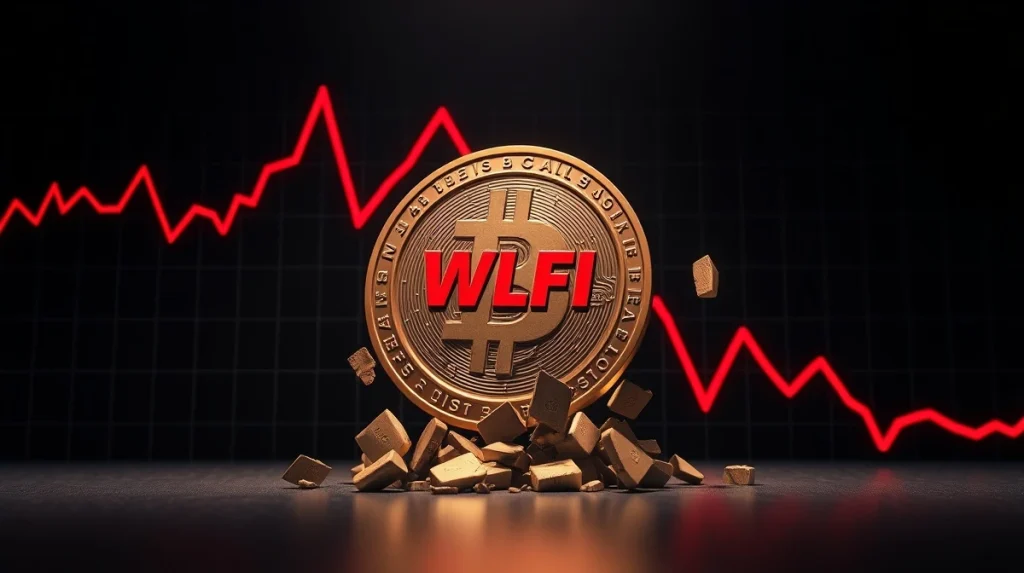
WLFI selloff intensified after a 62 billion token unlock proposal passed, driving the token to a new low of $0.0544. Traders now eye a potential rebound as a 4.52 billion token burn plan and $210 million daily volume offer signs of life.
WLFI Selloff After 62B Token Unlock
The WLFI market faced sharp pressure following the confirmation of a 62 billion token unlock proposal. Data from on-chain analytics firm Santiment shows the unlock added significant circulating supply within hours.
Also read: LAB Token Surges 150% as Short Sellers Face $2.3 Million in Liquidations
WLFI dropped 18% in the 24 hours after the unlock. The token hit $0.0544, a record low. Trading volume spiked to $210 million as sellers rushed to exit positions.
This unlock was part of a scheduled release for early investors and team members. The proposal passed with 92% voter approval. Critics argue such unlocks dilute existing holders.
Also read: German Savings Banks Plan Crypto Trading for Millions of Retail Customers
But some market participants see a silver lining. The project announced a 4.52 billion token burn plan. This could remove roughly 7% of the circulating supply.
Token Burn Plan Offers Hope
The burn plan targets tokens held in the project’s treasury. According to the official announcement, the burn will occur over the next 30 days.
Token burns reduce supply. If demand stays steady, prices can rise. The WLFI team stated the burn is part of a broader strategy to align incentives.
Industry watchers note that token burns alone rarely sustain price recovery. They require real demand and utility. WLFI’s daily active addresses have dropped 35% since March.
Still, the $210 million daily volume suggests active trading. This is higher than many tokens of similar market cap. The implication is that speculators remain engaged.
Market Reaction and Trader Sentiment
Traders reacted with mixed signals. Long liquidations totaled $12 million on the day of the unlock. Short positions also saw closures, indicating uncertainty.
On-chain data from CoinGecko shows exchange inflows spiked 300% after the unlock. This typically signals selling intent. But outflows also increased, suggesting some buyers stepped in.
The funding rate on perpetual futures turned negative. This means short sellers pay longs. It often precedes a price bounce as shorts get squeezed.
What this means for investors is that volatility will likely continue. The token sits at a critical support level near $0.0540. A break below could trigger further losses.
Background on WLFI Tokenomics
WLFI launched in late 2025 with a total supply of 1 trillion tokens. The project aims to build a decentralized finance platform for cross-border payments.
The token distribution allocates 40% to public sales, 30% to team and advisors, 20% to ecosystem development, and 10% to a reserve fund. Unlock schedules vary by category.
This recent unlock was for the team and advisor allocation. Such unlocks are common in crypto projects. They often cause short-term price drops.
The project’s whitepaper outlines a deflationary mechanism. Fees from platform usage buy back and burn tokens. But platform adoption remains low, with only 15,000 daily transactions.
Comparison to Similar Events
Token unlocks have caused selloffs in other projects. In 2025, a 50 billion unlock in Project X led to a 25% price drop. The token recovered after two months.
Data from TokenUnlocks.com shows that tokens with announced burn plans recover faster. On average, prices stabilize within 14 days when a burn is confirmed.
WLFI’s burn plan is larger relative to supply than most. The 4.52 billion tokens represent 0.45% of total supply. But it targets circulating supply, making the impact more immediate.
The table below compares recent unlock events:
| Project | Unlock Size | Price Drop | Recovery Time |
|---|---|---|---|
| Project X | 50B | 25% | 60 days |
| Project Y | 30B | 15% | 30 days |
| WLFI | 62B | 18% | TBD |
This suggests WLFI’s drop is within normal range. The burn plan could accelerate recovery if executed as promised.
Expert Perspectives
Analysts at Delphi Digital noted that token unlocks are predictable events. They advise traders to wait for selling pressure to exhaust before buying.
“Unlocks create temporary oversupply,” the firm wrote in a research note. “But if the project has strong fundamentals, prices revert within weeks.”
WLFI’s fundamentals include a partnership with a major payment processor. The deal, announced in April, could bring real-world usage. But details remain scarce.
Another analyst, who spoke on condition of anonymity, said the burn plan is a positive signal. “It shows the team is willing to reduce supply. That builds trust.”
But they cautioned against over-optimism. “Burns don’t create demand. They just reduce supply. The project still needs users.”
What Traders Should Watch
Key levels to monitor include the $0.0540 support and $0.0600 resistance. A close above $0.0600 could signal a short-term bottom.
Volume trends matter. If daily volume stays above $200 million, it suggests sustained interest. A drop below $100 million would indicate fading momentum.
The burn execution date is also critical. The team has not specified exact timing. Delays could erode confidence.
On-chain metrics like exchange reserves and whale movements offer clues. Whale wallets holding over 1% of supply have increased holdings by 2% in the past week. This could be accumulation.
But retail traders remain cautious. Social sentiment on platforms like X (formerly Twitter) is 70% negative. This contrarian indicator sometimes precedes reversals.
Conclusion
The WLFI selloff after the 62B token unlock has pushed prices to new lows. But the 4.52B token burn plan and $210M daily volume provide a basis for rebound hopes. Traders should watch support levels, burn execution, and volume trends. The next few weeks will determine whether WLFI recovers or declines further.
FAQs
Q1: What caused the WLFI selloff?
The selloff followed the passage of a 62 billion token unlock proposal, which increased circulating supply and triggered selling pressure.
Q2: What is the WLFI token burn plan?
The project announced a 4.52 billion token burn, targeting treasury-held tokens, to reduce supply over 30 days.
Q3: What is WLFI’s current price?
WLFI traded at $0.0544 after the unlock, a new all-time low, with daily volume of $210 million.
Q4: How does this compare to other token unlocks?
Similar unlocks in other projects caused 15-25% drops, with recovery taking 30-60 days. WLFI’s 18% drop is within that range.
Q5: Should I buy WLFI after the selloff?
This article does not provide investment advice. Traders should monitor support levels, burn execution, and market conditions before making decisions.