Swift Blockchain Trial with DTCC and Euroclear Data Signals Major Capital Markets Shift
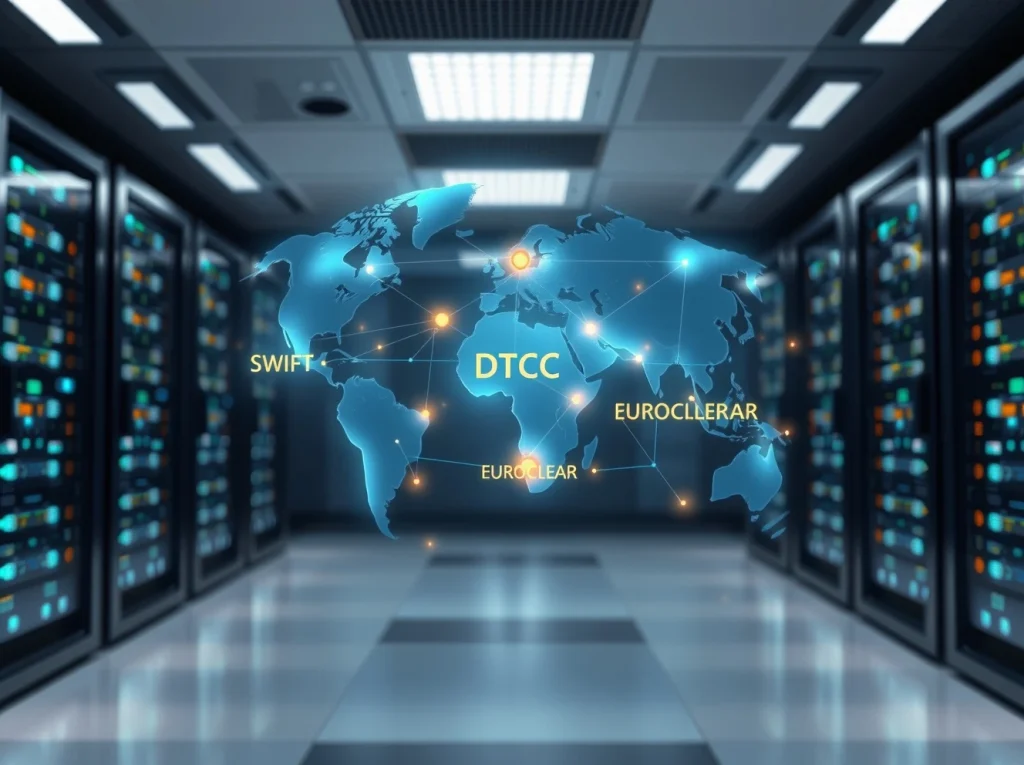
A recent trial by the global financial messaging giant SWIFT, completed in late 2025, has demonstrated a path toward unifying the foundational data of the world’s capital markets. The project connected tokenized assets on multiple blockchains to traditional finance through a common gateway. More significantly, it showed how the core securities data held by titans like the Depository Trust & Clearing Corporation (DTCC) in the United States and Euroclear in Europe could interact on a shared ledger framework. This development suggests a future where the siloed infrastructure of global finance begins to merge.
The Swift and Chainlink Interoperability Milestone
According to an announcement from SWIFT in November 2025, the cooperative completed a significant proof-of-concept focused on digital asset interoperability. The trial utilized oracle networks provided by Chainlink. Its goal was practical: to show how SWIFT’s network could provide a single point of access for interacting with a wide range of blockchain platforms. Over 24 global financial institutions participated. Major European banks including BNP Paribas Securities Services, Intesa Sanpaolo, and Société Générale’s FORGE platform were key participants.
Also read: South Korea Crypto Exchange Volume Drops Below KRW 10 Trillion, Lowest Since 2023
The test involved the issuance and secondary market transfer of tokenized bonds. SWIFT’s system acted as a central orchestrator. It facilitated transactions across both private and public blockchain environments. This approach differs from building a single new blockchain. Instead, it seeks to connect existing ones. Industry watchers note that this strategy could accelerate adoption. It leverages SWIFT’s existing relationships with more than 11,000 institutions worldwide.
Connecting the Data Titans: DTCC and Euroclear
The deeper implication of SWIFT’s work lies in its potential connection to the underlying data repositories of finance. The DTCC, through its subsidiary DTCC Digital Assets, has been exploring digital ledger technology for years. It handles the post-trade settlement for the vast majority of U.S. securities transactions. Similarly, Euroclear is a central securities depository for European markets, settling trillions of euros in transactions annually.
Also read: Best Free Crypto APIs in 2026: Top Picks for Developers
Data from these entities represents the official record of ownership for stocks and bonds. Currently, their systems operate independently but interface through complex messaging and reconciliation processes. The SWIFT trial’s architecture suggests a model where this core reference data could be synchronized or accessed via blockchain protocols. This could signal a move toward a shared source of truth for securities data across Atlantic markets.
The Infrastructure Challenge
Market infrastructure is notoriously fragmented. A cross-border transaction often involves multiple intermediaries, each with its own ledger. This creates cost, delay, and operational risk. A shared blockchain data layer could, in theory, streamline this. Analysts point to potential benefits like near-instant settlement and reduced collateral requirements. But the challenge is not technical. It is governance. Getting competing financial utilities to agree on common standards and protocols is a monumental task. SWIFT’s role as a neutral cooperative positions it as a potential facilitator for this agreement.
What This Means for Global Capital Markets
The convergence of SWIFT, DTCC, and Euroclear on a shared data model would represent a structural shift. It would move the industry from a world of bilateral messaging to one of multilateral state synchronization. For investors, the implication is a potential reduction in settlement times from days to minutes or seconds. This frees up capital and reduces counterparty risk.
For regulators, a unified ledger could provide a clearer, real-time view of systemic exposures. However, it also concentrates operational risk. A failure in a single shared system could have widespread effects. This suggests that any such network would need to be exceptionally resilient. The SWIFT trial specifically tested the ability to continue operations if one blockchain or oracle network failed.
The Path Forward and Remaining Hurdles
The 2025 proof-of-concept was a step, not a finished product. Moving from trial to production requires solving several problems. Legal and regulatory frameworks for digital assets vary widely by jurisdiction. The legal finality of a transaction recorded on a blockchain must be recognized in court. Furthermore, the scalability of such a system to handle global market volumes remains unproven.
Despite these hurdles, the economic incentive is strong. A report by the Boston Consulting Group in 2024 estimated that tokenization of global illiquid assets could become a $16 trillion business by 2030. This potential is driving infrastructure players to seek interoperable solutions. SWIFT’s initiative is a direct response to this demand. It is an attempt to modernize without forcing members to abandon their legacy systems immediately.
Conclusion
The SWIFT blockchain trial with Chainlink is more than a technical experiment. It is a strategic move to position traditional market infrastructure at the center of the digital asset ecosystem. By demonstrating a path to connect the core data of DTCC and Euroclear, it outlines a future of unified ledgers for capital markets. The shift would be profound. It promises efficiency but demands exceptional cooperation. The coming years will determine if the industry can address this complex transition toward shared Swift blockchain data.
FAQs
Q1: What was the main goal of the SWIFT blockchain trial?
The primary goal was to demonstrate that SWIFT’s existing network could serve as a single, secure gateway for financial institutions to interact with multiple blockchain platforms, specifically for buying and selling tokenized bonds.
Q2: How does DTCC and Euroclear data fit into this?
DTCC and Euroclear are the primary record-keepers for securities ownership in the U.S. and Europe. The trial’s architecture suggests a model where the authoritative data from these depositories could be integrated or referenced on interoperable blockchains, creating a more unified global system.
Q3: What are the potential benefits of this kind of system?
The key benefits could include faster settlement (moving from T+2 to near-instant), lower costs from reduced reconciliation needs, decreased counterparty risk, and improved transparency for regulators.
Q4: What are the biggest challenges to making this a reality?
The major challenges are not technical but involve governance, legal recognition of blockchain settlements, regulatory alignment across countries, and achieving consensus among competing financial institutions and infrastructure providers.
Q5: Is this the same as SWIFT creating its own cryptocurrency?
No. SWIFT is not creating a digital currency. It is testing a messaging and interoperability layer that allows its members to transact in existing digital assets and tokenized traditional securities across different blockchain networks.