Bitcoin Stability Fuels Altcoin Search: SUI Rises as APEMARS Token Attracts Pre-Listing Attention
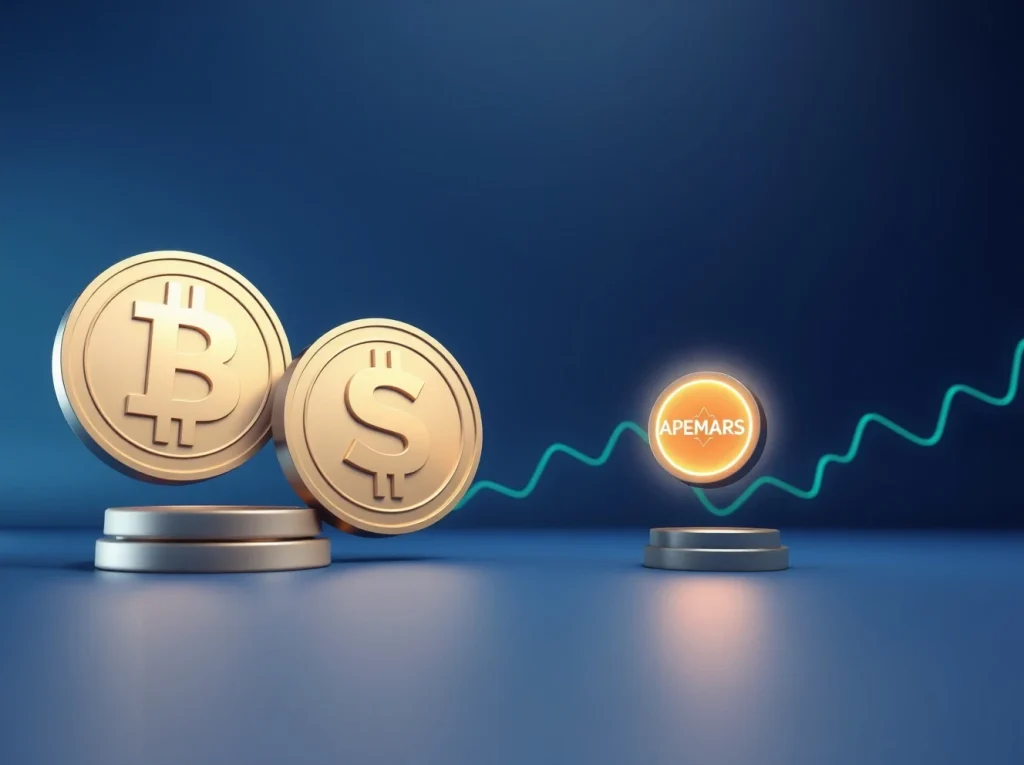
As Bitcoin’s price action enters a period of consolidation, a familiar pattern is emerging across cryptocurrency markets. Data from CoinMarketCap shows Bitcoin trading within a relatively tight range above $67,000 in early April 2026, a level it has tested several times since late 2025. This stability in the largest digital asset often acts as a catalyst for increased activity elsewhere. Market participants, seeking higher potential returns, frequently turn their attention to smaller-cap tokens during these phases. This rotation is now visibly benefiting projects like SUI and drawing speculative interest toward newer assets such as APEMARS, currently priced at approximately $0.0001967.
Bitcoin’s Role as Market Anchor
Bitcoin’s recent performance provides critical context. After a volatile first quarter in 2026, the flagship cryptocurrency has shown signs of establishing a firmer foundation. Trading volume, while down from its January peaks, remains solid. According to analytics firm Glassnode, Bitcoin’s realized price—the average price at which all coins last moved—has steadily climbed, indicating a higher cost basis for the market. This metric often serves as a support level in bull markets.
Also read: BNB Chain Reveals New Layer 1 Blockchain for Agentic Trading, Mainnet Set for 2027
“When Bitcoin consolidates after a strong move, it typically signals a healthy market,” noted a report from crypto research firm Kaiko on April 8, 2026. “Liquidity doesn’t disappear; it often rotates into assets perceived to have stronger short-term narratives.” This behavior has historical precedent. During similar consolidation phases in 2023 and 2021, capital flowed aggressively into select altcoins, creating sharp, outsized rallies.
The current environment shares those characteristics. Bitcoin dominance, which measures Bitcoin’s share of the total crypto market capitalization, has dipped slightly from its March highs. This small shift suggests money is beginning to seek opportunities beyond the market leader.
Also read: Naver Financial and Dunamu Push Share Swap Deadline to December Amid Regulatory Hurdles
SUI’s Building Momentum
Among the beneficiaries of this rotational trade is SUI, the native token of the Sui blockchain. The layer-1 network, developed by former Meta engineers, has reported consistent growth in key on-chain metrics throughout 2026. Data from Suiscan, the network’s explorer, shows total value locked (TVL) in its decentralized finance (DeFi) protocols has increased by over 40% since the start of the year.
SUI’s price has reflected this fundamental progress. After trading below $1.50 for much of late 2025, the token broke above key resistance levels in February 2026. It has since maintained most of those gains, trading recently around $1.85. This represents a significant recovery from its 2025 lows and outperforms the broader smart contract platform sector average for the same period.
The project’s development activity also remains high. According to GitHub analytics, commit frequency on the Sui core repository ranks among the top ten blockchain projects. This sustained developer effort is a metric many institutional analysts track as a proxy for long-term viability.
What Drives the Altcoin Rotation?
The movement from Bitcoin into tokens like SUI isn’t random. Industry watchers note several contributing factors. First, Bitcoin’s reduced volatility lowers the perceived risk of holding more speculative assets. Second, many altcoin projects, including Sui, have scheduled major technical upgrades or ecosystem expansions for 2026. These events create tradable narratives.
Finally, there’s a liquidity effect. “Large investors and funds often use Bitcoin as a base currency,” explained a market structure analyst from ByteTree in a March 2026 commentary. “When they decide to increase risk exposure, they sell a portion of their Bitcoin holdings to fund purchases of altcoins. This creates the rotational price action we observe.”
This cycle appears to be in its early stages. Trading volume ratios between Bitcoin and major altcoins have begun to normalize, but have not yet reached the extremes seen during peak altcoin seasons.
The APEMARS Phenomenon and Listing Speculation
Further down the risk spectrum, newer and smaller-market-cap tokens are attracting attention. One such token is APEMARS. Currently trading around $0.0001967 on decentralized exchanges (DEXs), it has become a subject of discussion in certain trading communities. The primary narrative revolves around the potential for the token to be listed on larger, centralized exchanges (CEXs).
A listing on a major platform like Binance, Coinbase, or Kraken typically provides a massive influx of liquidity and new buyers. This often leads to a rapid price appreciation, a phenomenon traders call “closing the listing gap.” The speculative price target cited by some proponents is $0.0055, representing a multi-fold increase from current levels.
However, this speculation carries substantial risk. The token’s current valuation and liquidity are minimal. Data from DEXScreener shows its 24-hour trading volume rarely exceeds a few hundred thousand dollars. Furthermore, there is no official confirmation from any major exchange regarding a potential APEMARS listing. Investments at this stage are highly speculative and akin to venture capital, where the potential for total loss is significant.
Key Risks for Tokens Like APEMARS:
- Liquidity Risk: Very low trading volume makes entering and exiting positions difficult without impacting price.
- Information Asymmetry: Reliable, verified information is scarce compared to established projects.
- Regulatory Uncertainty: The regulatory status of such tokens is often unclear.
- Smart Contract Risk: Newer projects may have unaudited or poorly tested code.
Market Structure and Investor Psychology
The simultaneous trends of SUI’s rise and APEMARS speculation highlight the layered nature of crypto markets. Different investor profiles operate at different levels of risk. Institutional and sophisticated retail investors may add to positions in established altcoins like SUI during Bitcoin consolidations. Meanwhile, a subset of retail traders engages in higher-risk speculation on micro-cap tokens, chasing the possibility of exponential returns.
This structure isn’t new. It mirrors patterns from previous cycles. The critical difference in 2026 is the increased regulatory scrutiny and institutional presence, which may dampen the most extreme speculative frenzies but does not eliminate them.
Data from analytics platform Santiment, dated April 10, 2026, shows social media mentions for terms like “low cap gem” and “pre-exchange” have risen by 120% in the past month. This increase in retail chatter often correlates with, but does not guarantee, increased price volatility for the assets being discussed.
Conclusion
The cryptocurrency market is exhibiting classic rotational behavior. Bitcoin’s stability is providing a backdrop for capital to explore other opportunities. Projects with growing fundamentals, such as SUI, are seeing legitimate interest based on measurable progress. Concurrently, the speculative fringe of the market is active, with tokens like APEMARS drawing attention based on future listing potential rather than current utility. For investors, this environment demands clear differentiation between investment theses built on development and adoption versus those built purely on speculation and narrative. The coming weeks will test whether SUI’s momentum is sustainable and if the speculative fever around tokens like APEMARS leads to realized gains or serves as a reminder of the market’s inherent risks.
FAQs
Q1: Why does Bitcoin consolidation often lead to altcoin rallies?
When Bitcoin’s price movement slows, it reduces overall market volatility. This can make investors more comfortable taking on the additional risk of altcoins. Historically, capital has rotated from Bitcoin into smaller assets during these phases in search of higher percentage returns.
Q2: What are the main reasons for SUI’s recent price increase?
SUI’s rise appears linked to fundamental growth. Key factors include a significant increase in Total Value Locked (TVL) on its blockchain, consistent high levels of developer activity, and the general market rotation toward layer-1 blockchain tokens as Bitcoin stabilized in early 2026.
Q3: What does “closing the listing gap” mean for a token like APEMARS?
It refers to the potential price increase a token might experience if it gets listed on a major centralized exchange (CEX). The “gap” is the difference between its current price on decentralized exchanges (DEXs) and its expected price post-listing, due to vastly increased access and liquidity.
Q4: How can investors verify information about potential exchange listings?
The only reliable source is an official announcement from the exchange itself. Speculation on social media or forums is not verification. Investors should be wary of claims not backed by official channels, as false listing rumors are a common market manipulation tactic.
Q5: What is the biggest risk when considering an asset like APEMARS?
The primary risk is liquidity. With very low trading volume, selling even a moderate amount of tokens can drastically move the price down, making it difficult to exit a position. This is compounded by the high risk of the project failing or the listing speculation proving false.