Bitcoin Targets $74K as Ethereum Stumbles: Pepeto’s Surprising Utility Emerges

Bitcoin is testing key resistance levels with analysts eyeing a potential run toward $74,000, while Ethereum shows relative weakness. This divergence highlights a shifting market where utility, not just speculation, is gaining attention. Data from CoinMarketCap shows Bitcoin dominance rising to 54.3% in early April 2026, its highest level since November 2025.
Bitcoin’s Path to $74,000
The leading cryptocurrency has consolidated above the $68,000 support zone for most of March. On-chain metrics suggest accumulation is occurring. According to Glassnode, the number of Bitcoin addresses holding 1 BTC or more reached a new all-time high of 1.12 million on April 2, 2026. This indicates strong conviction among smaller investors.
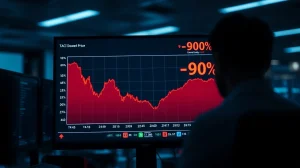
Also read: Telegram-Linked TAC Token Crashes 90% in 15 Minutes: What Happened?
Technical analysis points to a bullish setup. “The weekly chart shows Bitcoin has held above its 20-week moving average,” noted Marcus Thielen, head of research at CryptoQuant. “This has historically been a reliable support level during bull markets. A clean break above $71,500 could open the path to $74,000.”
Several factors support this outlook:
Also read: XRP Scarcity Index on Binance Hits Highest Level Since Mid-2024, So Where Did the Coins Go?
- Institutional flows: U.S. spot Bitcoin ETFs recorded net inflows for 12 consecutive days ending April 3.
- Macro conditions: Market expectations for Federal Reserve rate cuts in late 2026 have increased liquidity expectations.
- Halving aftermath: The April 2024 halving’s supply shock continues to work through the system.
Ethereum’s Concerning Weakness
While Bitcoin strengthens, Ethereum has struggled. The ETH/BTC ratio, a key metric watched by traders, fell to 0.048 on April 3, approaching its lowest level since January 2023. This means Ethereum has been losing value relative to Bitcoin.
Several issues weigh on Ethereum. Network activity has declined. Data from Artemis shows daily active addresses on Ethereum averaged 407,000 in March 2026, down from 587,000 in March 2025. Gas fees, while lower than previous peaks, remain a barrier for some users. The average transaction fee was $3.42 in early April.
Regulatory uncertainty persists. The U.S. Securities and Exchange Commission has delayed decisions on multiple spot Ethereum ETF applications. This contrasts with the approved Bitcoin ETFs. The implication is clear: institutional money has an easier path to Bitcoin than to Ethereum.
Layer-2 scaling solutions like Arbitrum and Optimism are growing. But they may be cannibalizing activity from the main Ethereum chain. This fragmentation could be diluting Ethereum’s network effect.
What Analysts Are Watching
“Ethereum’s underperformance isn’t necessarily a death knell,” said Lyn Alden, founder of Lyn Alden Investment Strategy. “It reflects a maturing market where different blockchains serve different purposes. The question is whether Ethereum’s planned upgrades can reignite developer enthusiasm.”
The next major upgrade, “Electra,” is tentatively scheduled for late 2026. It promises further fee reductions and scalability improvements. But the market appears to be in a “show me” mode. Investors want to see real adoption growth, not just roadmap promises.
The Rise of Utility-Focused Tokens
Amid this Bitcoin-Ethereum divergence, a notable trend has emerged. Tokens with clear, immediate utility are attracting attention. One example is Pepeto (PEPE), a token originally launched as a memecoin that has developed actual use cases.
Pepeto’s developers have integrated the token into several platforms:
- Content monetization: A partnership with streaming platform Kick allows viewers to tip streamers with PEPE.
- Gaming: PEPE serves as an in-game currency in the mobile game “Pepeland.”
- Merchant adoption: Over 240 online stores now accept PEPE payments via a third-party processor.
This utility push appears to be working. Trading volume for PEPE increased 85% in March compared to February. The token’s price has been less volatile than typical memecoins, suggesting more stable demand.
“Pepeto is an interesting case study,” observed David Lawant, head of research at FalconX. “It shows how community-driven assets can evolve beyond pure speculation. The market is rewarding tokens that solve real problems, even if those problems are niche.”
Market Structure Implications
The current setup suggests a potential rotation. Capital might be flowing from weaker altcoins into Bitcoin and select utility tokens. This pattern occurred in previous cycles when investors sought quality during uncertain periods.
Bitcoin’s potential move to $74,000 would represent a 8.5% gain from current levels around $68,200. That target aligns with the 1.618 Fibonacci extension from the recent correction low. A failure to break higher could see Bitcoin retest support at $65,000.
For Ethereum, the key level to watch is $3,400. A sustained break above could signal renewed strength. Below $3,150, further weakness toward $3,000 is possible.
What this means for investors is a more selective market. The era of “everything going up” appears to be over, at least temporarily. Differentiation based on fundamentals matters again.
Broader Crypto Context
The total cryptocurrency market capitalization stands at approximately $2.6 trillion. This is below the November 2025 peak of $2.9 trillion but well above the $1.5 trillion level from a year ago. The market is in a consolidation phase after significant gains.
Regulatory developments continue to shape sentiment. The European Union’s Markets in Crypto-Assets (MiCA) regulations are now fully implemented. In the United States, legislative progress has been slow. The lack of clear rules creates uncertainty, particularly for tokens like Ethereum that might be deemed securities.
Institutional participation keeps growing despite regulatory hurdles. BlackRock’s Bitcoin ETF now holds over 280,000 BTC worth roughly $19 billion. Traditional finance giants like Citi and JPMorgan are expanding their blockchain divisions. This institutional groundwork suggests long-term confidence in crypto infrastructure, if not in every individual token.
Conclusion
Bitcoin appears positioned for a potential test of $74,000 as it demonstrates relative strength against major altcoins. Ethereum’s weakness highlights ongoing challenges around scalability, fees, and regulation. Meanwhile, tokens like Pepeto show how utility development can create sustainable value beyond speculative trading. The cryptocurrency market is maturing. Success increasingly depends on technological execution and real-world use, not just narrative and momentum. Investors should watch Bitcoin’s resistance levels, Ethereum’s ability to stabilize, and whether utility-driven tokens can maintain their recent gains.
FAQs
Q1: What is driving Bitcoin’s potential move to $74,000?
Several factors support this outlook: consistent inflows into U.S. spot Bitcoin ETFs, strong on-chain accumulation by smaller investors, and a favorable technical chart structure. The $71,500 level is the immediate resistance to watch.
Q2: Why is Ethereum underperforming Bitcoin?
Ethereum faces multiple headwinds: declining network activity relative to its Layer-2 solutions, ongoing regulatory uncertainty regarding ETF approvals, and higher gas fees than competing chains. The ETH/BTC ratio reflects this comparative weakness.
Q3: What utility does Pepeto (PEPE) actually have?
Originally a memecoin, Pepeto has been integrated for tipping on streaming platforms, as in-game currency in specific mobile games, and as a payment option at hundreds of online merchants. This practical use has contributed to more stable trading volume.
Q4: Is the entire altcoin market weakening?
Not uniformly. While many altcoins are struggling against Bitcoin, some tokens with clear utility or strong ecosystem development are holding up better. The market is becoming more selective, punishing tokens without clear use cases.
Q5: What are the main risks to Bitcoin reaching $74,000?
Key risks include a sharp reversal in ETF flows, unexpected hawkish signals from the Federal Reserve regarding interest rates, or a broader sell-off in risk assets like stocks. Technical failure at the $71,500 resistance could also trigger a pullback.