Bitcoin’s Hidden Blueprint: Heatmap Points to $64K Test Before $76K Target
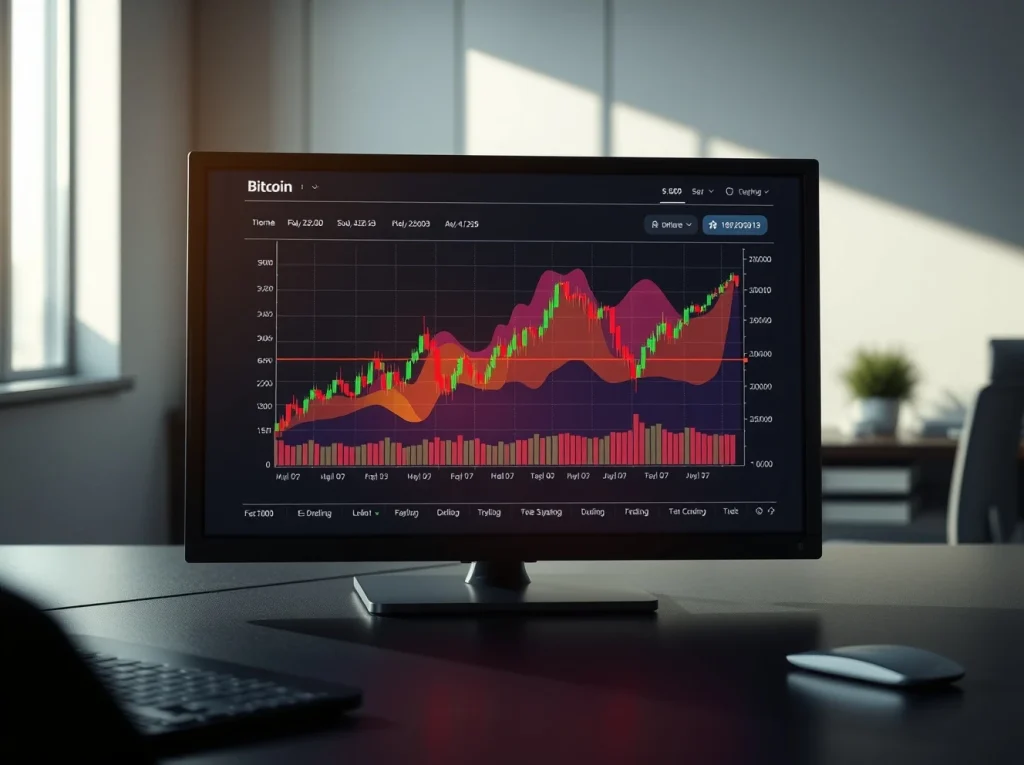
Bitcoin’s price appears stuck. But beneath the surface, a specific tool used by professional traders suggests a clear sequence may be unfolding. According to recent data, a liquidation heatmap points to a potential retest of the $64,000 zone before any sustained move toward $76,000. This analysis comes as capital flows show subtle shifts that could set the stage for the next major move.
Decoding the Bitcoin Liquidation Heatmap
Liquidation heatmaps are not typical price charts. Instead, they visualize where large numbers of leveraged long or short positions are likely to be automatically closed, or “liquidated,” by exchanges. These clusters act like magnets for price action. When price approaches a dense cluster of long positions, a drop can trigger a cascade of selling. Conversely, approaching a short cluster can fuel a squeeze higher. Data from analytics platforms like Coinglass and Hyblock shows a pronounced cluster of low-employ long positions sitting just below current prices, around $64,000. This suggests that area could act as a support zone if tested. Meanwhile, a significant wall of short liquidations awaits near $76,000.
Also read: BNB Chain Reveals New Layer 1 Blockchain for Agentic Trading, Mainnet Set for 2027
Analyst LP_NXT noted on the social platform X that these clusters are stacking in a clean order. “The heatmap is painting a textbook path,” the analyst stated. “Market makers and high-volume traders watch these levels closely because they represent high-probability turning points.” This tool has gained prominence among institutional crypto desks over the past two years.
Why $64,000 is a Critical Level
The $64,000 level is not arbitrary. It aligns with several key technical and on-chain metrics. On-chain data from Glassnode indicates it was a major accumulation zone in late 2023 and early 2024. Many wallets bought Bitcoin near that price. Furthermore, it represents a high-volume node on the volume profile, a tool that shows where the most trading activity has historically occurred. A break below it could trigger stop-loss orders and shake out weaker hands. However, if it holds, it would reinforce the market’s underlying strength. The heatmap adds a layer of precision by highlighting the exact density of leveraged positions that would be wiped out at that level.
Also read: Naver Financial and Dunamu Push Share Swap Deadline to December Amid Regulatory Hurdles
The Capital Flow Context
Heatmap analysis doesn’t exist in a vacuum. It must be viewed alongside capital movements. Data from CryptoQuant shows exchange netflows have been relatively neutral recently. This suggests neither aggressive selling nor buying from major holders. However, funding rates in perpetual swap markets have cooled from earlier highs. This cooling often precedes a volatile move, as it reduces the immediate risk of a massive long squeeze. The implication is that the market is consolidating energy. Industry watchers note that this period of range-bound trading is typical before a decisive breakout or breakdown. The heatmap provides a hypothesis for which direction that energy might be released.
The Path to $76,000
A successful hold at $64,000 would set the stage for an attempt at $76,000. The heatmap identifies this higher level as a major liquidation zone for short positions. If Bitcoin’s price were to rally and approach $76,000, traders who bet against the rally would be forced to buy back Bitcoin to cover their losses. This covering can create a self-reinforcing buying wave. What this means for investors is that a move above key resistance near $72,000 could accelerate rapidly toward the $76,000 target. This scenario would likely require a catalyst, such as positive regulatory news or a surge in Bitcoin ETF inflows.
Key levels to watch based on current heatmap data:
- Immediate Support: $64,000 – $65,500 (Low-tap into long liquidation cluster)
- Major Resistance: $72,000 – $73,500 (Previous local high)
- Primary Upside Target: $75,500 – $76,500 (High-density short liquidation cluster)
Risks and Limitations of Heatmap Analysis
While useful, liquidation heatmaps are not crystal balls. They are a snapshot of current derivative market positioning. A sudden, unexpected macroeconomic event or news headline can override these technical setups. For example, an unexpected Federal Reserve policy shift or a major exchange issue could cause price to ignore these levels entirely. Analysts stress that heatmaps are best used as one tool among many. They should be combined with trend analysis, on-chain data, and broader market sentiment. Relying solely on them can be risky, as large traders sometimes place orders to deliberately “spoof” the heatmap and trap other market participants.
Conclusion
The Bitcoin liquidation heatmap provides a data-driven framework for the market’s next potential moves. It highlights $64,000 as a critical support zone where leveraged longs are concentrated and $76,000 as a target where shorts could be squeezed. This suggests a possible dip to test lower levels before a renewed upward push. However, this blueprint depends on the broader context of capital flows and market sentiment holding steady. Traders will be watching these levels closely in the coming sessions for confirmation or invalidation of this technical narrative.
FAQs
Q1: What is a liquidation heatmap?
A liquidation heatmap is a trading tool that visually represents price levels where a high number of leveraged long or short positions are likely to be automatically closed by exchanges. It helps traders identify potential support and resistance zones.
Q2: How reliable are heatmaps for predicting Bitcoin’s price?
Heatmaps show current market structure, not future certainty. They indicate areas of high probability for price reactions, but external news or major market shifts can override these technical levels. They are a guide, not a guarantee.
Q3: What happens if Bitcoin breaks below $64,000?
A decisive break below the $64,000 cluster, especially on high volume, could trigger the liquidation of many long positions. This might lead to a swift drop toward the next major support level, which some analysts place near $60,000.
Q4: Why is $76,000 a target for a short squeeze?
The heatmap shows a dense cluster of short-sell orders placed around $76,000. If the price rises to that area, those traders face mounting losses and may be forced to buy Bitcoin to exit their positions, adding upward buying pressure.
Q5: Where can retail traders access liquidation heatmap data?
Several crypto analytics platforms offer public versions of this data. Coinglass and Hyblock Capital are two widely referenced sources that provide free heatmap visualizations for Bitcoin and other major cryptocurrencies.