Pi Network Founder’s Consensus 2026 Appearance Follows Five Critical Project Milestones
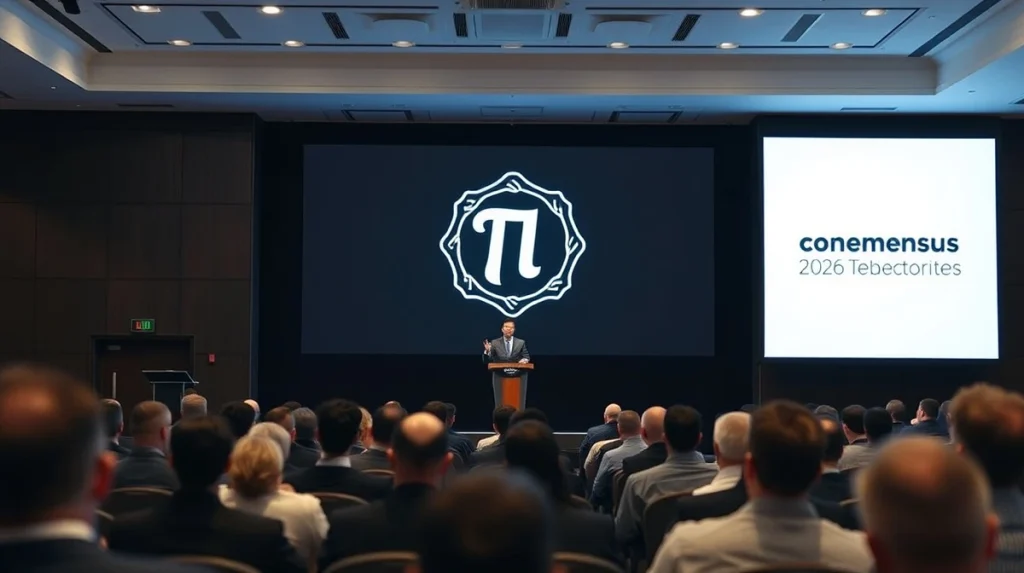
AUSTIN, Texas – April 21, 2026 – The founder of Pi Network, Dr. Nicolas Kokkalis, took the stage at the Consensus 2026 blockchain conference this week. His appearance followed a period of intense activity for the project. According to official project announcements, Pi Network has hit five significant technical and community milestones in just four months.
Pi Network’s Recent Milestones Detailed
Project data shows a series of advances since December 2025. These are not minor updates. They represent core developments for the long-awaited mobile-first cryptocurrency.
Also read: XRP ETF Gains Institutional Backing From Virginia and Florida Investment Advisors
The first milestone was the completion of a major Node software upgrade in late December. This upgrade improved network stability and data synchronization. A second achievement was the expansion of the KYC (Know Your Customer) solution. Pi’s core team reported processing over 15 million verified pioneers by the end of March 2026.
The third item involved utility. The project launched its first batch of closed mainnet migrations. This allowed a select group of verified users to transfer their Pi to a non-custodial wallet on the live blockchain. A fourth milestone was the signing of over 50 new integrations for the Pi browser ecosystem. These are real-world apps and services.
Also read: BlackRock’s BUIDL Fund Doubles on Avalanche, Surpasses $900M in AUM
The fifth and most recent development concerns infrastructure. Pi Network announced the deployment of additional Super Nodes in Asia and Europe. This aims to reduce latency and improve global access.
Consensus 2026: A Platform for Validation
Dr. Kokkalis’s participation at one of the world’s largest crypto events is notable. Consensus, organized by CoinDesk, attracts industry leaders, developers, and investors. His presentation focused on scalable blockchain design for mass adoption.
He did not announce a firm date for an open mainnet launch. Instead, his talk outlined the project’s phased approach to decentralization. Industry watchers note that a presence at this conference signals growing legitimacy. “Projects that present at Consensus are generally beyond the pure whitepaper stage,” said a blockchain analyst who attended the session. This analyst requested anonymity as they are not authorized to speak publicly.
The implication is clear. Pi Network is actively engaging with the broader blockchain industry at a high level.
The Long Road from Mobile Mining to Mainnet
Pi Network began in 2019. It allowed users to “mine” tokens on their phones without draining battery. This approach gathered a massive user base, estimated in the tens of millions. The project has always operated in an enclosed “mainnet” period. This means mined Pi tokens are not yet tradable on open exchanges.
The recent milestones address key prerequisites for an open network. KYC compliance is mandatory for regulatory safety. Node stability is essential for security. Ecosystem apps provide actual use cases. What this means for investors and users is a more mature project foundation. The core team is systematically checking boxes.
Community Growth Amidst Scrutiny
Despite the progress, Pi Network faces ongoing questions. Critics point to the lengthy development timeline and the lack of open trading. Supporters highlight the sustained community growth and methodical technical updates.
Data from social analytics firms shows Pi-related discussions increased by 40% in Q1 2026 compared to Q4 2025. This surge correlates with the milestone announcements. The community’s size remains its biggest asset and its biggest challenge. Managing expectations for millions of users is a complex task.
This suggests the project is in a critical phase. It must transition from a promising experiment to a fully functional blockchain. The steps taken since December appear designed to enable that transition.
Comparing Development Trajectories
How does Pi’s pace compare to other major networks? The table below shows key early development phases.
| Project | Initial Concept to Testnet | Testnet to Open Mainnet | Key Differentiator |
|---|---|---|---|
| Ethereum | ~2 years (2013-2015) | ~6 months | Smart contract pioneer |
| Solana | ~2 years (2017-2019) | ~1 year | High throughput focus |
| Pi Network | ~3 years (2019-2022) | Enclosed Mainnet (Ongoing) | Mobile-first, user acquisition |
The comparison highlights Pi’s unique path. It prioritized user growth before full technical decentralization. This strategy is now being tested as the network matures.
Conclusion
The Pi Network founder’s appearance at Consensus 2026 marks a moment of external recognition. It comes after a productive four-month period where the project achieved five concrete milestones. These advances in nodes, KYC, migration, ecosystem apps, and infrastructure address foundational requirements. The project continues to manage the complex shift from a centralized, user-acquisition phase to a decentralized, utility-driven network. The coming months will show if this technical progress can satisfy a global community awaiting an open mainnet.
FAQs
Q1: What is the Pi Network?
The Pi Network is a cryptocurrency project that launched in 2019. It allows users to mine tokens using a mobile phone app. The project is currently in an enclosed mainnet period, meaning tokens are not yet freely tradable on public exchanges.
Q2: What was announced at Consensus 2026 regarding Pi?
Pi Network founder Dr. Nicolas Kokkalis gave a presentation on scalable blockchain design. He did not announce a specific open mainnet launch date. The appearance itself was significant, following several project milestones announced since December 2025.
Q3: What are the five milestones Pi Network recently hit?
According to project announcements, the milestones are: 1) A major Node software upgrade, 2) Expansion of KYC verification processing, 3) The first closed mainnet migrations, 4) New Pi browser ecosystem integrations, and 5) Deployment of additional global Super Nodes.
Q4: Can I trade Pi cryptocurrency yet?
As of April 2026, Pi is not listed on major public cryptocurrency exchanges. The project is conducting controlled migrations to its mainnet blockchain. Trading is expected to become possible only after an open mainnet transition, for which a date has not been set.
Q5: Why is the Pi Network mainnet taking so long to open?
The core team cites the need to build a reliable ecosystem, ensure regulatory compliance through KYC, and achieve sufficient decentralization first. The project’s priority on a large, verified user base and stable infrastructure has extended the development timeline compared to some other networks.