OKX Stablecoin Card: Revolutionary EU Payment Launch via Monavate Unlocks Crypto Spending
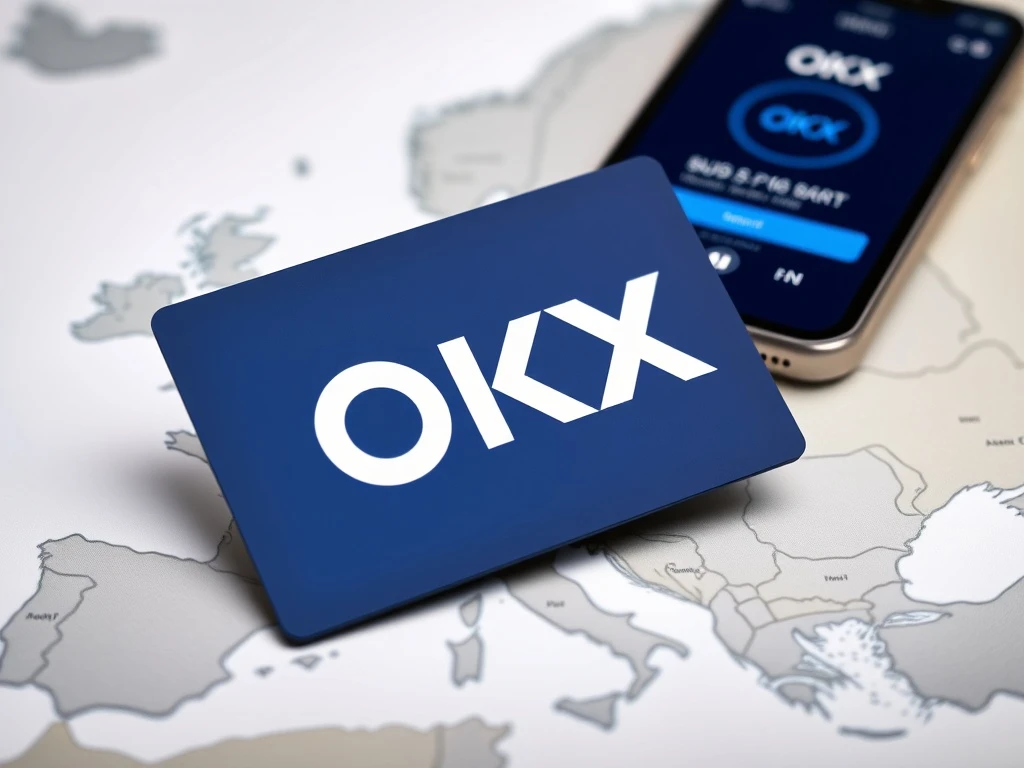
In a landmark move for European cryptocurrency adoption, global exchange OKX has officially launched its stablecoin payment card, issued through the regulated partner Monavate and operating on the Mastercard network. This pivotal development, announced on Wednesday, allows verified users across the European Union to seamlessly spend major stablecoins like USDC and USDG at millions of merchants. The launch arrives as the EU’s Markets in Crypto-Assets (MiCA) regulation provides a clearer framework for crypto-asset service providers, fundamentally reshaping how digital assets integrate with traditional finance.
OKX Stablecoin Card Bridges Crypto and Everyday Commerce
The newly introduced OKX Card represents a significant step toward practical cryptocurrency utility. Consequently, users can now convert their digital holdings into real-world purchases without complex conversions. The card directly supports spending in Circle’s USD Coin (USDC) and Paxos’s Global Dollar (USDG), two of the most prominent and regulated dollar-pegged stablecoins. Furthermore, the card leverages OKX Pay, the exchange’s self-custodial wallet, allowing users to top up their card balance directly from their exchange account. This integration creates a fluid ecosystem from trading to spending.
Also read: Bittensor TAO Sell Signal: TD Sequential Flashes Warning After Stunning 160% Surge
Erald Ghoos, CEO of OKX Europe, emphasized the card’s user-centric design. “With OKX Card, we’re making it simple for anyone in Europe to use crypto for real-world purchases,” Ghoos stated. He added that while the freedom to make payments is core to crypto’s original vision, it often remains technically challenging for the average user. The OKX Card, therefore, aims to democratize this access, enabling secure, everyday transactions while users maintain control of their assets.
The Regulatory Backbone: MiCA and Monavate’s Role
The card’s launch is deeply intertwined with Europe’s evolving regulatory landscape. Critically, OKX operates as a regulated Crypto-Asset Service Provider (CASP) under the MiCA framework. However, the payment instrument itself is issued by Monavate, a UK-based Electronic Money Institution (EMI). Monavate ensures the card operates in full compliance with stringent European Economic Area standards, including Anti-Money Laundering (AML) and Know Your Customer (KYC) directives. This dual-layer regulatory approach—MiCA for the exchange service and EMI rules for the card—provides a robust foundation of consumer protection and financial integrity.
Also read: XRP Whale's $35 Million Gamble Exposes Deep Market Rift
An OKX spokesperson confirmed to Crypto News Insights that Monavate adheres to strict AML and KYC standards. Notably, all potential cardholders must first pass OKX’s verification process, which aligns with MiCA obligations and EU AML regulations. This mandatory check underscores the industry’s maturation, prioritizing security and compliance alongside innovation. Interestingly, Monavate is poised for acquisition by self-custody wallet provider Exodus, as announced in November 2025, potentially signaling further consolidation in the crypto-finance infrastructure space.
Context and Impact on the European Crypto Payments Landscape
OKX’s entry into the crypto card market is not an isolated event but part of a broader, accelerating trend. For instance, reports indicate that Visa-issued crypto cards witnessed a staggering 525% increase in total net spending during 2025. This surge highlights a growing consumer appetite for leveraging digital assets in daily life. The European market, with its unified regulatory push via MiCA, has become a prime testing ground for these integrated financial products.
The following table compares key aspects of the new offering:
| Feature | Detail |
|---|---|
| Issuer | Monavate (Electronic Money Institution) |
| Payment Network | Mastercard |
| Supported Assets | USDC, USDG |
| Availability | Verified OKX users in the European Union |
| Regulatory Framework | MiCA (OKX) + EMI Regulations (Monavate) |
| Wallet Integration | OKX Pay (Self-custodial) |
This launch strategically positions OKX alongside other players exploring stablecoin utility. For example, the recent $250 million funding round for Visa-linked platform Rain at a $1.95 billion valuation underscores the immense investor confidence in this convergence. Analysts view these developments as critical steps in addressing three core financial needs: payment facilitation, wealth accrual, and credit access. The OKX Card directly targets the first need, providing a practical tool that was previously missing for many crypto holders.
Expert Analysis on Market Trajectory and User Adoption
Financial technology experts point to several factors driving this innovation. Primarily, the regulatory clarity provided by MiCA has reduced operational uncertainty for companies like OKX. This clarity allows them to design products with known compliance parameters, encouraging investment and development. Additionally, the growing institutional acceptance of stablecoins like USDC as a reliable store of value and medium of exchange provides the necessary asset backbone for such payment systems.
The success of the OKX Card will likely depend on several key variables:
- User Experience: Seamlessness of topping up and spending.
- Fee Structure: Transparency and competitiveness of transaction costs.
- Merchant Acceptance: Leveraging Mastercard’s vast network.
- Regulatory Stability: Continued adherence to evolving EU standards.
If these elements align, the card could significantly lower the barrier to crypto spending, moving it from a niche activity to a mainstream financial behavior. The long-term vision extends beyond simple payments, potentially paving the way for integrated loyalty programs, decentralized finance (DeFi) yield opportunities linked to card balances, and broader financial inclusion.
Conclusion
The launch of the OKX stablecoin payment card via Monavate marks a definitive milestone in the maturation of the European cryptocurrency ecosystem. By combining regulatory compliance under MiCA with the extensive reach of the Mastercard network, OKX has created a tangible bridge between digital asset ownership and everyday economic activity. This move not only enhances the utility of stablecoins like USDC and USDG but also signals a broader industry shift toward practical, user-friendly crypto applications. As the regulatory landscape continues to solidify in 2025 and beyond, such innovations are poised to redefine the intersection of traditional and digital finance, making the foundational promise of cryptocurrency—free and seamless transacting—a practical reality for millions.
FAQs
Q1: What is the OKX Card and who can get it?
The OKX Card is a payment card that allows users to spend their cryptocurrency stablecoins at merchants that accept Mastercard. It is currently available only to users who have completed identity verification (KYC) on the OKX platform and are located within the European Union.
Q2: Which cryptocurrencies can I spend with the OKX Card?
At launch, the card supports spending using two major stablecoins: USD Coin (USDC) issued by Circle and the Global Dollar (USDG) issued by Paxos. These are digital assets pegged to the value of the US dollar.
Q3: How is the OKX Card regulated in Europe?
The card is issued by Monavate, a licensed Electronic Money Institution (EMI) that complies with strict EU financial regulations, including Anti-Money Laundering (AML) rules. OKX, the provider, is also a regulated Crypto-Asset Service Provider under the EU’s Markets in Crypto-Assets (MiCA) framework.
Q4: Do I need to convert my crypto to euros before spending?
No, a key feature of the card is that it allows for direct spending of supported stablecoins. The conversion to the local currency at the point of sale is handled automatically by the payment network, simplifying the process for the user.
Q5: What is the significance of Monavate being acquired by Exodus?
The planned acquisition of Monavate by Exodus, a self-custody wallet provider, announced in late 2025, suggests a strategic move to deeply integrate payment card functionality with non-custodial wallet services. This could indicate a future where users have even more direct control over their assets while spending them.

This article was produced with AI assistance and reviewed by our editorial team for accuracy and quality.