Crypto Futures Activity Surges: 7x Faster Than Spot Trading Signals Critical Market Shift
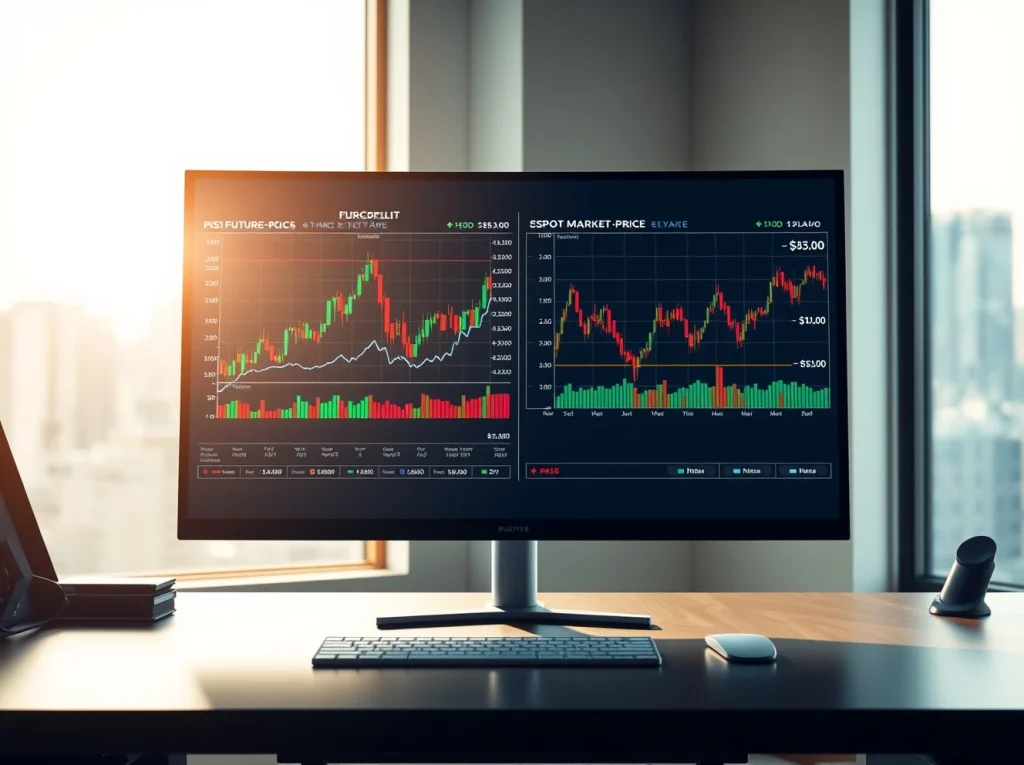
Data from major cryptocurrency exchanges reveals a startling divergence: futures trading activity is now moving at a pace seven times faster than spot market transactions. This significant gap, observed in early April 2026, presents a complex picture for Bitcoin’s price and overall market health. While some analysts see this as a sign of sophisticated capital flows, others warn it could indicate excessive speculation detached from underlying asset fundamentals.
Futures Outpacing Spot: The Data Behind the Divergence
According to aggregated exchange data compiled by CryptoCompare and CoinMetrics, the daily notional volume for Bitcoin futures contracts across platforms like CME, Binance, and Bybit has consistently dwarfed spot volumes throughout the first quarter of 2026. In March, the ratio reached a peak of 7:1. This means for every dollar traded in the simple buying and selling of Bitcoin, seven dollars were wagered on its future price direction through leveraged derivatives.
Also read: Ethereum Faces $1,800 Wall as 4.3M ETH Holds Key to Next Major Price Breakout
This trend isn’t entirely new, but its scale is. A report from Arcane Research noted that the futures-to-spot volume ratio averaged around 3:1 throughout much of 2024 and 2025. The jump to 7:1 represents a more than twofold increase in relative futures dominance. Industry watchers note that such a high ratio often precedes periods of heightened volatility.
What This Means for Bitcoin’s Price and Market Stability
The implications of this activity are multifaceted. On one hand, sturdy futures markets provide liquidity and allow institutional players to hedge positions. The Chicago Mercantile Exchange (CME) has reported record open interest in its Bitcoin futures products, suggesting deeper institutional involvement. Data from The Block shows CME’s open interest surpassed $8 billion in late March 2026.
Also read: Ethereum Foundation Sends $4.34M in stETH to Argot as Fourth Annual Grant Payment
However, the sheer speed and volume disparity raise red flags. “When futures trade this much faster than spot, it can create a feedback loop,” said a market structure analyst from Kaiko, a crypto data firm. “Liquidations in the futures market can force selling pressure that spills over into the spot price, even if spot demand is steady.” This dynamic was observed during the market downturn of June 2024, where cascading futures liquidations accelerated price declines.
The current environment suggests two possible narratives:
- Sophisticated Positioning: Large traders are using futures to express complex views on Bitcoin’s upcoming halving cycle or macroeconomic trends, without needing to hold the underlying asset.
- Speculative Frenzy: High apply and easy access are fueling short-term bets that amplify price moves in both directions, increasing systemic risk.
The Accumulation Zone Argument
Amid this derivatives noise, on-chain data points to a different story. Analysis from Glassnode, referencing metrics from April 2026, indicates that certain wallet cohorts classified as “long-term holders” have been accumulating Bitcoin consistently. Their cost basis, according to the data, clusters in a band between $18,500 and $20,000. This pattern has led some to label this price range an “accumulation zone”—a level where patient capital is willing to buy and hold, providing potential price support.
This creates a market dichotomy. The spot market, driven by these accumulators, may exhibit relative stability. Meanwhile, the frenetic futures market operates on a different timescale, driven by utilize and short-term incentives. The danger lies in the futures market’s ability to temporarily overwhelm spot-driven price discovery.
Historical Precedents and Liquidation Risks
Markets have seen this movie before. A study by BitMEX Research analyzing the 2021 bull run found that extreme futures-to-spot volume ratios often coincided with local price tops and subsequent sharp corrections. The mechanism is typically a volatility squeeze that triggers a wave of forced liquidations.
The current utilize levels in the system are a key concern. Data from Coinglass shows the estimated apply ratio across perpetual swap markets remains elevated. When highly leveraged positions are concentrated, a relatively small price move can trigger billions in automatic sell or buy orders. This suggests that while the path to $20,000 might be supported by spot accumulation, the journey could be exceptionally bumpy due to the overhang of futures positions.
Regulatory Scrutiny and Market Evolution
This activity has not gone unnoticed by regulators. In a speech on March 15, 2026, a commissioner from the U.S. Commodity Futures Trading Commission (CFTC) highlighted the need for better visibility into the interconnectedness of global crypto derivatives markets. The concern is that risk originating in offshore, high-utilize venues could transmit instability to more regulated markets and traditional finance.
For traders and investors, this environment demands a nuanced approach. Understanding whether price action is driven by spot market supply/demand or futures market mechanics is more important than ever. The 7:1 ratio is a clear signal that the latter currently holds the whip hand.
Conclusion
The seven-fold speed of crypto futures activity compared to spot trading is a powerful indicator of the market’s current state. It reflects deep institutional participation but also carries the seeds of potential instability. While on-chain accumulation around $20,000 may provide a fundamental floor, the dominant force in daily price movement is the leveraged futures market. This divergence means investors should brace for volatility and watch liquidation levels closely. The market’s next major move will likely be decided by which of these two forces—patient spot accumulation or frenetic futures trading—finally gains the upper hand.
FAQs
Q1: What does it mean that futures are trading 7x faster than spot?
It means the notional value of Bitcoin derivative contracts being traded is seven times greater than the value of actual Bitcoin being bought and sold on spot exchanges. This shows much more activity is focused on betting on future prices than on immediate ownership.
Q2: Is a high futures-to-spot ratio bad for Bitcoin’s price?
Not necessarily, but it is a risk factor. It provides liquidity but can also lead to amplified volatility. Sharp price moves can trigger mass liquidations in the futures market, which then force additional selling or buying that impacts the spot price.
Q3: What is an ‘accumulation zone’?
An accumulation zone is a price range where data shows long-term investors are consistently buying and withdrawing coins to cold storage, suggesting they believe the asset is undervalued. It can act as a level of support.
Q4: Does this data suggest institutions are involved?
Yes. The growth of regulated futures markets like the CME, which primarily serves institutions, alongside the high volume, indicates significant professional and institutional capital is active in the crypto derivatives space.
Q5: How should an investor interpret this market structure?
Investors should recognize that short-term price action is heavily influenced by leveraged derivatives trading, which can be unpredictable. Long-term fundamentals may be stronger, but the path will likely be volatile. Monitoring futures funding rates and liquidation levels becomes important.