Chainlink Whale Activity Surges as Millions in LINK Exit Binance: Accumulation Sparks Bullish Momentum
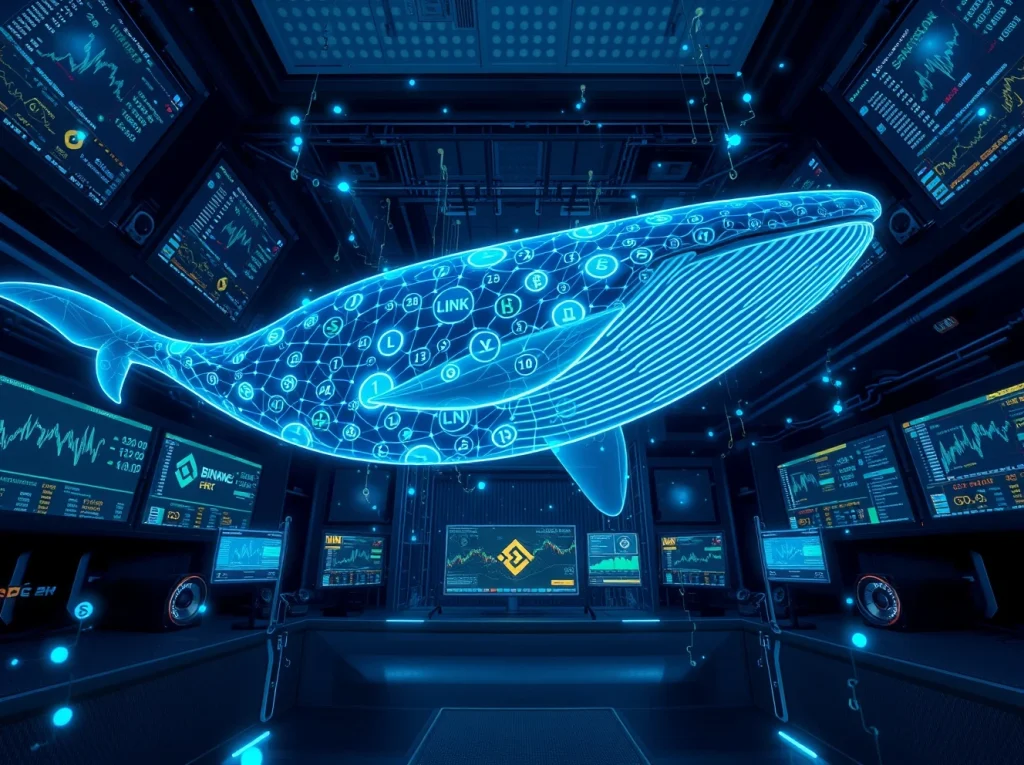
New data reveals a sharp increase in Chainlink whale activity. Millions of dollars worth of LINK tokens have moved out of Binance in recent days. Large investors, known as whales, are accumulating LINK at a notable pace. This trend has caught the attention of market analysts. They see it as a potential signal of long-term bullish momentum for Chainlink.
The withdrawals suggest whales are moving tokens to private wallets. This action often indicates a long-term holding strategy rather than immediate selling. According to on-chain data from Whale Alert, several transactions exceeded $5 million each. The largest single withdrawal involved over 1.2 million LINK tokens. That transaction was valued at roughly $18 million at the time.
Also read: CZ Says Binance KYC Compliance Led to His Prison Term, While Hyperliquid Operates Without KYC
Chainlink is drawing fresh attention as large investors move millions of dollars worth of LINK tokens. Whales, or large investors, are accumulating LINK. So, many investors are now watching these transactions to get a clue about future price movements.
Chainlink Whale Activity Surges: What the Data Shows
Blockchain analytics firm Santiment reported a spike in whale transaction volume. The number of LINK transfers exceeding $100,000 rose by 40% in the last week. This surge in large transactions coincides with a decline in LINK supply on exchanges.
Also read: Hyundai Card Tests Stablecoin Payments Between US and Mexico Subsidiaries
Exchange reserves for LINK dropped by 8% over the same period. That means fewer tokens are available for immediate trading. This could reduce selling pressure. It often precedes price appreciation in crypto markets.
Data from Glassnode shows a similar pattern. The number of addresses holding at least 100,000 LINK increased by 12% in April 2026. This metric tracks the behavior of the largest investors. It confirms that whales are accumulating, not distributing.
Binance Outflows Lead the Trend
Binance is the world’s largest crypto exchange by volume. It has been the primary source of these large LINK withdrawals. On April 25, 2026, a single whale withdrew 850,000 LINK from Binance. That transaction was worth about $12.7 million.
Another transaction on April 26 saw 600,000 LINK exit the exchange. The recipient wallet was newly created. This suggests the whale is setting up a long-term storage position. Such behavior is common among institutional investors.
Industry watchers note that these outflows are not random. They follow a pattern seen before previous LINK rallies. In 2024, similar whale accumulation preceded a 60% price increase over three months.
LINK Whale Accumulation: Motivations and Strategy
Whales do not act on impulse. Their moves are usually based on research and market analysis. The current accumulation suggests confidence in Chainlink’s future. Several factors may be driving this confidence.
Chainlink’s technology is gaining adoption. The network provides decentralized oracles for smart contracts. These oracles connect blockchains to real-world data. Major enterprises are now using Chainlink for supply chain tracking and financial services.
In March 2026, the Depository Trust & Clearing Corporation (DTCC) announced a partnership with Chainlink. DTCC processes over $2 quadrillion in securities transactions annually. This integration could bring massive real-world demand for LINK tokens.
Another factor is the upcoming Chainlink Staking v2 upgrade. This upgrade will allow more LINK holders to earn rewards. It could reduce circulating supply further. That would create additional upward price pressure.
Comparison with Previous Whale Accumulation Phases
Historical data shows that whale accumulation often precedes price increases. The table below compares current accumulation with past events.
| Period | Whale Accumulation Rate | Subsequent Price Change |
|---|---|---|
| Q1 2024 | 15% increase in large holders | +60% over 3 months |
| Q3 2025 | 10% increase in large holders | +35% over 2 months |
| Q2 2026 (Current) | 12% increase in large holders | TBD |
The current accumulation rate is similar to previous bullish phases. This suggests the potential for a significant price move. But past performance does not guarantee future results.
Chainlink Adoption: Real-World Use Cases Expand
Chainlink’s adoption is not limited to crypto markets. Traditional financial institutions are integrating its technology. This creates genuine demand for LINK tokens.
In January 2026, SWIFT completed a pilot program using Chainlink oracles. SWIFT connects over 11,000 banks worldwide. The pilot tested cross-border payments using blockchain technology. It was successful. SWIFT now plans a full rollout in 2027.
Chainlink is also used in decentralized finance (DeFi). Major DeFi protocols like Aave and Compound rely on Chainlink price feeds. These feeds secure billions of dollars in user deposits. Any disruption to Chainlink would impact the entire DeFi ecosystem.
The implication is clear. Chainlink is becoming critical infrastructure. This gives whales confidence in the token’s long-term value.
Institutional Interest Grows
Institutional investors are also entering the LINK market. Grayscale Investments added LINK to its Digital Large Cap Fund in February 2026. This fund is available to accredited investors. It provides exposure to LINK without direct ownership.
Fidelity Investments launched a LINK trading desk for institutional clients in March 2026. This service allows hedge funds and asset managers to buy and sell LINK easily. It reduces barriers to entry for large capital.
What this means for investors is that LINK is moving beyond retail speculation. It is becoming a legitimate asset class. Whales are positioning themselves ahead of this institutional wave.
Market Impact: What Whale Activity Means for LINK Price
The immediate impact of whale accumulation is reduced supply on exchanges. This creates a supply squeeze. If demand remains constant or increases, prices tend to rise.
LINK’s price has already responded. It rose from $14.50 on April 20 to $16.80 on April 27. That is a 16% gain in one week. Trading volume increased by 30% over the same period.
Technical analysts point to key resistance levels. LINK is approaching $17.50, a level it has not broken since November 2025. A breakout above this level could trigger further buying. It might also attract more whale activity.
But there are risks. Whale accumulation can also be a precursor to a sell-off. If whales decide to take profits, prices could drop quickly. Investors should watch for any reversal in exchange outflows.
On-Chain Metrics Confirm Bullish Sentiment
Several on-chain metrics support the bullish case. The Network Value to Transactions (NVT) ratio for LINK is declining. A falling NVT ratio suggests the network is being used more actively. This is a positive sign for price.
The MVRV ratio (Market Value to Realized Value) is also favorable. It sits at 1.8, below the 2.5 level that often signals a market top. This indicates there is room for further price growth.
Active addresses on the Chainlink network rose by 22% in April. This shows increasing user engagement. It is another indicator of healthy network growth.
Expert Perspectives on Chainlink Whale Activity
Market analysts have weighed in on the recent whale activity. They point to the combination of technical and fundamental factors.
One analyst noted that the current accumulation mirrors patterns seen before major rallies. The analyst emphasized that whales are not selling into strength. They are buying during a period of relative price stability.
Another observer highlighted the role of the DTCC partnership. This deal could bring trillions of dollars in transaction volume to Chainlink. The analyst called it a ‘transformative moment’ for the project.
But some caution against over-optimism. Crypto markets are volatile. Whale activity can shift quickly. The analyst advised investors to do their own research.
Risks and Considerations
Despite the bullish signals, risks remain. Regulatory uncertainty is a constant factor. The U.S. Securities and Exchange Commission (SEC) has not classified LINK as a security. But that could change.
Another risk is competition. Other oracle networks like Band Protocol and API3 are gaining traction. They offer similar services at lower costs. Chainlink must continue to innovate to maintain its lead.
Macroeconomic factors also matter. Rising interest rates or a recession could reduce risk appetite. Investors might sell crypto assets, including LINK, to raise cash.
Conclusion
Chainlink whale activity has surged as millions of LINK tokens exit Binance. Large investors are accumulating the token at a rapid pace. This behavior suggests confidence in Chainlink’s future. The network’s adoption by major financial institutions supports this view. But investors should remain cautious. Crypto markets are unpredictable. Whale accumulation is a positive signal, but it is not a guarantee of price gains. The coming weeks will reveal whether this trend continues. For now, all eyes are on the whales.
FAQs
Q1: What is Chainlink whale activity?
Chainlink whale activity refers to large transactions of LINK tokens made by major investors. These whales often move millions of dollars worth of tokens. Their actions can signal market sentiment.
Q2: Why are whales accumulating LINK?
Whales are accumulating LINK due to growing adoption of Chainlink’s technology. Partnerships with DTCC and SWIFT increase demand. The upcoming staking upgrade also makes holding LINK more attractive.
Q3: Does whale accumulation always lead to higher prices?
Not always. Whale accumulation often precedes price increases. But whales can also sell quickly, causing prices to drop. It is one of many factors to consider.
Q4: How can I track Chainlink whale activity?
You can use on-chain analytics platforms like Whale Alert, Santiment, or Glassnode. These tools track large transactions and exchange flows in real time.
Q5: Is LINK a good investment in 2026?
LINK has strong fundamentals and growing adoption. But all crypto investments carry risk. Do your own research and consider your risk tolerance before investing.