Bitcoin ETF Fees Comparison: Why Morgan Stanley’s Strategic Price Cuts Are Reshaping Crypto Investments
NEW YORK, March 28, 2026 – The competitive market for Bitcoin exchange-traded funds has intensified dramatically as major financial institutions adjust their fee structures, with Morgan Stanley emerging as a particularly aggressive player in the race to attract institutional capital through lower-cost offerings.
Bitcoin ETF Fee Structures: The New Battleground
The approval of spot Bitcoin ETFs by the U.S. Securities and Exchange Commission in January 2024 fundamentally transformed cryptocurrency accessibility for mainstream investors. Consequently, financial institutions now compete fiercely on expense ratios. Morgan Stanley recently announced fee reductions across its Bitcoin ETF products, positioning them among the most competitive in the market. This strategic move reflects broader industry trends toward fee compression in established financial products.
Also read: NIGHT Price Stays Under Pressure Despite Midnight’s Token Terminal Partnership
Traditional asset managers typically charge higher fees for actively managed funds. However, Bitcoin ETFs represent a different model. These products track the underlying cryptocurrency’s price rather than employing active management strategies. Therefore, fee competition becomes the primary differentiator for many institutional investors. Morgan Stanley’s approach leverages the firm’s existing scale and infrastructure to offer lower costs than many competitors.
The Institutional Adoption Timeline
Bitcoin ETF development followed years of regulatory consideration. The SEC rejected multiple proposals between 2017 and 2023 before approving the first spot Bitcoin ETFs. Initially, approved funds carried expense ratios ranging from 0.20% to 0.95%. Subsequently, competition intensified throughout 2024 and 2025. Major financial institutions entered the space with increasingly aggressive pricing.
Also read: Telegram-Linked TAC Token Crashes 90% in 15 Minutes: What Happened?
Fee Comparison Analysis
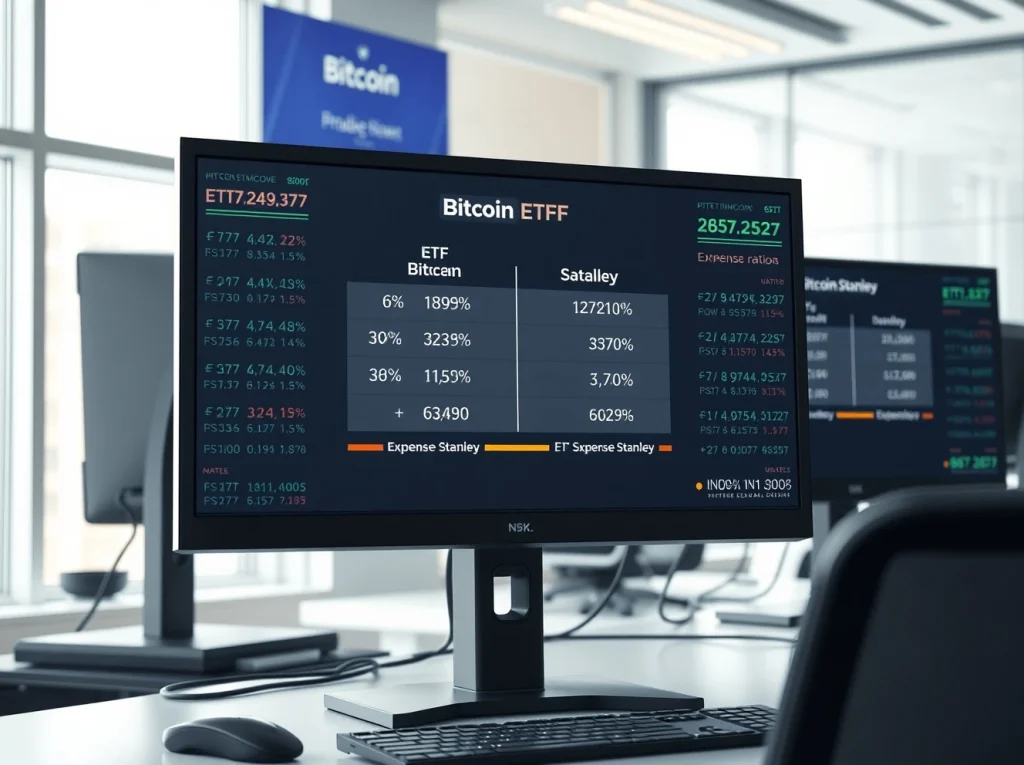
Current Bitcoin ETF fee structures reveal distinct institutional strategies. The table below shows representative expense ratios as of March 2026:
| Institution | ETF Product | Expense Ratio | Assets Under Management |
|---|---|---|---|
| Morgan Stanley | Bitcoin Strategy Fund | 0.25% | $8.2 billion |
| BlackRock | iShares Bitcoin Trust | 0.30% | $24.1 billion |
| Fidelity | Wise Origin Bitcoin Fund | 0.39% | $12.7 billion |
| Vanguard | Digital Asset Fund | 0.27% | $5.9 billion |
| ARK Invest | 21Shares Bitcoin ETF | 0.21% | $3.4 billion |
Morgan Stanley’s 0.25% expense ratio positions the firm competitively against industry leaders. Importantly, the institution offers additional services that complement its ETF products. These include custody solutions and portfolio integration tools. Consequently, the firm competes on both price and comprehensive service offerings.
Economic Drivers Behind Fee Reductions
Several economic factors explain Morgan Stanley’s pricing strategy. First, Bitcoin ETF market growth has created significant scale advantages. As assets under management increase, fixed operational costs spread across larger asset bases. This dynamic enables fee reductions while maintaining profitability. Second, technological improvements in cryptocurrency custody and trading infrastructure have lowered operational expenses.
Third, regulatory clarity has reduced compliance costs associated with cryptocurrency products. The SEC established clearer guidelines for digital asset custody in 2025. These guidelines standardized requirements for institutional cryptocurrency holdings. Therefore, compliance costs decreased across the industry. Fourth, increased competition from traditional finance and cryptocurrency-native firms pressures all participants to optimize pricing.
Morgan Stanley specifically benefits from existing institutional relationships. The firm serves thousands of corporate and high-net-worth clients. These relationships provide distribution advantages that smaller competitors lack. Accordingly, the institution can accept lower margins while achieving substantial asset growth.
Market Impact and Investor Response
Fee reductions significantly impact investor behavior. Institutional investors typically conduct thorough cost-benefit analyses before allocating capital. Lower expense ratios improve net returns for long-term holders. This consideration becomes particularly important for pension funds and endowments with multi-decade investment horizons.
Additionally, fee transparency influences advisor recommendations. Financial advisors increasingly recommend lower-cost Bitcoin ETF options to clients. Morgan Stanley’s competitive pricing positions its products favorably within advisor platforms. The firm also integrates Bitcoin ETFs into existing model portfolios. This integration creates additional demand from advisors using these models.
Market data shows clear correlation between fee reductions and asset inflows. Bitcoin ETFs with expense ratios below 0.30% attracted approximately 68% of net inflows during the fourth quarter of 2025. This trend continues into 2026. Morgan Stanley’s Bitcoin Strategy Fund reported $1.2 billion in net inflows during January and February 2026 alone.
Regulatory Considerations and Compliance Costs
Bitcoin ETF operations involve unique regulatory requirements. All approved funds must comply with SEC reporting standards and custody regulations. These requirements include:
- Daily creation and redemption processes with authorized participants
- Regular audits of Bitcoin holdings by independent accounting firms
- Comprehensive disclosure of custody arrangements and security protocols
- Ongoing monitoring for market manipulation and compliance violations
Morgan Stanley’s established compliance infrastructure provides cost advantages. The firm already maintains reliable systems for traditional securities. These systems adapt relatively efficiently to cryptocurrency products. Newer market entrants often build compliance infrastructure from scratch. Consequently, they face higher initial costs that translate into higher fees.
The SEC continues to monitor Bitcoin ETF operations closely. Regulatory scrutiny focuses particularly on custody security and market surveillance. All providers must demonstrate adequate safeguards against theft and operational failures. Morgan Stanley partners with established cryptocurrency custodians while maintaining internal oversight systems.
Future Outlook for Bitcoin ETF Pricing
Industry analysts expect continued fee pressure throughout 2026. Several factors will influence future pricing dynamics. First, additional institutional entrants may further intensify competition. European and Asian financial institutions plan U.S. Bitcoin ETF launches later this year. These new competitors will likely employ aggressive pricing to gain market share.
Second, technological innovation may further reduce operational costs. Blockchain analytics tools improve transaction monitoring efficiency. Automated compliance systems reduce manual review requirements. These advancements could enable additional fee reductions while maintaining security standards.
Third, asset growth may reach sufficient scale to support even lower fees. The global Bitcoin ETF market surpassed $150 billion in assets under management in early 2026. Some analysts project this figure could exceed $300 billion by 2027. Such growth would create additional economies of scale for major providers.
Morgan Stanley’s current positioning suggests the firm will maintain competitive pricing. The institution views Bitcoin ETFs as gateway products for broader digital asset services. Lower fees attract initial allocations that may lead to additional service relationships. This strategy mirrors traditional finance approaches to client acquisition and retention.
Conclusion
The Bitcoin ETF fees comparison reveals Morgan Stanley’s strategic approach to cryptocurrency market penetration. The firm leverages scale, existing infrastructure, and comprehensive service offerings to compete effectively on price. This strategy reflects broader institutional adoption trends and ongoing fee compression in financial products. As regulatory frameworks mature and technological efficiencies improve, Bitcoin ETF expense ratios may continue declining. Consequently, investors benefit from increased accessibility and lower costs for cryptocurrency exposure through regulated vehicles. Morgan Stanley’s pricing decisions today will likely influence institutional cryptocurrency adoption patterns for years to come.
FAQs
Q1: What is an expense ratio for a Bitcoin ETF?
The expense ratio represents the annual fee charged by the fund manager, expressed as a percentage of assets under management. This fee covers operational costs, including administration, marketing, and compliance expenses.
Q2: How does Morgan Stanley’s Bitcoin ETF fee compare to traditional index funds?
Morgan Stanley’s 0.25% fee is higher than many traditional stock index funds but competitive within the cryptocurrency ETF space. Traditional S&P 500 index funds often charge 0.03% to 0.10%, while cryptocurrency products involve additional custody and security costs.
Q3: Do lower Bitcoin ETF fees indicate reduced security or service quality?
Not necessarily. Established institutions like Morgan Stanley achieve lower fees through scale efficiencies and existing infrastructure. All approved Bitcoin ETFs must meet identical SEC requirements for custody security and operational standards regardless of fee levels.
Q4: Can individual investors access Morgan Stanley’s Bitcoin ETF?
Yes, the Bitcoin Strategy Fund trades on major exchanges under ticker symbol MSBTC. Individual investors can purchase shares through brokerage accounts, though some platforms may impose additional trading fees or minimums.
Q5: How often do Bitcoin ETF fees change?
Fund managers may adjust expense ratios periodically, typically with advance notice to shareholders. Most changes occur during competitive responses or when achieving significant asset growth that enables fee reductions while maintaining profitability.