Aave Price Alert: Chaos Labs Exit Triggers DeFi Security Fears

The sudden departure of security firm Chaos Labs from the Aave ecosystem has sent shockwaves through decentralized finance. Announced on April 2, 2026, this move places fresh scrutiny on the protocol’s risk management and the stability of its native AAVE token. Market data shows the token dipped 8% in the 48 hours following the news, underperforming against broader crypto indices.
Chaos Labs Exit and Immediate Aave Price Reaction
Chaos Labs confirmed its exit in a brief social media post, citing “shifting strategic priorities.” The firm had served as Aave’s primary risk management partner since 2022. Its responsibilities included monitoring lending pools, simulating stress scenarios, and proposing parameter updates to the Aave decentralized autonomous organization (DAO). According to blockchain analytics firm Arkham Intelligence, Chaos Labs managed risk parameters for pools holding over $12 billion in total value locked at their peak.
Also read: Telegram-Linked TAC Token Crashes 90% in 15 Minutes: What Happened?
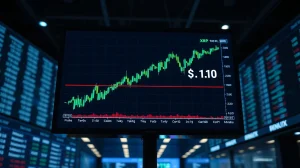
The AAVE token price fell from $112.40 to a low of $103.15 following the announcement. Trading volume spiked 150% above its 30-day average. This suggests the market is reassessing the protocol’s security premium. “When a key technical guardian leaves, it creates an information gap,” said Marcus Thielen, head of research at CryptoQuant. “Investors hate uncertainty, especially around complex risk systems.”
Understanding the Role Chaos Labs Played
To grasp the impact, one must understand what Chaos Labs did. The firm operated as a technical service provider for the Aave DAO. Its core function was proactive risk analysis. This involved constant monitoring of collateral assets, loan-to-value ratios, and liquidity across all Aave markets.
Also read: XRP Scarcity Index on Binance Hits Highest Level Since Mid-2024, So Where Did the Coins Go?
Key responsibilities included:
- Risk Parameter Recommendations: Proposing changes to interest rates, liquidation thresholds, and collateral factors.
- Economic Security Audits: Stress-testing the protocol against market crashes and volatile asset behavior.
- Governance Support: Providing data-driven analysis for AAVE token holders voting on protocol changes.
Data from Flipside Crypto shows that over 80% of Aave governance proposals related to risk parameters in the past year incorporated analysis from Chaos Labs. The firm’s exit leaves a significant operational void. The Aave DAO now faces the immediate task of finding a replacement or redistributing these critical duties.
A Comparative Look at DeFi Risk Management
The situation highlights a broader trend in DeFi. Major lending protocols increasingly rely on specialized, centralized entities for complex security tasks. The table below shows similar arrangements across the sector.
| Protocol | Primary Risk Manager | Engagement Type |
|---|---|---|
| Compound | OpenZeppelin + Gauntlet | Multi-firm Advisory |
| Aave (Previously) | Chaos Labs | Primary Partner |
| MakerDAO | Phoenix Labs (Spark Protocol) | Internal Team |
| Morpho Blue | Independent Auditors | Contract-Based |
This suggests Aave’s model was not unique. However, its dependence on a single external firm may have created a point of failure. Industry watchers note that Compound’s use of multiple advisors could offer more resilience.
Governance Response and Protocol Security
The Aave DAO has activated its contingency planning. A governance forum post from a core contributor known as “MarcZeller” on April 4 outlined interim measures. These include forming a temporary “Risk Stewards Committee” composed of existing community technical advisors. The committee will handle daily monitoring until a long-term solution is ratified by AAVE token holders.
Security analysts are divided on the immediate threat. “The protocol’s smart contracts are battle-tested and haven’t changed,” noted a report from blockchain security firm CertiK. “The operational risk is elevated, but the fundamental code integrity remains.” Other experts warn the real danger is slower response times to market events. Without dedicated simulation, a sudden price drop in a major collateral asset could catch the community off guard.
On-chain data provides some reassurance. According to DefiLlama, Aave’s total value locked has remained stable at around $9.8 billion since the announcement. Major withdrawals have not materialized. This could indicate that large institutional depositors are taking a wait-and-see approach.
Market Implications for the AAVE Token
The AAVE token serves dual purposes: governance and protocol safety. Holders vote on key decisions and act as a backstop in a severe shortfall event. The Chaos Labs exit directly affects the perceived effectiveness of both functions. If governance becomes slower or less informed, the token’s utility diminishes.
Historical precedent exists. When the MakerDAO community faced internal disputes in early 2024, its MKR token underperformed the DeFi sector for several months. The implication for AAVE is similar. Token price may face sustained pressure until the governance apparatus demonstrates it can manage risk effectively without its former partner.
What this means for investors is heightened volatility. The token will likely trade on news related to the DAO’s replacement efforts. Any delay or disagreement in governance could trigger sell-offs. Conversely, a swift, competent resolution could restore confidence. Options market data from Deribit shows a notable increase in put option volume for AAVE, indicating traders are hedging against further downside.
Broader DeFi Stability Concerns
This incident transcends Aave. It tests a core DeFi narrative: that decentralized governance can reliably manage complex, billion-dollar financial systems. Critics have long argued that true decentralization is often an illusion, with key functions outsourced to centralized experts. The Chaos Labs exit puts that theory on trial.
Regulators are paying attention. The European Banking Authority’s recent consultation paper on DeFi specifically mentioned the reliance on “oracles and external risk managers” as a potential systemic vulnerability. This event may provide a case study for policymakers. The outcome could influence future regulatory frameworks for decentralized finance globally.
For users, the takeaway is to audit your DeFi exposures. Understand which protocols rely on single points of failure for critical operations. Diversification across platforms with different governance and security models remains a prudent strategy. The Aave situation is a reminder that in DeFi, technical risk and governance risk are inextricably linked.
Conclusion
The Chaos Labs exit presents a clear test for Aave. The immediate Aave price reaction reflects market anxiety over a security and governance gap. The protocol’s long-term health depends on how its decentralized community responds. Success would reinforce DeFi’s resilience. Failure could expose deeper flaws in the model. All eyes are now on the Aave DAO’s next governance vote. The decision will shape not just Aave’s future, but perceptions of decentralized finance stability for the foreseeable future.
FAQs
Q1: What exactly did Chaos Labs do for Aave?
Chaos Labs acted as Aave’s primary risk management partner. It monitored lending pools, simulated economic attacks, and recommended changes to parameters like loan-to-value ratios and liquidation penalties to keep the protocol secure.
Q2: Has the Aave protocol been hacked or compromised?
No. The smart contract code has not been breached. The concern is operational. The exit removes a dedicated team that proactively managed risk, potentially slowing the protocol’s ability to respond to future market stress.
Q3: Who is managing Aave’s risk now?
The Aave DAO has established a temporary “Risk Stewards Committee” of existing community technical advisors. They are performing basic monitoring while the community votes on a permanent solution, which could involve hiring a new firm or building an internal team.
Q4: Should I withdraw my funds from Aave?
That is a personal financial decision. On-chain data shows no mass exodus. The core contracts are unchanged and have a strong security history. However, users should assess their own risk tolerance regarding potential delays in future risk parameter updates.
Q5: Does this affect other DeFi protocols like Compound or Maker?
Indirectly, yes. It highlights the industry-wide reliance on specialized risk managers. Other protocols may face questions about their own dependencies. It has not caused direct technical issues on other platforms, but it has sparked a sector-wide discussion on governance resilience.