Bitcoin Price Stalls at $90K as Gold Shatters $5,300 Record Ahead of Critical FOMC Decision
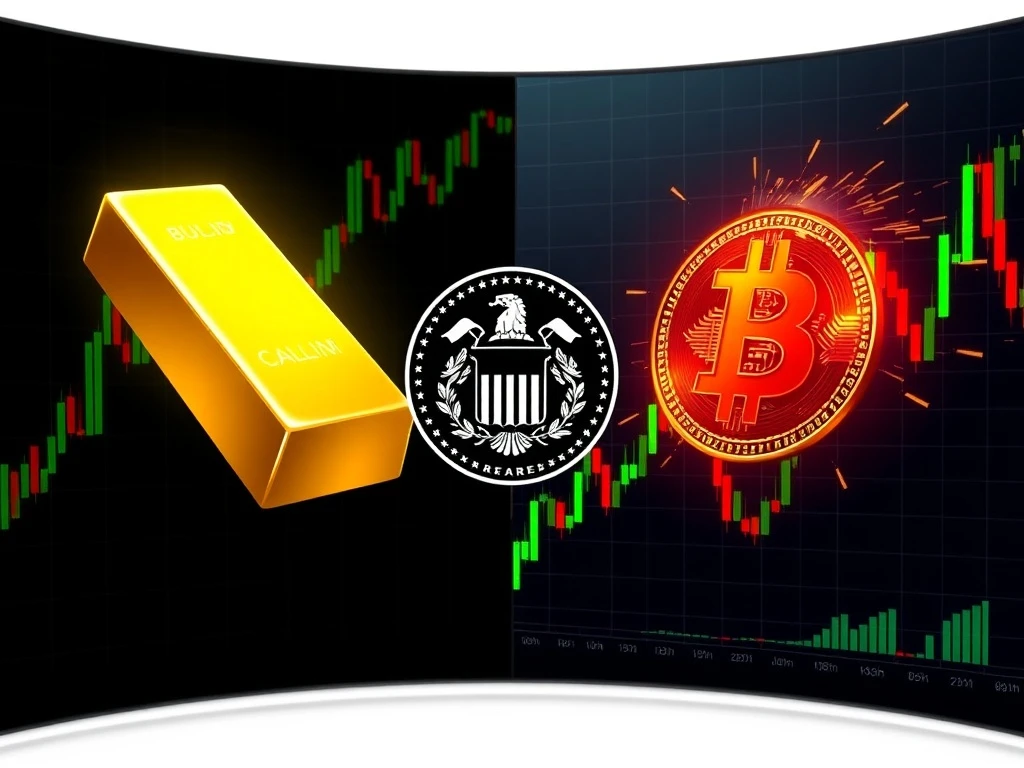
On Wednesday, December 10, 2025, global financial markets witnessed a stark divergence as the price of Bitcoin failed to capitalize on a historic surge in gold, highlighting the complex and evolving relationship between traditional safe-haven assets and digital currencies ahead of a key Federal Reserve policy announcement.
Bitcoin Price Stalls at Critical $90,000 Resistance
Bitcoin’s attempt to decisively break above the psychologically significant $90,000 level proved short-lived during Wednesday’s Wall Street trading session. Data from TradingView illustrated a classic rejection pattern: BTC/USD briefly touched approximately $90,500 before swiftly retreating to the $88,800 region. This price action underscores the persistent selling pressure and liquidity concentration at the upper bounds of Bitcoin’s established trading range, which has largely confined the asset between $86,000 and $93,000 since November 2025. Consequently, traders expressed growing frustration with the asset’s inability to rally alongside other macro-sensitive instruments.
Also read: Bittensor TAO Sell Signal: TD Sequential Flashes Warning After Stunning 160% Surge
Market analysts quickly noted the technical significance of this failure. “The first reaction from the Range Low yielded a +13% move. Thus far, this rebound is +4%,” noted analyst Rekt Capital in a social media post. He further warned that a weaker rebound from support could signal a potential for a broader breakdown over time. This sentiment was echoed by trader EliZ, who observed that liquidity pools are gathering at the range extremes, forcing an eventual decisive move. The market’s current indecision reflects a cautious stance as participants await clearer macroeconomic signals.
Gold’s Meteoric Ascent to $5,300 Per Ounce
In stark contrast to Bitcoin’s stagnation, gold (XAU/USD) achieved a monumental milestone, breaching the $5,300 per ounce barrier during Asian trading hours. This record-setting rally was driven by a potent confluence of factors, primarily escalating geopolitical tensions and a pronounced weakening of the US Dollar. Analysts point to recent military posturing as a key catalyst, reinforcing gold’s centuries-old status as the ultimate safe-haven asset during periods of global uncertainty. Furthermore, the metal’s surge occurred alongside a notable downturn in the US Dollar Index (DXY), which posted its worst annual performance in eight years.
Also read: XRP Whale's $35 Million Gamble Exposes Deep Market Rift
The dollar’s weakness has become a focal point for macro observers. Commentary from The Kobeissi Letter suggested strategic tolerance for a weaker currency at the highest levels of US government, noting its benefits for exports, trade deficits, and nominal GDP growth. This environment of deliberate dollar softness and geopolitical friction created ideal conditions for a gold breakout. The precious metal’s performance traditionally signals deep-seated investor anxiety about currency devaluation and systemic risk, a narrative that has only partially translated to the cryptocurrency sector in this instance.
Expert Analysis on the Divergence
The failure of Bitcoin to mirror gold’s ascent presents a fascinating puzzle for market participants. Several expert perspectives help frame this divergence. Firstly, Bitcoin’s correlation with traditional risk assets like tech stocks has fluctuated over time, and its decoupling from gold may indicate its trading is currently dominated by internal crypto market dynamics, such as ETF flows or on-chain holder behavior, rather than broad macro fear. Secondly, the immediate trigger for gold—geopolitical risk—may be perceived as less impactful for a decentralized digital network, or the market may be awaiting the more definitive catalyst of the Federal Open Market Committee (FOMC) statement and Jerome Powell’s press conference.
Prominent crypto analyst Michaël van de Poppe anticipated “fireworks” from the Fed event, suggesting the real market-moving action was on hold. This waiting game has compressed Bitcoin’s volatility within its multi-week range, a condition that historically precedes significant directional moves. The table below summarizes the key asset performances leading into the FOMC decision:
| Asset | Key Price Level | Performance (Session) | Primary Driver |
|---|---|---|---|
| Gold (XAU/USD) | Record High >$5,300 | Strong Rally | Geopolitics, USD Weakness |
| Bitcoin (BTC/USD) | Rejection at ~$90,500 | Range-Bound/Neutral | Awaiting FOMC, Range Resistance |
| US Dollar Index (DXY) | Multi-Year Lows | Significant Decline | Policy Perception, Export Focus |
| US Equities | Varied by Index | Flat/Subdued | Pre-FOMC Caution |
The Federal Reserve’s Major Role in Market Direction
All eyes are firmly fixed on the Federal Reserve’s concluding FOMC meeting of 2025. While the consensus among economists firmly anticipated no change to the benchmark interest rate, the nuanced language of the policy statement and Chairman Jerome Powell’s subsequent press conference held immense power to sway markets. Investors meticulously parse this communication for clues regarding:
- Future Rate Path: Any shift in the “dot plot” or forward guidance.
- Inflation Outlook: Adjustments to the assessment of price stability progress.
- Balance Sheet Policy: Potential timing for changes to quantitative tightening.
- Economic Risk Assessment: Changes in tone regarding growth or employment.
For Bitcoin and digital assets, the implications are profound. A hawkish tilt, emphasizing persistent inflation concerns, could strengthen the dollar and pressure risk assets, potentially testing Bitcoin’s lower range support. Conversely, a dovish acknowledgment of economic softening or a tolerant view of recent dollar weakness could provide the catalyst for a breakout above $93,000. The flat opening in US equity markets reflected this pervasive state of suspense, with capital awaiting clear direction from the central bank before committing to new positions.
Conclusion
The December 10th market session delivered a clear narrative of divergence: traditional safe-haven gold soared on geopolitical and currency trends, while the Bitcoin price remained captive to a tight trading range, unable to conquer the $90,000 hurdle. This split highlights the ongoing maturation and unique drivers of the cryptocurrency market, which does not always move in lockstep with classical macro plays. The immediate future for both assets, however, converges on a single point: the Federal Reserve’s policy decision. The Fed’s words will determine whether this period of consolidation breaks into a new trend, finally resolving the tension between Bitcoin’s potential as digital gold and its current reality as a risk-sensitive asset awaiting its next major cue. The market’s patience is finite, and the impending volatility promises to redefine short-term trajectories for the US dollar, gold, and the Bitcoin price alike.
FAQs
Q1: Why did Bitcoin’s price not rise when gold hit a record high?
Bitcoin and gold, while sometimes compared, are driven by different investor bases and immediate catalysts. Bitcoin’s price action was dominated by technical resistance at $90,000 and a wait-and-see approach ahead of the FOMC decision, while gold rallied specifically on acute geopolitical tensions and US dollar weakness.
Q2: What is the FOMC and why does it matter for Bitcoin?
The Federal Open Market Committee (FOMC) is the branch of the US Federal Reserve that sets national monetary policy, including interest rates. Its decisions directly influence the US Dollar’s strength, global liquidity, and investor appetite for risk assets like Bitcoin, making its meetings critical market events.
Q3: What was the main reason for gold’s surge to $5,300?
Gold’s record price was primarily fueled by two factors: escalating geopolitical risks that increase demand for safe-haven assets, and a significant decline in the US Dollar’s value, as gold is priced in dollars and becomes cheaper for foreign buyers when the dollar falls.
Q4: What are analysts saying about Bitcoin’s current trading range?
Analysts note Bitcoin has been consolidating between approximately $86,000 and $93,000 for several weeks. They warn that weakening momentum on bounces from the range low could precede a breakdown, while a breakout above $93,000 is needed to confirm a new bullish phase.
Q5: How did the US Dollar perform alongside these moves?
The US Dollar Index (DXY), which measures the dollar against a basket of major currencies, experienced notable weakness, contributing to gold’s rise. Commentary suggests this weakness may be viewed favorably by policymakers for its potential to boost economic exports and growth.

This article was produced with AI assistance and reviewed by our editorial team for accuracy and quality.