Bitcoin Hashrate Plummets: Winter Storm Chaos Reveals Mining’s Critical Grid Role
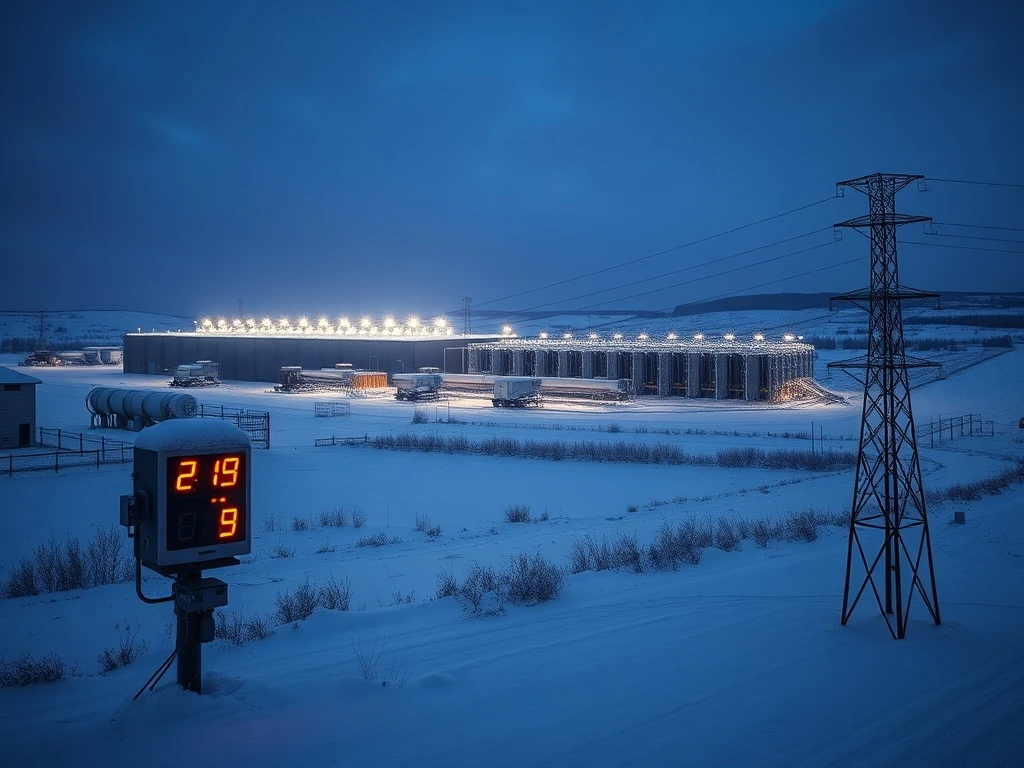
A severe winter storm sweeping across the United States in early 2025 triggered a dramatic and sudden plunge in the Bitcoin network’s global computational power, briefly sending the hashrate tumbling to levels not seen since mid-2025 and starkly illustrating the cryptocurrency mining industry’s deep integration with—and impact on—national energy infrastructure.
Bitcoin Hashrate Crashes Amid Extreme Weather
Data from mining analytics platforms reveals a precipitous drop in Bitcoin’s total hashrate beginning Friday, February 7, 2025. Consequently, by Sunday, February 9, the network’s processing power had collapsed to approximately 663 exahashes per second (EH/s). This figure represents a staggering decline of over 40% within a mere 48-hour window. However, the hashrate demonstrated remarkable resilience, initiating a recovery phase by Monday, February 10, climbing back to around 854 EH/s as conditions eased.
This event marks the lowest point for the Bitcoin hashrate in seven months. The primary catalyst was a massive winter storm system that bombarded the central and eastern United States with heavy snow, ice, and frigid temperatures. AccuWeather reported the storm affected 36 states, leading to widespread power outages impacting nearly one million energy customers. The timing and severity of the weather event directly correlated with the mining network’s steep decline.
US Mining Dominance and Grid Vulnerability
The scale of the hashrate drop directly stems from the United States’ position as the global leader in Bitcoin mining. According to Hashrate Index, the US contributes nearly 38% of the world’s total Bitcoin mining power. A 2024 report from the federal Energy Information Administration identified over 137 active crypto-mining facilities nationwide, with significant concentrations in Texas, New York, and Georgia.
These facilities, often major energy consumers, became focal points for grid operators during the storm. As residential and commercial heating demand surged to record levels, regional power grids faced extreme strain. In response, many Bitcoin mining operations voluntarily curtailed or completely shut down their power-intensive activities. This deliberate action helped prevent rolling blackouts and stabilized voltage frequencies across vulnerable grids.
The Built-In Flexibility of Bitcoin Mining
Industry experts point to this event as a real-world demonstration of Bitcoin mining’s unique demand-response capability. “Approximately 40% of global Bitcoin mining capacity has gone offline in the past 24 hours due to extreme winter weather,” stated a representative from Abundant Mines, a mining firm based in Oregon. “As energy demand surges, some mining operations reduce activity to ease pressure on regional power systems and support critical infrastructure. This flexibility is a built-in strength of Bitcoin mining. It can scale down quickly when needed and resume just as fast when conditions allow.”
This operational model, known as “load balancing,” allows miners to act as a shock absorber for the grid. Miners can rapidly power down during periods of peak demand, freeing up electricity for essential services. Conversely, they can ramp up consumption during periods of excess renewable energy production, such as windy or sunny days, preventing clean energy from being wasted.
Impact on Major Mining Companies and Production
The storm’s impact extended beyond network metrics to the bottom lines of publicly traded mining corporations. Data analyzed by CryptoQuant’s Head of Research, Julio Moreno, showed a sharp decline in daily Bitcoin production for leading US miners during the peak of the weather event.
The following table illustrates the production slowdown for two major firms:
| Mining Company | Typical Daily Production (Approx.) | Production During Storm Peak |
|---|---|---|
| Marathon Digital Holdings | 45 BTC | 7 BTC |
| IREN (formerly Iris Energy) | 18 BTC | 6 BTC |
This production halt, while temporary, highlights the financial volatility and operational risks mining companies face from external factors like climate and grid stability. Their ability to power down, however, is often facilitated by pre-arranged agreements with utility providers, sometimes providing the miners with financial compensation for their flexibility.
Bitcoin Mining as a Grid Stabilization Tool
The 2025 winter storm event provides a compelling case study for the evolving narrative around Bitcoin’s energy use. Proponents argue that mining’s interruptible load is a valuable asset for modern energy grids, especially those integrating higher levels of intermittent renewables like wind and solar.
Daniel Batten, a noted Bitcoin ESG researcher, highlighted the synergy in Texas. In a social media post, he noted that “Bitcoin mining and demand response worked together in Texas to stabilize the grid amid the extreme weather.” Texas, home to a significant portion of US mining hashrate, has a uniquely isolated power grid (ERCOT) that is particularly susceptible to supply-demand imbalances.
The key mechanisms by which Bitcoin mining supports grid stability include:
- Rapid Demand Response: Miners can shut off nearly instantaneously, providing a fast-acting resource for grid operators.
- Location Agnosticism: Mining facilities can be built near stranded or underutilized energy sources, monetizing them.
- Baseload for Renewables: Miners can consume excess renewable generation that would otherwise be curtailed, improving the economics of wind and solar farms.
Conclusion
The brief but severe drop in the global Bitcoin hashrate to mid-2025 levels during the February 2025 US winter storm was more than a statistical anomaly. It was a high-stakes stress test that revealed the profound interconnection between cryptocurrency mining and national energy infrastructure. The event demonstrated the industry’s capacity to act as a flexible, large-scale grid stabilizer, voluntarily reducing operations to prevent broader power failures. As Bitcoin mining continues to grow, its role in energy ecosystems—both as a consumer and a potential stability tool—will remain a critical topic for regulators, energy experts, and the crypto industry alike. The recovery of the hashrate to pre-storm levels within days further underscores the resilient and adaptive nature of the decentralized Bitcoin network.
FAQs
Q1: What is Bitcoin hashrate and why did it drop?
Bitcoin hashrate is the total combined computational power used to process transactions and secure the network. It dropped by over 40% because a major winter storm in the US forced many large-scale mining operations to power down to relieve stress on overburdened regional electricity grids.
Q2: How does Bitcoin mining help stabilize power grids?
Bitcoin mining operations can act as a “flexible load.” They can power down almost instantly during periods of peak electricity demand (like a cold snap), freeing up power for homes and businesses. This rapid response helps grid operators balance supply and demand and prevent blackouts.
Q3: Which US mining companies were most affected?
Publicly traded firms like Marathon Digital Holdings and IREN saw their daily Bitcoin production fall dramatically. For example, Marathon’s output dropped from roughly 45 Bitcoin per day to just 7 during the storm’s peak, as they curtailed operations.
Q4: How important is the United States to global Bitcoin mining?
The US is the world’s largest hub for Bitcoin mining, contributing an estimated 38% of the global hashrate. This dominance is why a widespread US weather event can have such a pronounced impact on the entire network’s total processing power.
Q5: Did the Bitcoin network itself experience problems due to the hashrate drop?
While the hashrate plunge was significant, the Bitcoin network is designed to adjust its mining difficulty automatically. Transaction processing may have slowed slightly, but the network remained secure and operational. The rapid recovery of the hashrate shows the system’s resilience.