US Stocks Close Lower: Market Plunge Rattles Investors as Major Indices Post Significant Declines
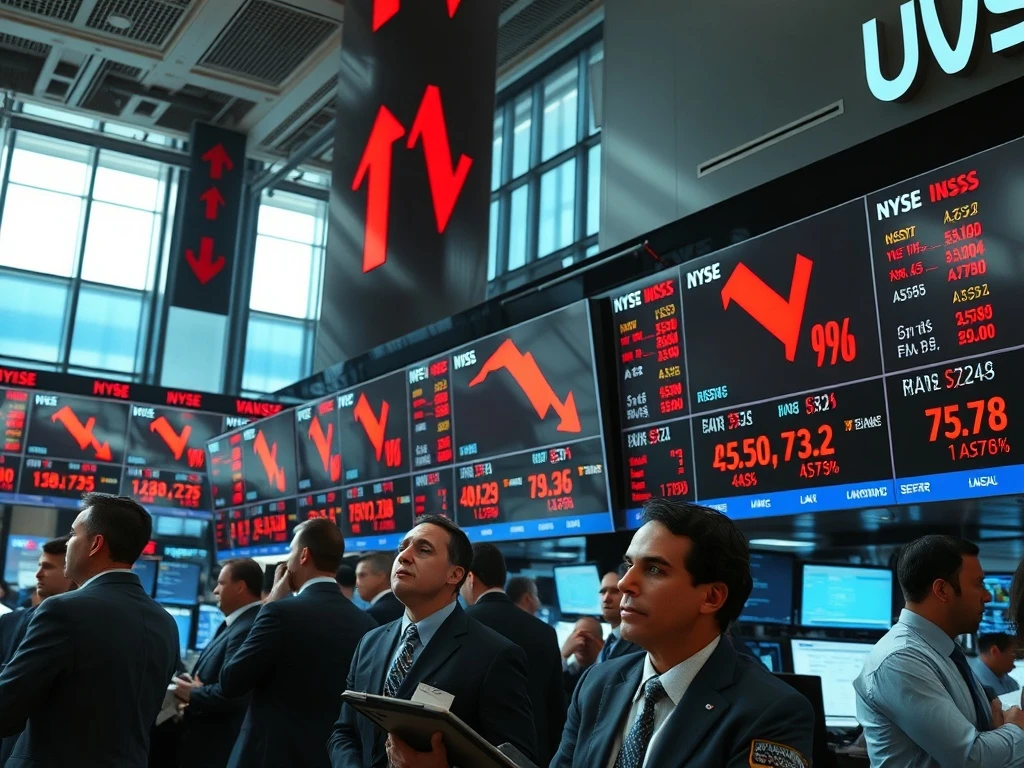
NEW YORK, Tuesday – US stocks closed sharply lower today, sending ripples through global financial markets as all three major indices posted substantial declines during Tuesday’s trading session. The S&P 500 dropped 2.06%, the Nasdaq Composite fell 2.39%, and the Dow Jones Industrial Average declined 1.76%, marking one of the most significant single-day pullbacks in recent weeks. This market movement reflects growing investor concerns about economic indicators and monetary policy directions.
US Stocks Close Lower: Analyzing Tuesday’s Market Decline
Tuesday’s trading session delivered a clear message to investors: volatility remains a dominant market force. The S&P 500’s 2.06% decline represents its largest single-day drop since early February, while the technology-heavy Nasdaq Composite’s 2.39% fall highlights particular pressure on growth stocks. Meanwhile, the Dow Jones Industrial Average’s 1.76% decrease demonstrates broad-based selling across traditional industrial sectors. Market analysts immediately began examining the underlying causes behind these simultaneous declines across major indices.
Several factors contributed to today’s market downturn. First, renewed inflation concerns emerged following morning economic data releases. Second, Federal Reserve commentary suggested continued monetary policy tightening. Third, corporate earnings reports from key sectors showed mixed results. Fourth, geopolitical tensions in multiple regions created uncertainty. Finally, technical indicators pointed to overbought conditions preceding today’s sell-off. These combined elements created a perfect storm for equity markets.
Market Context and Historical Comparisons
Today’s market decline occurs within a specific historical context. The S&P 500 had gained approximately 8% year-to-date before today’s session, while the Nasdaq Composite had risen nearly 10% during the same period. This recent strength made markets particularly vulnerable to profit-taking. Historically, similar single-day declines have occurred 15 times in the past five years, with markets typically recovering within two to three weeks following such corrections.
Comparative analysis reveals interesting patterns. Today’s 2.06% S&P 500 decline ranks as the 12th largest single-day drop since 2020. The technology sector underperformed the broader market significantly, continuing a trend observed throughout recent quarters. Defensive sectors like utilities and consumer staples showed relative resilience, declining only 0.8% and 1.2% respectively. This sector rotation suggests investors are repositioning portfolios rather than exiting markets entirely.
Expert Analysis and Market Perspectives
Financial experts offer varied interpretations of today’s market movement. “Today’s decline reflects normal market digestion of recent gains,” explains Dr. Sarah Chen, Chief Market Strategist at Global Financial Insights. “We’ve seen eight consecutive weeks of inflows into equity funds, creating technical conditions ripe for correction.” Chen emphasizes that fundamental economic indicators remain largely unchanged from last week.
Meanwhile, Michael Rodriguez, Senior Portfolio Manager at Horizon Investments, highlights specific concerns. “The market is reassessing inflation expectations following this morning’s producer price index data,” Rodriguez states. “While the Federal Reserve has signaled patience, markets are pricing in potential policy adjustments.” Rodriguez notes that trading volume surged 40% above the 30-day average during today’s session, indicating institutional participation in the sell-off.
Sector Performance and Technical Breakdown
Today’s market decline displayed distinct sector variations. Technology stocks led the downturn with the Nasdaq-100 index falling 2.6%. Semiconductor companies particularly struggled, with the Philadelphia Semiconductor Index dropping 3.1%. Communication services and consumer discretionary sectors also underperformed, declining 2.4% and 2.3% respectively. Conversely, energy stocks gained 0.8% as oil prices rose, while healthcare and utilities showed relative stability.
Technical analysis reveals important support and resistance levels. The S&P 500 closed below its 50-day moving average for the first time in six weeks, a potentially significant technical development. Trading volume patterns indicate distribution rather than accumulation, with declining stocks outnumbering advancing stocks by approximately 4-to-1 on the New York Stock Exchange. Market breadth measurements confirm broad participation in today’s sell-off across market capitalizations.
Economic Indicators and Monetary Policy Context
Today’s market movement coincides with important economic developments. The Bureau of Labor Statistics released producer price index data showing a 0.3% month-over-month increase, slightly above consensus estimates. Meanwhile, retail sales data indicated moderate consumer spending growth of 0.2% for the previous month. Federal Reserve officials have maintained their data-dependent approach to monetary policy, with recent commentary emphasizing patience regarding interest rate adjustments.
Global economic factors also influenced today’s trading. European markets closed lower ahead of tomorrow’s European Central Bank policy decision. Asian markets showed mixed performance overnight, with Japanese indices declining while Chinese markets posted modest gains. Currency markets saw the US dollar strengthen against major counterparts, creating additional pressure on multinational corporations’ earnings expectations. Bond yields fluctuated throughout the session, with the 10-year Treasury yield settling at 4.32%.
Investor Implications and Market Outlook
Today’s market decline carries important implications for various investor categories. Short-term traders face increased volatility and potential margin requirements adjustments. Long-term investors confront portfolio rebalancing decisions amid changing sector leadership. Retirement account holders may see temporary valuation decreases in equity allocations. Institutional investors are reassessing risk exposures and hedging strategies following today’s price action.
Market professionals emphasize perspective when evaluating single-day movements. “One trading session doesn’t define a market trend,” notes financial historian Robert Williams. “Historical data shows that markets experience an average of four 2%+ declines annually, yet still produce positive returns in approximately 70% of calendar years.” Williams recommends focusing on fundamental economic indicators rather than daily price fluctuations when making long-term investment decisions.
Conclusion
US stocks closed lower today in a broad-based market decline affecting all major indices. The S&P 500, Nasdaq Composite, and Dow Jones Industrial Average posted significant losses during Tuesday’s trading session, reflecting investor reassessment of economic conditions and policy expectations. While single-day movements capture attention, market professionals emphasize the importance of maintaining perspective amid normal market volatility. Today’s price action underscores the ongoing interplay between economic data, monetary policy, and investor psychology that continues to shape financial market outcomes.
FAQs
Q1: What caused US stocks to close lower today?
Multiple factors contributed including inflation concerns, Federal Reserve policy expectations, mixed corporate earnings, geopolitical tensions, and technical market conditions following recent gains.
Q2: How significant was today’s market decline compared to historical averages?
Today’s 2.06% S&P 500 decline ranks as the 12th largest single-day drop since 2020. Markets typically experience four 2%+ declines annually based on historical averages.
Q3: Which sectors performed worst during today’s trading session?
Technology stocks led the decline with semiconductors particularly weak. Communication services and consumer discretionary sectors also significantly underperformed the broader market.
Q4: Did today’s decline affect all companies equally?
No, significant variation occurred across sectors. Energy stocks actually gained 0.8% while healthcare and utilities showed relative stability compared to technology and growth stocks.
Q5: What should investors do following today’s market movement?
Financial professionals generally recommend maintaining long-term perspectives, avoiding emotional decisions, reviewing portfolio allocations, and focusing on fundamental economic indicators rather than single-day price movements.