Trump’s Bold Prediction: US Stock Market Could Double by End of Presidential Term
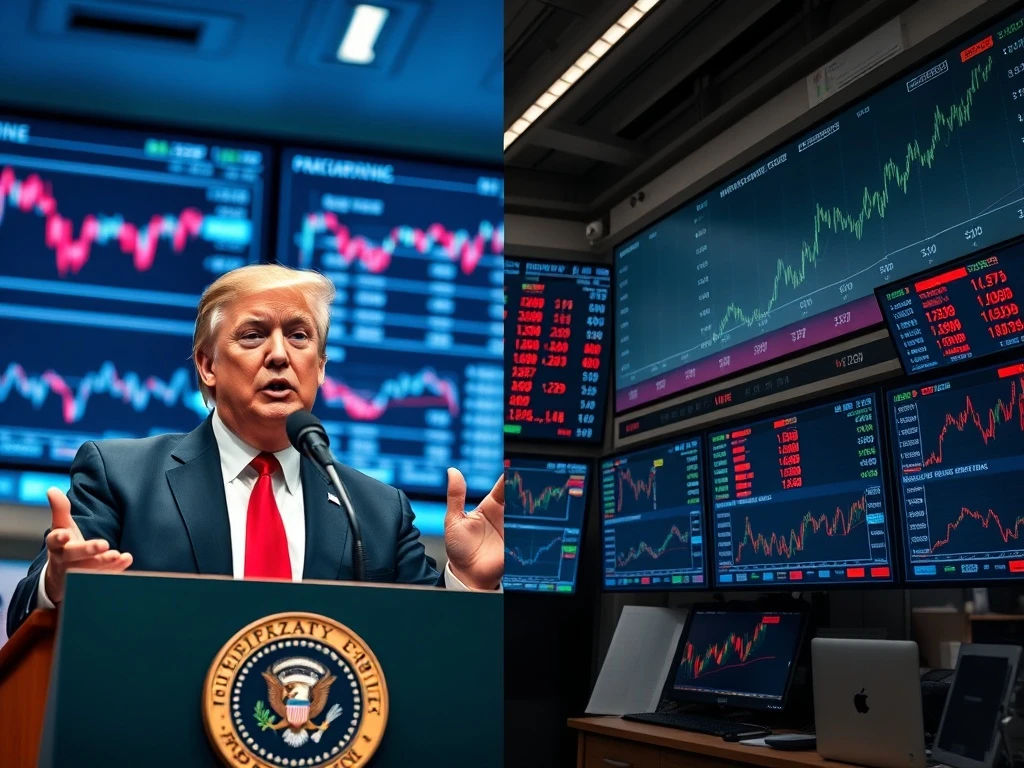
WASHINGTON, D.C. – November 2025 – President Donald Trump recently made a striking financial forecast that captured immediate attention across global markets. During a White House economic briefing, the President predicted the U.S. stock market would double from current levels by the conclusion of his presidential term. This ambitious projection arrives during a period of significant economic transition and prompts serious analysis from financial experts worldwide.
Trump’s Stock Market Prediction: Context and Implications
President Trump delivered his market doubling prediction during discussions about America’s economic trajectory. The statement immediately reverberated through financial circles, generating both enthusiasm and skepticism. Historical data reveals that such aggressive growth targets remain exceptionally rare for mature economies like the United States. Market analysts quickly began calculating the necessary conditions for this forecast to materialize.
Also read: Operation Atlantic: Global Law Enforcement Shatters $45M Crypto Fraud Ring
Financial experts note that a doubling of major indices like the S&P 500 or Dow Jones Industrial Average would require historic sustained growth. Specifically, the market would need to achieve compound annual growth rates exceeding 15-20% over the remaining presidential term. For comparison, the historical average annual return for the S&P 500 stands at approximately 10% before inflation adjustment.
Historical Presidential Market Performance Analysis
Historical context provides essential perspective for evaluating presidential market predictions. Previous administrations have witnessed varying market performances that rarely approach doubling scenarios. The table below illustrates notable presidential term market performances:
Also read: Spartans.com Shatters Norms with $7 Million Leaderboard Launch, Rewriting Online Gambling Rules
| President | Term | S&P 500 Performance | Key Economic Conditions |
|---|---|---|---|
| Bill Clinton | 1993-2001 | +210% | Tech boom, budget surplus |
| Barack Obama | 2009-2017 | +166% | Post-crisis recovery, QE |
| Donald Trump | 2017-2021 | +70% | Tax cuts, pre-pandemic growth |
| Joe Biden | 2021-2025 | +28% | Post-pandemic recovery, inflation |
Only President Clinton’s two terms approached the doubling threshold President Trump now predicts for a single term. However, that exceptional period coincided with unique technological revolutions and favorable global conditions. Current economic circumstances present different challenges and opportunities that analysts must carefully consider.
Economic Factors Supporting Market Growth
Several economic developments could potentially support substantial market appreciation. The Federal Reserve’s monetary policy trajectory significantly influences equity valuations. Additionally, corporate earnings growth remains a fundamental driver of stock prices. Technological innovation, particularly in artificial intelligence and renewable energy, continues creating new market opportunities.
Demographic trends also play key roles in market performance. The millennial generation’s peak earning years coincide with this forecast period. Their investment behaviors could substantially impact market dynamics. Furthermore, global capital flows increasingly favor U.S. markets as safe havens during geopolitical uncertainty.
Expert Perspectives on Market Doubling Scenarios
Financial analysts and economists have responded to President Trump’s prediction with measured analysis. Most experts acknowledge the theoretical possibility while emphasizing the challenging requirements. Dr. Evelyn Chen, Chief Economist at Stanford Financial Institute, notes: “While mathematically possible, market doubling within a presidential term requires nearly perfect economic alignment.”
Key considerations from financial experts include:
- Earnings Growth Requirements: Corporate profits would need to expand dramatically
- Valuation Multiple Expansion: Price-to-earnings ratios might reach historical extremes
- Interest Rate Environment: Sustained low rates typically support higher valuations
- Geopolitical Stability: Reduced global tensions enable risk appetite
- Technological Breakthroughs: Major innovations often drive market surges
Market strategists emphasize that such aggressive growth typically follows significant market corrections or economic crises. The current economic expansion already represents one of the longest in history. This context makes uninterrupted acceleration particularly challenging according to historical patterns.
Potential Market Catalysts and Headwinds
Several specific developments could influence whether President Trump’s prediction proves accurate. Legislative initiatives affecting corporate taxation and regulation directly impact market valuations. Trade policy developments with major partners like China and the European Union significantly affect multinational corporations. Additionally, energy policy decisions influence both production costs and sector performance.
Potential headwinds requiring navigation include:
- Federal debt levels and financing costs
- Demographic shifts affecting labor markets
- Climate policy transitions and adaptation costs
- Technological disruption across traditional industries
- Global economic synchronization or divergence
Market technicians also monitor technical indicators that might support or contradict the doubling prediction. Trading volume patterns, market breadth measurements, and volatility indices all provide important signals. Currently, most indicators suggest cautious optimism rather than explosive growth expectations.
Investor Implications and Portfolio Considerations
Individual and institutional investors must carefully evaluate how such predictions affect their strategies. While presidential forecasts capture attention, prudent investment decisions rely on fundamental analysis. Diversification across asset classes, sectors, and geographies remains essential regardless of political predictions.
Financial advisors generally recommend against making dramatic portfolio changes based on political forecasts. Instead, they suggest maintaining disciplined investment approaches aligned with long-term goals. Regular portfolio rebalancing ensures investors systematically buy low and sell high rather than chasing predictions.
Retirement investors particularly should maintain perspective about market predictions. Time horizons extending beyond presidential terms reduce the significance of any single period’s performance. Dollar-cost averaging into diversified portfolios historically produces favorable outcomes regardless of political cycles.
Conclusion
President Trump’s prediction that the U.S. stock market will double by the end of his term represents an ambitious economic forecast. While historical precedents exist for exceptional market performance, the specific conditions required remain demanding. Financial experts continue analyzing the economic policies, global developments, and market dynamics that might enable such growth. Investors should monitor these developments while maintaining disciplined, long-term investment strategies regardless of political predictions about stock market performance.
FAQs
Q1: Has any U.S. president previously seen the stock market double during their term?
Yes, President Bill Clinton witnessed the S&P 500 increase approximately 210% during his two terms (1993-2001), though this occurred over eight years rather than a single term. No modern president has seen markets double within a single four-year term.
Q2: What annual growth rate would the market need to achieve for President Trump’s prediction to come true?
The stock market would need to achieve compound annual growth between 15-20% depending on the exact starting point and time remaining in the term. This compares to the historical average of approximately 10% annually.
Q3: How do presidential predictions typically affect actual market performance?
Historical analysis shows minimal correlation between presidential market predictions and actual performance. Markets respond primarily to economic fundamentals, corporate earnings, monetary policy, and global developments rather than political forecasts.
Q4: Which economic sectors would likely benefit most if markets doubled?
Technology, financials, and consumer discretionary sectors typically lead during strong bull markets. However, sector rotation patterns mean leadership often changes throughout extended market advances.
Q5: How should individual investors respond to such market predictions?
Financial advisors recommend maintaining diversified portfolios aligned with long-term goals rather than reacting to political predictions. Disciplined investment approaches historically outperform attempts to time markets based on forecasts.

This article was produced with AI assistance and reviewed by our editorial team for accuracy and quality.