Stablecoin Interest Payments Spark Fiery Clash Between Coinbase CEO and Top Central Banker at Davos
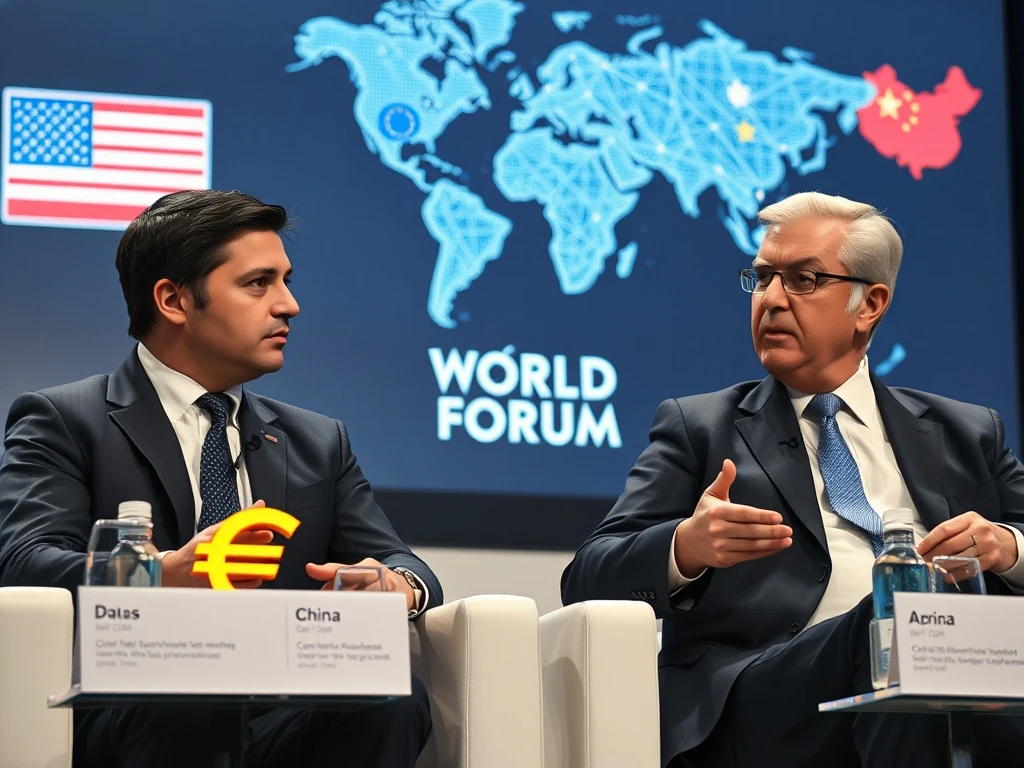
DAVOS, SWITZERLAND – A fundamental clash over the future of money erupted at the World Economic Forum this week, pitting cryptocurrency innovation directly against traditional financial guardianship. The core debate centered on a single, powerful question: should stablecoin interest payments be permitted? On one side, Coinbase CEO Brian Armstrong championed user rights and national competitiveness. Conversely, Bank of France Governor François Villeroy de Galhau issued a stark warning about risks to banking stability and monetary sovereignty. This confrontation, reported by CoinDesk, exposes the deepening fault lines in global finance as digital assets mature.
The Davos Debate on Stablecoin Interest Payments
The panel discussion provided a rare, high-stakes arena for these conflicting ideologies. Brian Armstrong, leading one of the world’s largest cryptocurrency exchanges, presented a pragmatic and competitive argument. He asserted that users possess a fundamental right to earn a return on their capital, whether held in traditional bank accounts or digital wallets. Armstrong then framed the issue in geopolitical terms. He pointed to China’s digital yuan, which reportedly allows for interest-bearing features, as a concrete example. “A U.S. ban on such payments,” he implied, would not stifle innovation but merely cede ground to international competitors. His argument hinges on the belief that financial technology, like any other sector, thrives through competition and consumer choice.
Governor Villeroy de Galhau’s rebuttal came from the bedrock principle of central banking: financial stability. He expressed clear opposition to private digital tokens offering interest. His concern is systemic. Traditional banks rely on deposits to fund lending; a mass migration of deposits to high-yielding, private stablecoins could undermine this crucial mechanism. For the digital euro, a project he helps steer, Villeroy de Galhau stated interest payments should not be a feature. The primary objective, he stressed, must remain preserving the stability of the financial system, not maximizing returns for holders of a public digital currency.
Beyond Stablecoins: The Bitcoin Disagreement
The divergence extended beyond stablecoins to the very philosophy of money. Armstrong highlighted Bitcoin’s unique value proposition: its independence. He described it as an asset class without a central issuer, making it inherently resistant to control by any single entity, including governments. This, for proponents, is its core strength. Governor Villeroy de Galhau viewed this same characteristic through a lens of risk. He cautioned that widespread adoption of unregulated private currencies, including certain stablecoins, could evolve into a political threat. The potential consequence, he argued, is a gradual erosion of national monetary sovereignty—the ability of a state to control its own currency and monetary policy.
Global Context: The Race for Digital Currency Supremacy
This Davos debate is not an isolated academic discussion. It reflects a tangible, global race involving three distinct models of digital value:
- Central Bank Digital Currencies (CBDCs): Sovereign, digital forms of fiat currency. Over 130 countries, representing 98% of global GDP, are exploring them. The digital euro and digital yuan are flagship projects.
- Private Stablecoins: Cryptocurrencies pegged to assets like the US dollar. They aim to combine crypto’s efficiency with price stability. Examples include USD Coin (USDC) and Tether (USDT).
- Decentralized Cryptocurrencies: Assets like Bitcoin and Ethereum, which operate on public blockchains without central control.
The table below summarizes the key philosophical differences highlighted in the Davos clash:
| Area of Debate | Brian Armstrong (Coinbase) | François Villeroy de Galhau (Bank of France) |
|---|---|---|
| Stablecoin Interest | Necessary for user rights and global competitiveness. | Risky for traditional banking stability. |
| Primary Objective | Innovation and consumer choice in finance. | Preservation of financial and monetary stability. |
| View on Bitcoin | An independent, non-sovereign store of value. | A potential threat to monetary sovereignty. |
| Geopolitical Lens | Focus on competing with China’s digital yuan. | Focus on protecting the European financial system. |
Expert Analysis and Regulatory Implications
Financial technology analysts see this debate as a critical inflection point. “The question of interest on stablecoins cuts to the heart of whether they are mere payment tools or full-scale financial instruments,” notes Dr. Lena Schmidt, a fintech policy researcher at the European University Institute. “Regulators must decide if they are managing a new type of bank account or a digital cash equivalent.” The European Union’s Markets in Crypto-Assets (MiCA) regulation, set for full implementation, already imposes strict requirements on stablecoin issuers, including robust reserve backing. However, the interest-bearing question remains a grey area globally.
In the United States, legislative efforts like the Lummis-Gillibrand bill have proposed frameworks that could allow for regulated, interest-bearing stablecoins under stringent bank-like oversight. The Davos clash directly informs this ongoing policy struggle. Armstrong’s argument aligns with a pro-innovation regulatory approach, fearing overreach will push development offshore. Villeroy de Galhau’s stance reflects a more cautious, stability-first posture prevalent among many major central banks, including the U.S. Federal Reserve, which has expressed similar reservations.
The Path Forward: Coexistence or Conflict?
The future likely hinges on finding a balance. Potential models include:
- Tiered Systems: CBDCs for everyday transactions without interest, and regulated, licensed private stablecoins for savings and yield-bearing services.
- Hard Caps: Limiting the total value of interest-bearing private stablecoins to mitigate systemic risk to banks.
- Technical Integration: Using blockchain technology to improve traditional banking and payment systems, reducing the incentive for mass deposit flight.
The rapid evolution of technology continues to pressure policymakers. The dialogue at Davos, while contentious, is a necessary part of shaping a coherent global financial architecture for the digital age. The decisions made in the coming 24 months will significantly influence whether these systems evolve in conflict or through careful coexistence.
Conclusion
The debate between Coinbase’s Brian Armstrong and the Bank of France’s François Villeroy de Galhau over stablecoin interest payments encapsulates a defining struggle for 21st-century finance. It is a conflict between the disruptive force of consumer-centric innovation and the protective mandate of financial stability. As nations like China advance their digital currency projects, Western regulators and innovators face a complex dilemma. The outcome will determine not only the profitability of crypto enterprises but also the fundamental structure of how people save, spend, and trust money in an increasingly digital world. The Davos discussion proves that the journey toward resolving these tensions is only just beginning.
FAQs
Q1: What are stablecoin interest payments?
Stablecoin interest payments are yields or returns paid to users for holding or staking certain stablecoins. Similar to interest from a savings account, these payments are typically generated by the issuer lending out or investing the reserve assets backing the stablecoin.
Q2: Why does the Bank of France oppose stablecoin interest?
The Bank of France, like many central banks, fears that if private stablecoins offer attractive interest rates, they could draw significant deposits away from traditional banks. This could weaken banks’ ability to lend to the economy, potentially destabilizing the entire financial system.
Q3: What did Brian Armstrong say about China’s digital yuan?
Armstrong cited China’s digital yuan (e-CNY) as a key example of a central bank digital currency that can pay interest. He used this to argue that if the U.S. bans interest on digital dollars, it will fall behind in financial technology innovation and global competitiveness.
Q4: What is monetary sovereignty, and why is it at risk?
Monetary sovereignty is a nation’s power to control its own currency and monetary policy (like interest rates). Central bankers like Villeroy de Galhau worry that if private, global stablecoins become widely used, they could diminish the effectiveness of national monetary policy and reduce state control over the money supply.
Q5: Are any stablecoins currently paying interest?
Yes, prior to increased regulatory scrutiny in 2023-2024, several platforms offered interest-bearing accounts for stablecoins like USDC. However, many of these services, particularly in the U.S., have been scaled back or paused due to regulatory actions from bodies like the Securities and Exchange Commission.