Spot Gold Shatters Records with Staggering $5,000 All-Time High
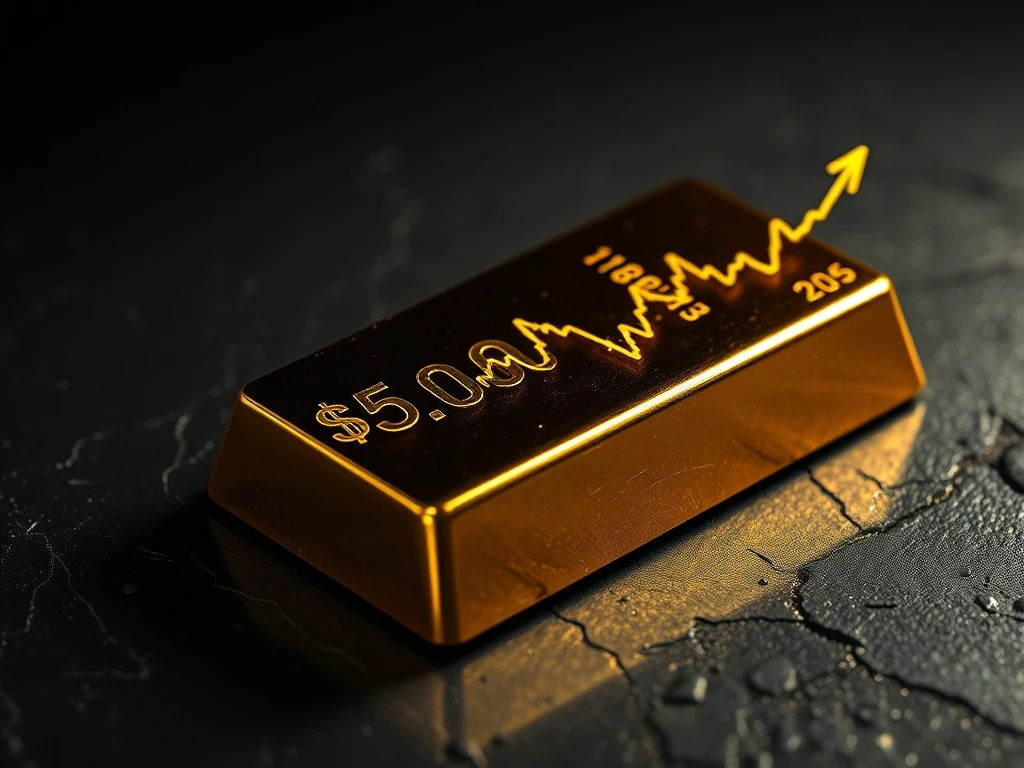
London, April 2025: The global financial markets witnessed a historic moment today as the spot price of gold surged past the once-unthinkable $5,000 per ounce barrier, setting a definitive new all-time high. Trading at $5,012.11, the precious metal has gained approximately $700, or over 16%, since the start of the year, cementing a powerful and sustained bull run that has captivated investors and analysts worldwide.
Spot Gold Achieves a Monumental $5,000 Milestone
The $5,000 per ounce mark represents more than a numerical milestone; it is a psychological and economic watershed. For decades, gold has served as the ultimate store of value, but its ascent to this level reflects a confluence of profound macroeconomic forces. The move today, a 0.52% gain from the previous session, continues a trend of remarkable resilience. Market data shows consistent buying pressure across both physical bullion markets and major futures exchanges like COMEX, indicating broad-based demand from diverse investor classes. This price action decisively breaks the previous record set in late 2024, establishing a new technical and fundamental baseline for the asset.
Analyzing the Powerful Drivers Behind Gold’s Surge
Several interconnected factors have propelled gold to its current heights. Primarily, persistent global inflationary pressures have eroded the purchasing power of fiat currencies, driving capital toward tangible assets. Central banks, particularly in emerging economies, have been net buyers of gold for over a decade, diversifying reserves away from the US dollar. This institutional demand provides a solid floor for prices.
- Geopolitical Uncertainty: Ongoing conflicts and trade tensions have amplified safe-haven demand.
- Monetary Policy Shifts: Expectations of interest rate cuts by major central banks reduce the opportunity cost of holding non-yielding gold.
- Currency Devaluation Concerns: Record levels of sovereign debt have led to fears of currency debasement, bolstering gold’s appeal.
- Retail Investment Inflows: Products like gold-backed ETFs (Exchange-Traded Funds) have seen substantial net inflows year-to-date.
The Historical Context: From Bretton Woods to $5,000
To appreciate the magnitude of this move, one must consider gold’s long-term trajectory. After the collapse of the Bretton Woods system in 1971, which severed the US dollar’s direct convertibility to gold, the metal began trading freely. It took until 1980 to first breach $800, a level it then failed to reclaim for nearly three decades. The 2008 financial crisis marked a paradigm shift, launching a bull market that saw gold reach $1,900 in 2011. The consolidation period that followed tested investor patience, but the breakout above $2,000 in 2020 proved to be a precursor to the current explosive phase. The journey from $4,000 to $5,000 has been among the fastest major climbs in its financial history.
Market Implications and Sector-Wide Consequences
The repercussions of a $5,000 gold price ripple across the global economy. For mining companies, profit margins have expanded dramatically, likely leading to increased capital expenditure, exploration, and potential mergers and acquisitions. However, they also face rising operational costs and heightened scrutiny over environmental, social, and governance (ESG) practices.
| Market Segment | Primary Impact |
|---|---|
| Central Banks | Re-evaluation of reserve asset allocation; potential acceleration of buying programs. |
| Jewelry Demand | Likely softening in key markets like India and China due to high prices, offset by luxury segment resilience. |
| Technology & Industrial | Increased input costs for electronics and medical devices, spurring research into substitution materials. |
| Currency Markets | Increased inverse correlation strength between gold and the US Dollar Index (DXY). |
Furthermore, the high price incentivizes recycling activity, bringing more scrap gold to market. For portfolio managers, gold’s low correlation to equities and bonds enhances its role as a critical diversifier, especially during periods of equity market volatility.
Expert Perspectives on Sustainability and Future Trajectory
Market analysts are divided on the near-term path. Some technical analysts point to overbought conditions and the potential for a sharp correction as speculative positions become crowded. Conversely, fundamental strategists argue that the macroeconomic drivers—especially fiscal deficits and geopolitical fragmentation—are long-term structural trends, not transient cycles. They suggest that while volatility is inevitable, the broader uptrend may remain intact. The key watchpoint, according to many, is real interest rates (nominal rates minus inflation). As long as these remain low or negative in major economies, the environment remains supportive for gold.
Conclusion
The breach of $5,000 for spot gold is a landmark event with deep significance for global finance. It is not an isolated price spike but the culmination of sustained macroeconomic shifts, institutional strategy, and investor sentiment seeking stability. This new all-time high validates gold’s enduring role as a monetary asset in an era of digital transformation and uncertainty. Whether it consolidates or continues its ascent, the $5,000 level now serves as a critical reference point for assessing risk, inflation expectations, and the evolving international monetary landscape for the foreseeable future.
FAQs
Q1: What does “spot gold” price mean?
The spot price is the current market price at which gold can be bought or sold for immediate delivery and payment. It is the benchmark price for physical bullion and derivatives, constantly fluctuating during market hours.
Q2: How does the current gold rally compare to previous ones?
This rally is notable for its breadth of participation. While the 2008-2011 surge was largely driven by retail and institutional investment post-crisis, the current move is significantly supported by sustained central bank buying and a longer-term macroeconomic narrative around debt and de-dollarization.
Q3: Does a high gold price mean a recession is coming?
Not necessarily. While gold often performs well during recessions as a safe haven, it can also rise during periods of high inflation, currency weakness, or geopolitical stress without an accompanying recession. Its current strength is attributed to a mix of these factors.
Q4: What are the main ways for an individual to invest in gold?
Common methods include purchasing physical bullion (bars, coins), shares of gold mining companies, gold-focused Exchange-Traded Funds (ETFs), and gold futures or options contracts on commodities exchanges.
Q5: How does a strong US Dollar typically affect the gold price?
There is typically an inverse relationship. Since gold is dollar-denominated, a stronger dollar makes gold more expensive for holders of other currencies, which can dampen demand and pressure the price. However, this relationship can break down when both are sought as safe havens simultaneously.