South Korea Crypto Regulation: Critical Ownership Caps Spark Exchange Governance Battle
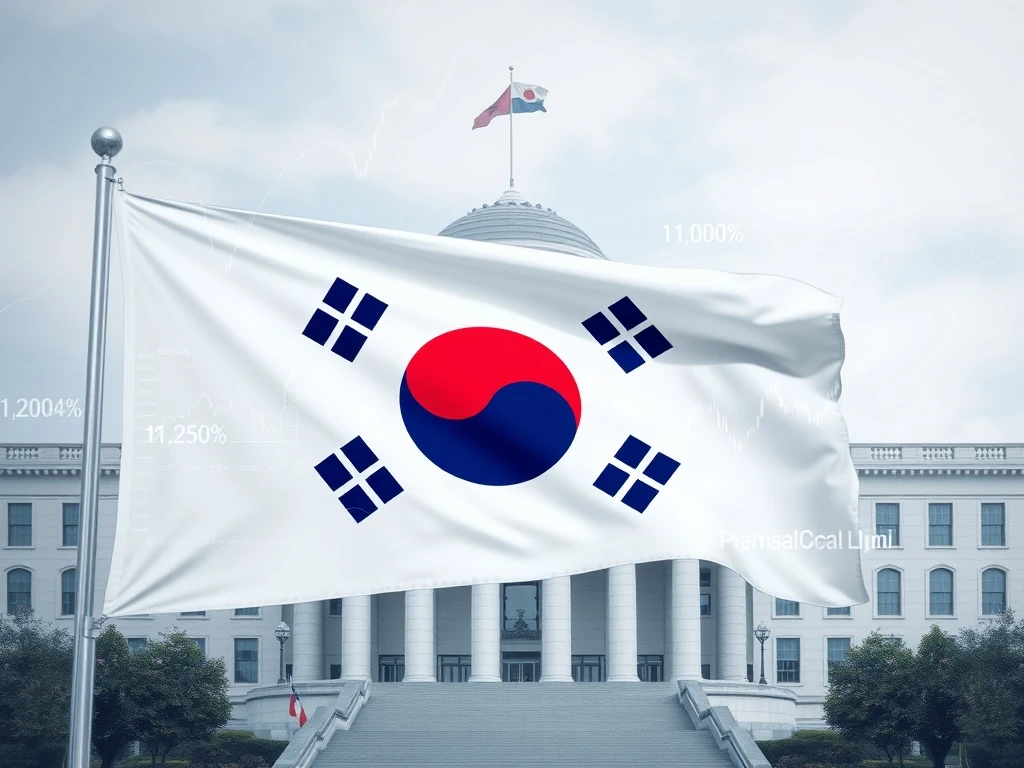
SEOUL, South Korea – February 2025: South Korea’s top financial regulator has taken a definitive stance on cryptocurrency exchange governance, advocating for strict ownership limits that could reshape the country’s digital asset landscape. Financial Services Commission Chair Lee Eog-weon’s public endorsement of 15-20% ownership caps represents a pivotal moment in the ongoing Digital Asset Basic Act negotiations, potentially forcing major exchanges to restructure their ownership frameworks.
South Korea Crypto Regulation Enters Critical Phase
The Financial Services Commission has transformed cryptocurrency exchange governance from theoretical discussion to imminent policy reality. Consequently, Chair Lee Eog-weon’s recent statements mark the clearest regulatory position yet on ownership concentration concerns. Specifically, the FSC now treats licensed crypto exchanges as public infrastructure rather than ordinary private companies. This philosophical shift carries profound implications for market structure and investor protection standards.
Also read: Bittensor TAO Sell Signal: TD Sequential Flashes Warning After Stunning 160% Surge
Meanwhile, the proposed ownership caps align with existing securities market regulations. For instance, Korea’s financial regulations already limit ownership in traditional securities exchanges to prevent market manipulation. Therefore, applying similar frameworks to cryptocurrency platforms represents regulatory consistency rather than innovation. However, exchange operators argue digital assets require different governance approaches than traditional financial markets.
Digital Asset Basic Act Timeline and Implications
Lawmakers face a mid-February deadline to finalize the Digital Asset Basic Act before the Lunar New Year holiday. The legislation has experienced multiple delays since its initial proposal, primarily due to stablecoin oversight disagreements. Currently, negotiators have resolved several contentious issues while ownership caps remain the primary sticking point.
Also read: XRP Whale's $35 Million Gamble Exposes Deep Market Rift
Legislative Progress and Remaining Hurdles
The National Assembly’s policy coordination document outlines several key provisions beyond ownership limits. First, stablecoin issuers must maintain minimum capital requirements of 5 billion won ($3.7 million). Second, cryptocurrency exchanges would transition from three-year notification renewals to permanent authorization status. Third, suitability reviews would assess exchange operators’ financial stability and compliance records.
Additionally, the legislation addresses market integrity concerns through several mechanisms:
- Transparency requirements for exchange operations and fee structures
- Customer protection measures including segregated funds and insurance mechanisms
- Market surveillance systems to detect manipulation and abnormal trading patterns
- Cybersecurity standards aligned with financial institution requirements
Exchange Ownership Structures Under Scrutiny
Major South Korean exchanges currently maintain concentrated ownership patterns that would violate proposed caps. Dunamu, operator of Upbit, shows Chair Song Chi-hyung and related parties controlling over 28% of shares. Similarly, Coinone founder Cha Myung-hoon maintains a 53% majority stake. These ownership concentrations raise regulatory concerns about potential conflicts of interest and market fairness.
Exchange operators present several counterarguments against ownership limits. Primarily, they claim caps could hinder capital raising and strategic partnerships. Furthermore, they argue existing shareholders have demonstrated commitment through market volatility periods. However, regulators emphasize that diversified ownership promotes better governance and reduces single-point failure risks.
| Exchange | Current Ownership Concentration | Proposed Maximum | Required Change |
|---|---|---|---|
| Upbit (Dunamu) | 28%+ by chair and related parties | 15-20% | 8-13% reduction needed |
| Coinone | 53% by founder | 15-20% | 33-38% reduction needed |
| Bithumb | Various ownership structures | 15-20% | Case-by-case assessment |
Global Regulatory Context and Comparisons
South Korea’s approach reflects broader international regulatory trends while maintaining distinctive national characteristics. Japan implemented similar exchange licensing requirements following the 2018 Coincheck hack. Meanwhile, Singapore’s Payment Services Act establishes ownership suitability reviews without specific percentage caps. The European Union’s Markets in Crypto-Assets Regulation emphasizes governance standards rather than ownership limits.
Notably, South Korea’s proposal exceeds many international standards in specificity. The 15-20% range provides clear compliance targets rather than subjective assessments. This precision reduces regulatory uncertainty but increases implementation challenges for existing exchanges. Consequently, industry representatives seek transition periods and grandfathering provisions for current ownership structures.
Economic and Market Impact Analysis
Ownership caps could affect exchange valuations and investment attractiveness. Some analysts suggest diversified ownership might increase institutional investor interest. Conversely, forced divestment could create temporary market disruptions. The legislation’s stablecoin provisions also merit attention, as the $3.7 million capital requirement establishes significant entry barriers for smaller issuers.
Market participants should monitor several developing aspects. First, implementation timelines will determine compliance pressures. Second, enforcement mechanisms require clarification. Third, international exchange operations might face different standards than domestic platforms. Finally, the legislation’s interaction with existing financial regulations needs explicit definition.
Political Dynamics and Legislative Process
The ruling Democratic Party leads Digital Asset Basic Act negotiations amid complex political considerations. Conservative opposition parties generally support stronger regulations but question specific implementation details. Industry lobbying has intensified as the February deadline approaches, with exchange operators emphasizing economic contributions and job creation.
Several factors complicate the legislative process. First, stablecoin oversight responsibilities remain contested between the Financial Services Commission and central bank. Second, consumer protection provisions require balancing innovation facilitation with risk mitigation. Third, international competitiveness concerns influence regulatory stringency decisions. Fourth, technological neutrality principles must accommodate evolving digital asset forms.
Conclusion
South Korea’s cryptocurrency regulation debate reaches a critical juncture with ownership caps representing the final major hurdle. The Financial Services Commission’s firm stance signals regulatory maturation and consumer protection prioritization. As the Digital Asset Basic Act moves toward potential passage, market participants must prepare for significant governance changes. Ultimately, South Korea’s regulatory approach will influence global standards while shaping domestic digital asset market development for years ahead.
FAQs
Q1: What ownership percentage is South Korea proposing for cryptocurrency exchanges?
The Financial Services Commission recommends capping major shareholders’ stakes at 15-20% of exchange ownership, similar to securities market regulations.
Q2: When will the Digital Asset Basic Act potentially become law?
Lawmakers aim to introduce the legislation before the Lunar New Year holiday in mid-February, though it must still clear committee review and National Assembly voting.
Q3: How will ownership caps affect existing South Korean exchanges?
Major exchanges like Upbit and Coinone would need to restructure their ownership, as current concentrations exceed proposed limits by significant margins.
Q4: What other key provisions does the Digital Asset Basic Act contain?
The legislation establishes $3.7 million capital requirements for stablecoin issuers, transitions exchanges to permanent authorization status, and implements suitability reviews for operators.
Q5: Why does South Korea’s regulator want ownership caps for crypto exchanges?
The Financial Services Commission believes concentrated ownership undermines market integrity and treats exchanges as public infrastructure requiring governance standards similar to traditional financial markets.

This article was produced with AI assistance and reviewed by our editorial team for accuracy and quality.