Kevin Warsh Fed Nomination: Trump’s Pivotal Choice for Monetary Policy Leadership
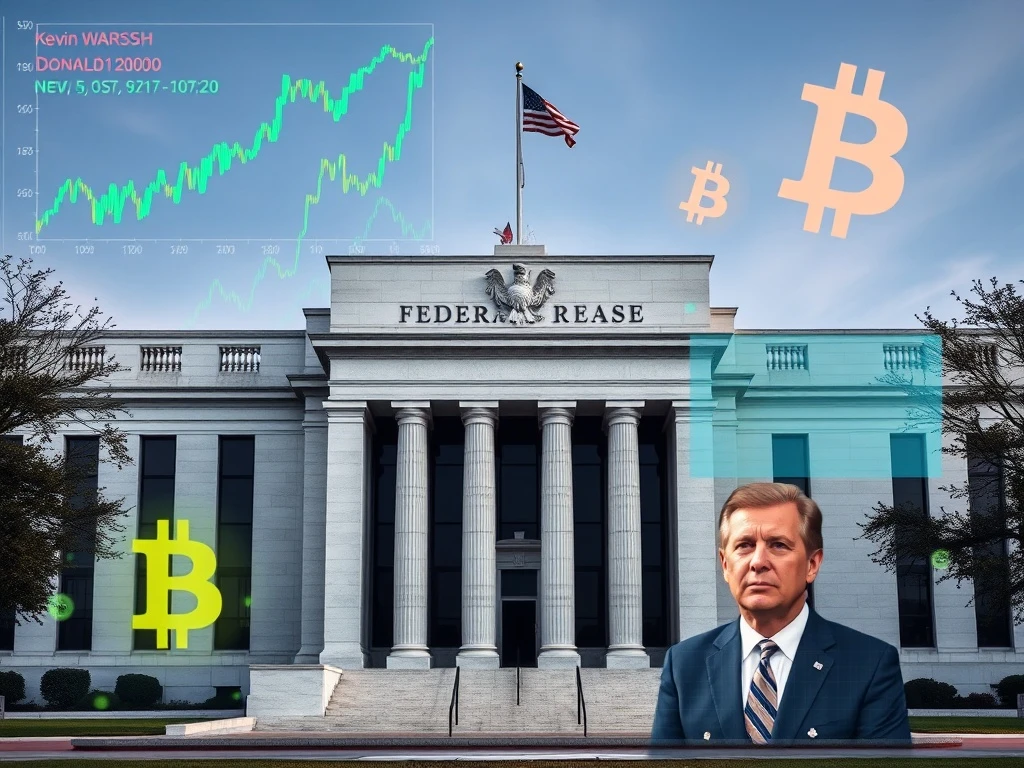
In a move that could redefine the trajectory of American monetary policy, former President Donald Trump announced on Friday, January 30, 2026, his intention to nominate Kevin Warsh as the next Chair of the Federal Reserve. This decision, communicated via Truth Social, immediately sent ripples through global financial and cryptocurrency markets, signaling a potential ideological pivot at the world’s most influential central bank as Jerome Powell’s term concludes.
Kevin Warsh Fed Nomination: A Profile of the Nominee
Kevin Warsh, 55, is not a newcomer to the Federal Reserve System. He served as a Governor of the Federal Reserve Board from 2006 to 2011, a period encompassing the global financial crisis. Following his public service, Warsh returned to the private sector, leveraging his experience as a former executive at Morgan Stanley and his academic background from Stanford Law School. His career represents a hybrid of Wall Street pragmatism and central banking experience, a profile that distinguishes him from recent Fed chairs.
Also read: AI Trading Agents: The Revolutionary Path to Mastering Your Crypto Portfolio in 2025
Trump’s endorsement was unequivocal. He stated, “I have no doubt he will go down in history as one of the GREAT Fed chairmen, maybe the best.” This nomination arrives at a critical juncture for the U.S. economy, marked by persistent inflation debates, a complex debt landscape, and the rapid integration of digital assets into the financial system.
Monetary Philosophy and Potential Policy Shifts
Analysts are scrutinizing Warsh’s historical policy positions to forecast the Fed’s future direction. During his previous tenure, Warsh frequently dissented from the consensus, advocating for a more rules-based and less interventionist monetary approach. His skepticism was particularly evident regarding the extensive use of quantitative easing (QE) post-2008.
Also read: RunBot AI Trading Bot: Revolutionizing Automated Cryptocurrency Strategies with Machine Learning
Key tenets of Warsh’s monetary philosophy include:
- Critique of Prolonged Accommodation: He has publicly criticized sustained low-interest-rate policies, labeling them as potentially “risky in the long term” for financial stability, arguing they can fuel asset bubbles.
- Advocacy for a “Regime Change”: Warsh has called for the Fed to adopt a more transparent, rule-bound framework to guide interest rate decisions, reducing discretionary power.
- Focus on Market Discipline: His statements suggest a belief in allowing market forces to play a greater corrective role, with the central bank acting as a stabilizer rather than a constant market participant.
Consequently, a Warsh-led Fed might pursue a less aggressive balance sheet policy and could be more inclined to raise interest rates sooner to preempt inflationary pressures, a stark contrast to the cautious, data-dependent approach of the Powell era.
The Senate Confirmation Battle Ahead
The nomination now faces a rigorous confirmation process in the U.S. Senate. Senators will likely probe Warsh’s past critiques of Fed policy, his views on regulatory independence, and his plans for managing the dual mandate of price stability and maximum employment. His Wall Street background may also attract scrutiny regarding regulatory capture concerns. This process is not merely a formality; it will be a substantive debate on the future of American monetary policy.
Immediate Reactions in Financial and Crypto Markets
Financial markets reacted with notable volatility following the announcement. Traders quickly began pricing in the possibility of a more hawkish Fed, leading to adjustments in Treasury yields and the U.S. dollar index. The prospect of tighter monetary policy traditionally pressures growth-oriented assets, but the reaction was nuanced.
The cryptocurrency market displayed particular sensitivity. Unlike Chair Powell, who has often expressed regulatory and stability concerns about digital assets, Kevin Warsh has articulated a more open perspective. In a July discussion at the Hoover Institution, he remarked that Bitcoin did not inherently threaten the Fed’s authority but could instead serve as a tool for “market discipline.” This view interprets cryptocurrencies as a check on fiat currency management, a significant ideological departure.
Market observers suggest this openness could lead to a more structured and potentially favorable regulatory environment for cryptocurrencies under a Warsh Fed. However, his overarching philosophy of financial discipline and stability means any regulatory framework would likely prioritize systemic risk mitigation.
Divergent Analyst Perspectives
Financial experts offer mixed forecasts. Some, like economist Peter Schiff, downplayed the immediate impact, suggesting recent market movements in precious metals were unrelated to the nomination and noting that Federal Open Market Committee (FOMC) consensus often moderates individual views. Others see it as a fundamental shift. They argue that the Chair’s influence on committee discourse, research direction, and public communication is profound, potentially steering the Fed toward a more normative, less activist stance over time.
Historical Context and Global Implications
This nomination occurs against a backdrop of evolving global economic power dynamics and the rise of digital finance. Central banks worldwide are exploring digital currencies (CBDCs) and grappling with the integration of crypto-assets. The U.S. Fed’s stance under new leadership will significantly influence this global conversation.
A shift toward a more rules-based U.S. monetary policy could affect international capital flows, exchange rates, and the global demand for dollar-denominated assets. For cryptocurrencies, the impact is twofold: it depends on both the regulatory posture and the broader financial conditions a Warsh Fed would create. Tighter traditional monetary policy might reduce liquidity-driven speculation, but clearer, more open regulation could foster institutional adoption.
Conclusion
The Kevin Warsh Fed nomination represents a pivotal moment for U.S. monetary policy and its intersection with the digital asset revolution. While Senate confirmation remains a hurdle, the selection signals a potential turn toward a more disciplined, rules-oriented, and structurally conservative Federal Reserve. For cryptocurrency markets, this introduces a complex equation: the possibility of a more receptive regulatory voice paired with the likelihood of a less accommodative overall financial environment. The coming months will determine whether this nomination merely alters the tone in Washington or fundamentally reshapes the financial landscape for years to come.
FAQs
Q1: Who is Kevin Warsh?
Kevin Warsh is a former Governor of the Federal Reserve Board (2006-2011), a former executive at Morgan Stanley, and the nominee for Chair of the Federal Reserve announced by Donald Trump in January 2026. He is known for his critical views on expansive monetary policy.
Q2: How could Warsh’s appointment affect interest rates?
Based on his past statements, a Warsh-led Fed might be inclined to raise interest rates more proactively to combat inflation and may be less likely to engage in large-scale asset purchase programs like quantitative easing, potentially leading to a tighter monetary policy environment.
Q3: What is Kevin Warsh’s view on Bitcoin and cryptocurrency?
Warsh has expressed a relatively open view, suggesting Bitcoin could act as a form of “market discipline” on central banks and does not inherently undermine the Fed’s authority. This contrasts with more cautious statements from previous Fed leadership.
Q4: What is the next step for this nomination?
The nomination must be confirmed by the U.S. Senate. Warsh will testify before the Senate Banking Committee, facing questions on his policy views, past actions, and vision for the Fed before a full Senate vote is scheduled.
Q5: How did financial markets react to the news?
Markets reacted with immediate volatility, adjusting expectations for future interest rate paths. The U.S. dollar and Treasury yields saw movement, and the cryptocurrency market showed sensitivity due to Warsh’s differing public stance on digital assets compared to outgoing Chair Jerome Powell.

This article was produced with AI assistance and reviewed by our editorial team for accuracy and quality.