Foundry USA Hashrate Plummets 60% as Deadly Storm Forces Critical Bitcoin Mining Curtailment
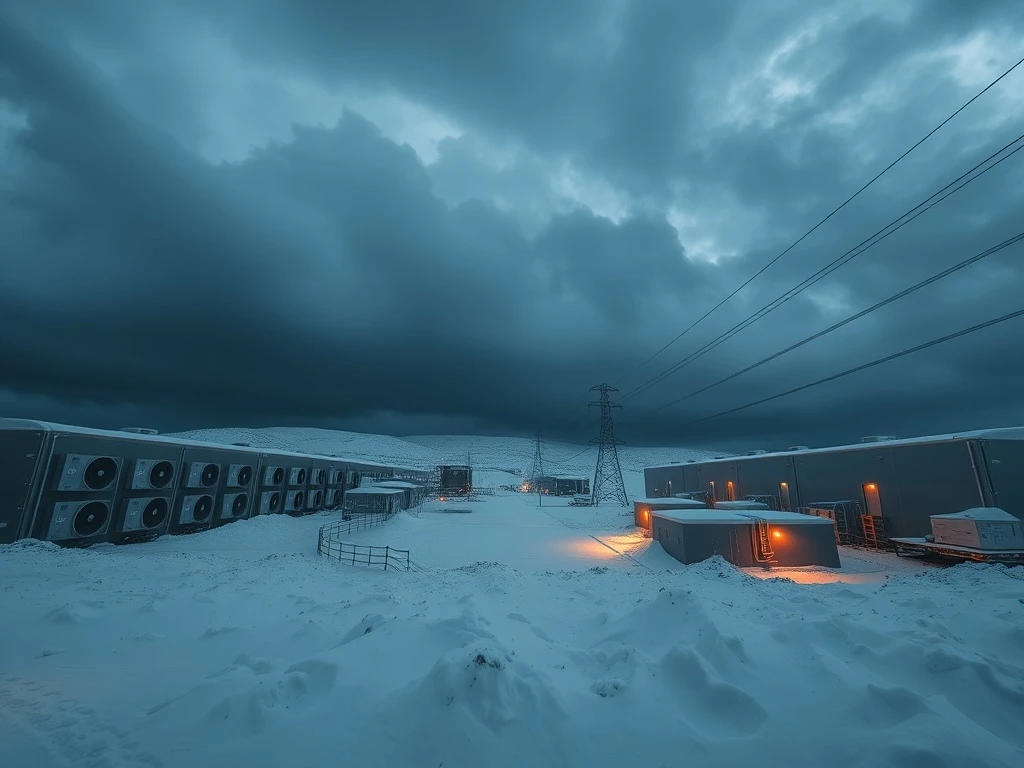
United States, March 2025: The global Bitcoin network is experiencing a significant shift in computational power as Foundry USA, the world’s largest Bitcoin mining pool, has voluntarily curtailed its hashrate by approximately 60%. This decisive action is a direct response to Winter Storm Fern, a deadly weather system causing massive power outages across the United States. The curtailment, which began on Friday, highlights the evolving and critical role Bitcoin miners can play as a flexible, controllable load for stabilizing national energy infrastructure during emergencies.
Foundry USA Hashrate Drops Amid Grid Emergency
Data from industry monitors shows a stark reduction in the computing power dedicated to securing the Bitcoin blockchain by Foundry USA. According to a report from TheMinerMag, the pool’s hashrate has fallen by nearly 200 exahashes per second (EH/s) since the onset of the storm. This represents a drop from a pre-storm estimated hashrate to roughly 198 EH/s. Consequently, the time to find new Bitcoin blocks for the pool has temporarily slowed, extending to an average of 12 minutes compared to the network’s 10-minute target. Despite this reduction, Foundry USA maintains its position as a dominant force, still accounting for an estimated 23% of the global Bitcoin mining pool hashrate, as tracked by Hashrate Index.
This is not an isolated incident. TheMinerMag notes that other U.S.-based mining pools, including Luxor, have also implemented curtailments. The coordinated response underscores an industry-wide recognition of the responsibility to support public utility grids under extreme duress. Winter Storm Fern, characterized by a dangerous mix of snow, ice, and freezing rain, has stretched over 1,800 miles from the Southeast through the Northeast and Midwest. The Weather Channel reports over one million residents have lost electrical power, creating a severe strain on energy generation and distribution systems.
The Mechanics of Bitcoin Mining and Grid Balance
To understand the significance of this curtailment, one must first grasp the unique relationship between Bitcoin mining and energy grids. Bitcoin miners operate specialized computers that solve complex mathematical problems to validate transactions and secure the network, a process known as proof-of-work. This activity consumes substantial electricity, making miners a major, but uniquely flexible, consumer of power.
- Controllable Load Resource: Unlike hospitals or residential heating, which require constant power, large-scale mining operations can power down thousands of machines almost instantaneously. This allows them to act as a “demand response” asset for grid operators.
- Absorbing Excess Supply: During periods of low consumer demand—often at night or during times of high renewable output—excess electricity on the grid can become a technical problem, risking damage to infrastructure. Miners can ramp up to absorb this surplus, providing a crucial economic sink for energy that would otherwise be wasted or curtailed.
- Releasing Capacity During Peak Demand: Conversely, during emergencies like Winter Storm Fern, when demand for heating and critical services spikes, miners can shut down operations within minutes. This action frees up significant megawatts of capacity, allowing that electricity to be redirected to homes, businesses, and emergency services.
The current event with Foundry USA is a real-world, large-scale test of this dynamic. By curtailing 60% of its load, the pool has effectively donated a massive amount of power capacity back to strained grids, helping to prevent more widespread blackouts.
A Historical and Industry-Wide Context
The practice of mining curtailment is not new but is becoming more formalized. Following the Winter Storm Uri crisis in Texas in 2021, many mining facilities entered into explicit agreements with grid operators like ERCOT. These agreements provide financial incentives for miners to power down during emergencies, creating a more resilient and responsive energy ecosystem. The event with Foundry USA demonstrates how this model has matured from a regional practice to a national consideration during widespread weather events.
Industry analysts point out that while a 60% drop in hashrate from a major pool is notable, the Bitcoin network itself is designed to be resilient. The protocol automatically adjusts the difficulty of the mathematical problems miners solve approximately every two weeks. If a significant amount of hashrate goes offline for an extended period, the network will lower the difficulty, allowing the remaining miners to continue finding blocks at a roughly consistent rate. This built-in adjustment mechanism ensures network security and transaction processing continue, even during major geopolitical or environmental disruptions.
Implications for Network Security and Bitcoin’s Narrative
The immediate impact of the hashrate drop is a demonstration of network robustness. While block times for Foundry USA have slowed, the global Bitcoin network continues to operate. Transactions are still being processed and confirmed by miners in other global regions unaffected by the storm. This geographic distribution of mining power is a key security feature, preventing any single regional event from halting the network.
Furthermore, this event powerfully counters a common criticism of Bitcoin mining: that it is a wasteful drain on energy systems. The voluntary, large-scale curtailment by Foundry USA provides a concrete case study in how Bitcoin mining can integrate with and support modern energy grids. It reframes miners not as passive consumers, but as active, responsive participants in grid management. This could influence future policy discussions and regulatory approaches to the industry, emphasizing its potential value as a grid-stabilizing tool.
The financial impact on miners involves a complex calculation. They forgo potential Bitcoin rewards when their machines are off. However, many participate in demand response programs that provide substantial payments for their curtailed load, often making the temporary shutdown financially neutral or even profitable. This economic alignment ensures miners are incentivized to be good grid citizens during crises.
Conclusion
The 60% curtailment of the Foundry USA hashrate is more than a statistical blip; it is a landmark event that illustrates the sophisticated intersection of cryptocurrency, energy infrastructure, and emergency response. As Winter Storm Fern continues to threaten power reliability for millions, the proactive shutdown of mining rigs provides critical megawatts to where they are needed most. This incident solidifies the evolving role of Bitcoin mining as a flexible, technologically advanced partner to national power grids, capable of enhancing stability during our most vulnerable moments. The resilience of both the Bitcoin network and the energy grid is being tested and demonstrated in real-time.
FAQs
Q1: What does “curtailing hashrate” mean?
It means a Bitcoin mining operation voluntarily reduces its computational power by shutting down some or all of its mining machines. This drastically lowers its electricity consumption, freeing up power on the grid for other uses.
Q2: Does this hashrate drop make the Bitcoin network less secure?
In the short term, a major regional drop in hashrate can slightly slow block production for affected pools. However, the global and decentralized nature of the Bitcoin network means miners in other continents continue securing it. The protocol’s built-in difficulty adjustment will also compensate over time.
Q3: Why would a mining company agree to lose money by turning off?
Many large miners have agreements with grid operators. They receive direct payments for being on standby to power down during emergencies. These payments can offset or exceed the potential Bitcoin rewards they miss, making curtailment a viable business decision.
Q4: Is this the first time Bitcoin miners have helped the power grid?
No. This is a well-established practice, particularly in Texas following the 2021 winter storm. Miners there regularly curtail operations during summer heat waves and winter cold snaps to support grid stability, acting as a “virtual power plant.”
Q5: How long will Foundry USA’s hashrate remain curtailed?
The duration depends entirely on the storm’s impact and the stability of the power grids in the regions where its facilities operate. Mining will likely resume gradually as weather conditions improve, power is restored to residents, and grid operators give the all-clear.