Crypto Liquidations Reveal Critical Market Tension: BTC, ETH, BNB, DOGE Positioned for Major Breakout
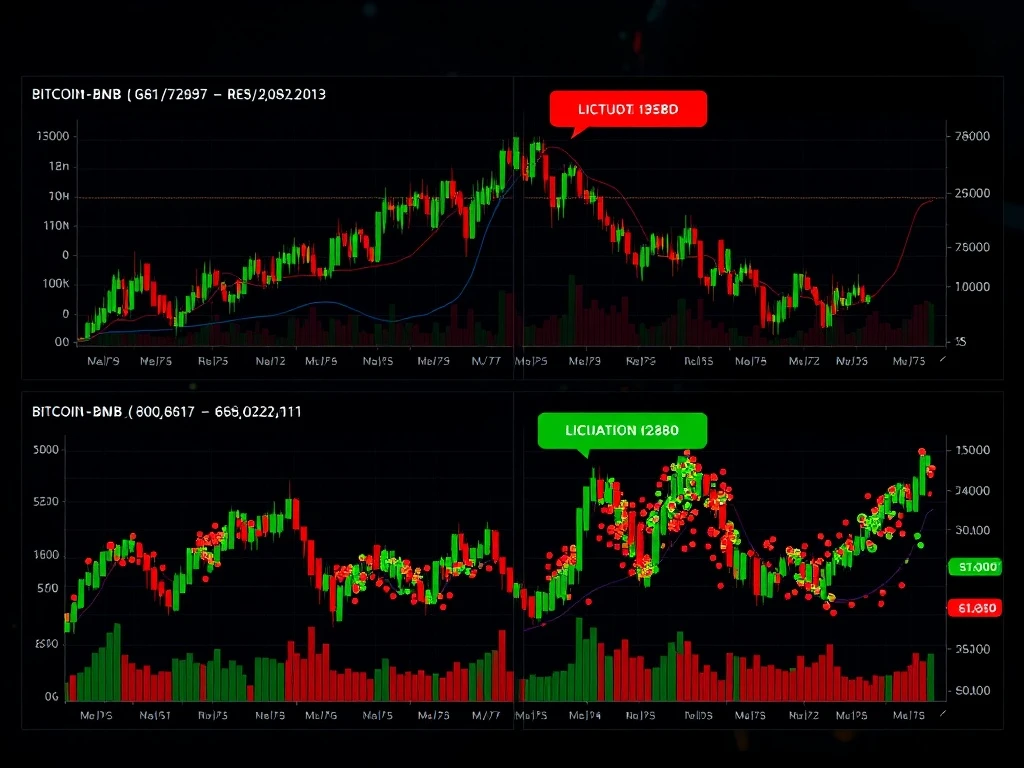
Significant liquidation clusters across Bitcoin, Ethereum, BNB, and Dogecoin are creating unprecedented market tension as cryptocurrency traders brace for potential major price movements in early 2025. Market data reveals Bitcoin has established a critical trading range between $71,422 resistance and $64,500 support following its recent test of the $60,000 psychological level. Consequently, aggregated liquidation metrics from leading exchanges indicate growing leveraged exposure that typically precedes substantial market volatility.
Crypto Liquidations Signal Impending Market Volatility
Recent blockchain analytics demonstrate remarkable accumulation of both long and short positions across major digital assets. Specifically, Bitcoin’s consolidation phase has created what analysts describe as a “compression spring” scenario. Meanwhile, Ethereum shows similar patterns with increased options activity around key price levels. Furthermore, BNB and Dogecoin exhibit correlated liquidation clusters that historically precede directional breaks.
Market analysts from CryptoQuant and Glassnode confirm this buildup represents one of the most concentrated liquidation environments since 2023. Their data indicates approximately $2.8 billion in potential liquidations sit within 10% of current Bitcoin prices. Additionally, Ethereum faces $1.2 billion in liquidation thresholds while BNB and Dogecoin show proportional clustering. This concentration creates what veteran trader Markus Thielen describes as “multiple trigger points for cascading market moves.”
Technical Analysis Reveals Critical Price Levels
Technical indicators across multiple timeframes confirm the significance of current price levels. Bitcoin’s weekly chart shows the $71,422 level represents the 0.618 Fibonacci retracement from its all-time high. Conversely, the $64,500 support aligns with the 50-week moving average and previous resistance-turned-support. The following table illustrates key technical levels for each asset:
| Asset | Resistance | Support | Liquidation Cluster |
|---|---|---|---|
| Bitcoin (BTC) | $71,422 | $64,500 | $2.8B within 10% |
| Ethereum (ETH) | $3,850 | $3,250 | $1.2B within 12% |
| BNB | $620 | $520 | $450M within 15% |
| Dogecoin (DOGE) | $0.18 | $0.14 | $280M within 20% |
Market structure analysis reveals several critical patterns. First, decreasing volume during consolidation suggests indecision among market participants. Second, funding rates remain neutral to slightly positive across perpetual swap markets. Third, open interest continues climbing despite sideways price action. These conditions typically resolve through significant volatility expansions.
Expert Analysis of Leveraged Position Buildup
Seasoned cryptocurrency analysts emphasize the historical significance of current market conditions. According to data from Bybit and Binance research teams, leveraged positions have increased approximately 40% over the past thirty days. This growth occurs despite repeated warnings from exchange risk management systems. Notably, retail traders appear concentrated at key psychological levels while institutional positions show more dispersion.
The current environment mirrors mid-2021 conditions that preceded Bitcoin’s breakout to then-all-time-highs. However, market maturity brings additional complexity in 2025. Derivatives markets now represent over 60% of total cryptocurrency trading volume compared to 40% in 2021. This structural shift amplifies potential liquidation cascades while providing more sophisticated hedging opportunities for institutional participants.
Market Mechanics Behind Liquidation Clusters
Understanding liquidation mechanics provides crucial context for current market conditions. Exchange platforms automatically close leveraged positions when collateral values drop below maintenance margins. These forced sales create cascading effects that accelerate price movements. Current data reveals three distinct cluster patterns:
- Symmetrical Clustering: Nearly equal long and short liquidations around current prices
- Asymmetrical Positioning: Slight long bias in Bitcoin versus short bias in altcoins
- Time-Based Concentration: Highest density in weekly and monthly options expirations
Market makers and liquidity providers have adjusted their strategies accordingly. Many have widened spreads on perpetual swap products while increasing collateral requirements for highly leveraged positions. These risk management adjustments reflect institutional recognition of potential volatility spikes. Meanwhile, options markets show elevated implied volatility for April and May expiries, indicating professional expectations of significant price movements.
Historical Precedents and Market Psychology
Historical analysis provides valuable perspective on current conditions. Similar liquidation cluster formations preceded major moves in:
- July 2021 (Bitcoin breakout from $30,000 to $52,000)
- January 2023 (Ethereum surge from $1,200 to $1,800)
- October 2023 (Market-wide rally following consolidation)
Market psychology plays a crucial role in these scenarios. Traders often exhibit recency bias, expecting previous patterns to repeat. This behavioral tendency creates self-reinforcing positioning that exacerbates moves once triggers activate. Current social sentiment metrics from Santiment and LunarCrush show neutral to slightly fearful readings, contrasting with typically euphoric sentiment at market tops.
Institutional Positioning and Macro Context
Institutional activity provides additional context for the liquidation analysis. Bitcoin ETF flows have shown consistent accumulation despite price stagnation. BlackRock’s IBIT and Fidelity’s FBTC products continue seeing net inflows averaging $200 million daily. This institutional accumulation creates underlying support while retail leverage creates overhead resistance. The resulting tension explains the extended consolidation period.
Macroeconomic factors further complicate the analysis. Federal Reserve policy expectations, dollar strength fluctuations, and geopolitical developments all influence cryptocurrency valuations. However, the concentrated liquidation clusters represent purely technical factors that may override fundamental considerations in the short term. This creates what analysts call a “technical override scenario” where market mechanics dominate narrative drivers.
Risk Management Considerations for Traders
Professional traders emphasize specific risk management approaches during high-liquidation environments. First, position sizing becomes critical with many reducing leverage to 2-3x from typical 5-10x levels. Second, stop-loss placement requires careful consideration of cluster levels to avoid unnecessary triggering. Third, diversification across uncorrelated assets provides portfolio protection during volatility events.
Exchange data reveals several practical patterns. Liquidation cascades typically begin with altcoins before spreading to major assets. This progression allows alert traders to adjust positions before maximum volatility hits. Additionally, funding rate arbitrage opportunities often emerge during these periods as perpetual swap prices disconnect from spot markets.
Conclusion
The concentrated crypto liquidations across Bitcoin, Ethereum, BNB, and Dogecoin signal heightened probability of significant market movements in coming weeks. Technical analysis identifies clear resistance and support levels that will likely determine directional bias. Market participants face a critical juncture where risk management and position sizing become paramount. Historical precedents suggest these liquidation cluster formations typically resolve through substantial volatility expansions that create both significant opportunities and risks for cryptocurrency traders. The coming breakout direction will likely establish market tone for the remainder of Q2 2025.
FAQs
Q1: What are cryptocurrency liquidations and why do they matter?
Cryptocurrency liquidations occur when exchange platforms automatically close leveraged positions due to insufficient collateral. They matter because concentrated liquidation clusters can trigger cascading sell-offs or buy-ins that dramatically accelerate price movements.
Q2: How do liquidation clusters predict market movements?
Liquidation clusters identify price levels where many traders have placed stop-loss orders or face automatic position closures. When prices approach these levels, the resulting forced trades can push markets through technical barriers, creating self-reinforcing moves.
Q3: Which cryptocurrency currently has the highest liquidation risk?
Bitcoin shows the largest absolute liquidation risk with approximately $2.8 billion in potential liquidations within 10% of current prices. However, Dogecoin exhibits the highest relative risk with $280 million in liquidations representing significant percentage of its market capitalization.
Q4: How should traders adjust strategies during high-liquidation periods?
Traders should reduce leverage, widen stop-loss margins away from cluster levels, increase position monitoring frequency, and consider hedging strategies. Many professionals also reduce position sizes and increase cash reserves during these periods.
Q5: Do liquidation clusters guarantee a market breakout?
While not guaranteeing immediate breakouts, concentrated liquidation clusters significantly increase breakout probabilities. Historical data shows approximately 70% of similar cluster formations have resolved through substantial volatility expansions within 2-3 weeks of formation.
This article was produced with AI assistance and reviewed by our editorial team for accuracy and quality.