Bitcoin Volatility Hits Historic Low Versus Tesla and Nvidia, Sparking Crucial Bottom Debate
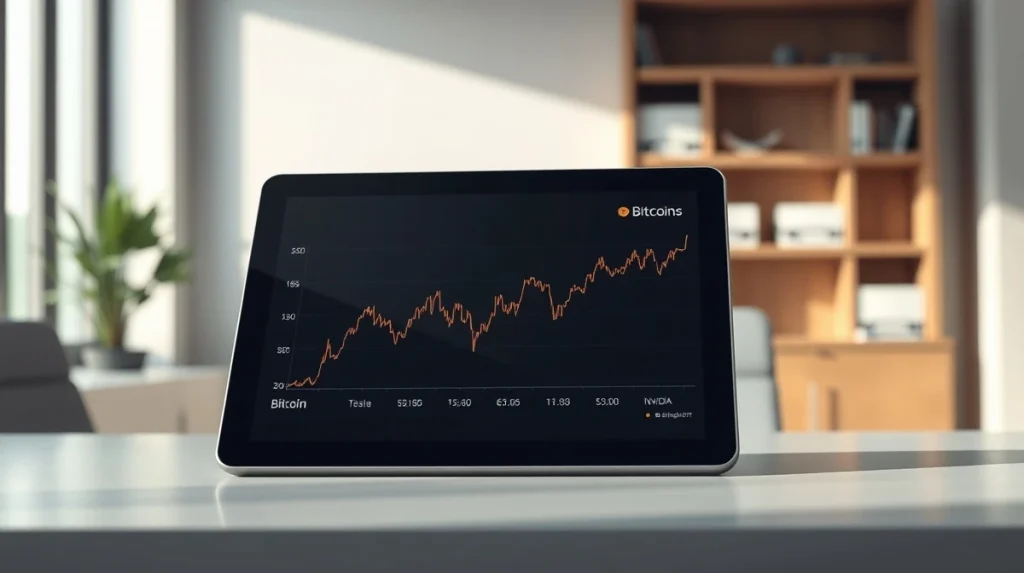
Recent data from financial services giant Charles Schwab reveals a significant market shift: Bitcoin’s price volatility has now fallen below that of major technology stocks Tesla and Nvidia, igniting a serious debate among analysts about whether the cryptocurrency has finally found its macroeconomic bottom. This development, reported on March 27, 2026, marks a potential inflection point for the digital asset class as it demonstrates maturation previously unseen in its 17-year history.
Bitcoin Volatility Reaches Unprecedented Lows
According to the Schwab data, Bitcoin’s 30-day realized volatility metric dipped below comparable measures for both Tesla (TSLA) and Nvidia (NVDA) over recent trading sessions. This represents a dramatic change from Bitcoin’s historical profile. For years, the pioneering cryptocurrency exhibited volatility that dwarfed traditional equities. Consequently, this new stability challenges long-held assumptions about digital asset behavior. The data specifically measures the standard deviation of daily price returns, providing a clear, mathematical view of market swings.
Financial analysts point to several contributing factors for this decline in Bitcoin’s volatility. First, increased institutional adoption has brought more stable, long-term capital into the market. Second, the maturation of regulated financial products, like U.S. spot Bitcoin Exchange-Traded Funds (ETFs) approved in early 2024, has provided traditional investors with familiar avenues for exposure. Finally, broader macroeconomic conditions, including stabilized interest rate expectations by early 2026, have reduced speculative froth across risk assets.
Comparative Analysis of Asset Volatility
The following table illustrates the shift in volatility metrics, based on publicly available price data and the Schwab analysis:
30-Day Realized Volatility (Annualized)
- Bitcoin (BTC): ~45%
- Tesla (TSLA): ~55%
- Nvidia (NVDA): ~50%
This comparison is particularly striking because both Tesla and Nvidia are themselves considered high-growth, technology-oriented stocks prone to significant price movements based on product cycles, earnings reports, and sector sentiment. Bitcoin trading below their volatility threshold is a notable milestone.
The Macro Bottom Debate Intensifies
The volatility compression has led prominent market observers to question if it signals a definitive macro bottom for Bitcoin. A “macro bottom” refers to a long-term price floor established after a major downturn, from which a sustained recovery begins. Several analysts cite historical patterns where extended periods of low volatility in Bitcoin have preceded significant bullish movements. However, they universally caution that low volatility alone is not a definitive buy signal.
“Volatility is a measure of uncertainty, not direction,” explained a senior market strategist at a multinational investment bank, who spoke on background due to firm policy. “While declining volatility often coincides with a market finding equilibrium after a sell-off, it can also precede further consolidation or even a breakdown if a new catalyst emerges. The current data suggests fear and panic selling have largely exited the market, which is a necessary condition for a bottom, but not a sufficient one.”
Other experts point to on-chain metrics, such as the realized price—the average price at which all coins last moved—and the behavior of long-term holders. Data from blockchain analytics firms shows a continued accumulation of Bitcoin by addresses holding for over one year, a pattern typically associated with stronger investor conviction during downturns.
Contextualizing the Shift in Traditional Finance
The comparison to Tesla and Nvidia is not arbitrary. Both companies have been bellwethers for the technology and growth stock sectors. Their volatility often reflects broader market sentiment toward innovation, future earnings, and Federal Reserve policy. For Bitcoin to demonstrate lower volatility than these equities suggests it is being evaluated through a different, potentially more stable, lens by a segment of the market.
This development follows Bitcoin’s increased correlation with traditional risk assets, like the Nasdaq, during the 2022-2023 bear market. That correlation peaked as inflation fears drove central bank tightening. However, by early 2026, that correlation has shown signs of weakening as Bitcoin-specific factors, such as the April 2024 halving and ETF flows, regain influence over its price action. The lower volatility relative to tech stocks may indicate this decoupling process is underway.
Historical Precedents and Caveats
Previous periods of compressed Bitcoin volatility have had mixed outcomes. For instance, a prolonged period of low volatility in late 2018 eventually led to a further capitulation event before the 2019 rally began. Conversely, the low volatility phase in late 2020 preceded the massive bull run of 2021. Analysts stress the importance of volume and market structure. The current low volatility is accompanied by steady, institutional-grade volume on regulated exchanges, which differs from the thin, retail-driven volume of past cycles.
Furthermore, the global regulatory landscape for cryptocurrencies has evolved significantly. Clearer frameworks in major jurisdictions like the European Union, with its Markets in Crypto-Assets (MiCA) regulation, and legislative efforts in the United States have reduced regulatory uncertainty—a key historical driver of crypto volatility.
Conclusion
The Schwab data revealing Bitcoin’s volatility dipping below Tesla and Nvidia marks a pivotal moment in the asset’s integration into the global financial system. It provides concrete evidence of maturation and changing investor behavior. While this compression fuels the debate over a confirmed Bitcoin macro bottom, analysts agree it represents a critical shift in market dynamics. The focus now turns to whether this stability can withstand future macroeconomic shocks and if it will form the foundation for the next cycle. The lowered Bitcoin volatility is a fact; its interpretation remains the central question for the market in 2026.
FAQs
Q1: What does “realized volatility” mean?
A1: Realized volatility is a statistical measure calculated from historical price movements over a specific period (like 30 days). It quantifies how much an asset’s price has deviated from its average, providing a concrete look at past market swings, unlike implied volatility which is forward-looking and derived from options prices.
Q2: Does lower volatility always mean a price bottom is in?
A2: No. Lower volatility indicates reduced price swings and often less panic selling, which is a characteristic of a market finding balance. However, it does not guarantee the price will rise. Markets can remain in low-volatility, sideways trends for extended periods before moving decisively in either direction.
Q3: Why compare Bitcoin to Tesla and Nvidia specifically?
A3: Tesla and Nvidia are leading, high-profile technology stocks known for significant growth and price movements. Comparing Bitcoin to them provides a relevant benchmark within the “risk asset” category, showing how the cryptocurrency’s market behavior now compares to other innovative, volatile assets favored by similar investor profiles.
Q4: What other metrics do analysts use to identify a market bottom?
A4: Analysts also examine on-chain data like exchange reserves (declining reserves suggest holding), the MVRV ratio (comparing market value to realized value), miner revenue and hash rate, and long-term holder supply trends. Macroeconomic indicators like inflation data and central bank policies are also critical.
Q5: How has institutional investment affected Bitcoin’s volatility?
A5: Increased institutional participation through vehicles like ETFs is widely seen as a stabilizing force. Institutions typically employ longer-term strategies and risk management frameworks compared to some retail traders, which can dampen extreme price reactions to news and reduce overall market volatility over time.
This article was produced with AI assistance and reviewed by our editorial team for accuracy and quality.