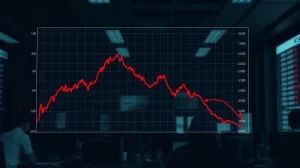
Bitcoin Price Drop: Sudden $1,500 Plunge Triggers Market-Wide Liquidation Cascade

Global cryptocurrency markets experienced a sharp, rapid correction on Tuesday as Bitcoin’s price plummeted by approximately $1,500 within a dramatic 20-minute window following the U.S. market open. This significant Bitcoin price drop, representing a decline of over 2% from its opening level, was primarily driven by a cascade of forced long liquidations, exacerbated by recent outflows from U.S. spot Bitcoin ETFs and elevated derivatives market open interest. Consequently, the event highlights the persistent volatility and complex leverage dynamics within digital asset markets.
Anatomy of the Bitcoin Price Drop
The sell-off commenced precisely as major U.S. equity exchanges began trading. Almost immediately, a wave of selling pressure overwhelmed available buy-side liquidity on major spot exchanges. Market data from CoinGlass and other analytics platforms indicates the move was not initiated by a single, massive sell order. Instead, it was a rapid succession of medium-sized sales that quickly triggered automated stop-loss orders and margin calls. As a result, a feedback loop developed where falling prices forced more leveraged positions to close, accelerating the decline.
Also read: Zero-Knowledge Proofs Guide: Hoskinson's Free 337-Page GitHub Release Empowers Developers
Key metrics preceding the event painted a vulnerable picture:
- Elevated Open Interest: Aggregate open interest in Bitcoin futures and perpetual swap markets had climbed to multi-week highs, indicating a large number of outstanding leveraged positions.
- ETF Outflows: U.S. spot Bitcoin ETFs recorded net outflows for several consecutive sessions prior to the drop, removing a key source of structural demand.
- Liquidation Heatmap: Order book analysis showed a dense cluster of stop-loss orders just below the $68,000 support level, which acted as a trigger zone.
This combination created a tinderbox scenario. A relatively modest spark of selling was enough to ignite a widespread long liquidation cascade, where traders who had borrowed funds to bet on higher prices were automatically closed out by their exchanges.
Also read: Crypto Liquidations Surge Past $450M as Options Expiry and Oil Shock Fuel Market Panic
The Role of Derivatives and Leverage
Modern cryptocurrency markets are deeply intertwined with complex derivatives products. Platforms offering futures and perpetual contracts allow traders to employ significant leverage, often exceeding 20x or even 100x their initial capital. While this amplifies potential gains, it also drastically increases risk. When prices move against these highly leveraged long positions, exchanges must liquidate them to prevent losses from exceeding the trader’s collateral. This liquidation process involves the exchange automatically selling the position into the market.
During Tuesday’s event, data shows over $300 million in long positions were liquidated across all cryptocurrencies within one hour, with Bitcoin accounting for the majority. This forced selling from liquidations directly contributed to the velocity of the Bitcoin price drop. Furthermore, the high open interest meant the cascade had more fuel to burn through as each liquidation level was hit. Market structure analysts often refer to this as a “long squeeze,” where overly optimistic leverage is rapidly purged from the system.
Expert Insight on Market Mechanics
According to principles of market microstructure, events like these are not random. They are a direct function of positioning and liquidity. When a market becomes overly crowded on one side—in this case, with leveraged longs—it becomes susceptible to a sharp reversal. The recent ETF outflows reduced the depth of natural buyers on the spot market, making it easier for liquidation-driven sales to push prices lower. This dynamic is well-documented in traditional finance, particularly in equity and commodity futures markets, and has become a recurring feature in crypto.
Historical context is also crucial. Similar rapid liquidation events occurred in July 2024 and January 2023, following periods of aggressive leverage buildup. Each event served to reset excessive optimism and lower systemic risk, albeit painfully for affected traders. The speed of the move, concentrated in 20 minutes, is characteristic of digital asset markets that operate 24/7 with globally interconnected order books and automated trading systems.
Immediate Aftermath and Market Response
Following the initial plunge, Bitcoin’s price found temporary support and entered a phase of consolidation. The violent move effectively “cleared” a significant portion of overleveraged long positions, reducing immediate selling pressure. However, market sentiment shifted noticeably. The Crypto Fear & Greed Index, a popular sentiment gauge, dropped several points into “Fear” territory following the drop.
The impact rippled through the broader digital asset ecosystem. Major altcoins like Ethereum (ETH), Solana (SOL), and Dogecoin (DOGE) also saw pronounced declines, typically exhibiting higher beta, or volatility, relative to Bitcoin’s movements. This correlation during stress events underscores that Bitcoin still acts as the primary liquidity and sentiment anchor for the entire sector.
| Metric | Pre-Drop Level | Post-Drop Level | Change |
|---|---|---|---|
| Bitcoin Price (USD) | ~$68,400 | ~$66,900 | -$1,500 (-2.2%) |
| Total Crypto Liquidations (1hr) | Minimal | $320 Million | +$320M |
| BTC Futures Open Interest | $38.2 Billion | $36.8 Billion | -$1.4B |
| Aggregate Spot Volume (Top Exchanges) | Normal | Spike of 250% | Significant Increase |
Market participants closely monitored order book depth after the event. The rebuilding of bid support around the $66,500 level was seen as a positive sign, suggesting institutional and long-term holders were willing to absorb selling at that price point. Nevertheless, the event served as a stark reminder of the risks associated with high leverage in an inherently volatile asset class.
Conclusion
The sudden Bitcoin price drop of $1,500 in under 30 minutes was a textbook example of a long liquidation cascade. It was precipitated by a dangerous mix of high derivatives leverage, recent ETF outflows, and thin spot market liquidity at a key technical level. While dramatic, such events are a mechanism within market structure that removes excessive risk and resets sentiment. For investors, this underscores the importance of understanding derivatives market dynamics, managing leverage prudently, and recognizing that Bitcoin’s path remains characterized by high volatility. The market’s ability to stabilize after the purge suggests underlying resilience, but the episode clearly demonstrates that sellers can return swiftly and with significant force.
FAQs
Q1: What exactly caused Bitcoin to drop $1,500 so quickly?
The primary cause was a long liquidation cascade. Elevated leverage in derivatives markets, combined with initial selling pressure, triggered a wave of automatic position closures (liquidations), which created forced selling that accelerated the Bitcoin price drop.
Q2: What are “long liquidations”?
Long liquidations occur when traders who have borrowed money to bet on a price increase (a “long” position) see the price fall. If it falls enough to wipe out their collateral, the exchange automatically sells their position to repay the loan, creating more selling pressure.
Q3: Did Bitcoin ETF outflows cause the crash?
Outflows from U.S. spot Bitcoin ETFs were a contributing factor, not the sole cause. They reduced a source of consistent buying demand, making the market more vulnerable. The immediate trigger was the leverage unwind in derivatives markets.
Q4: How common are these rapid price moves in cryptocurrency?
They are a recurring feature due to the 24/7 market structure, high available leverage, and relatively lower liquidity compared to traditional markets. Similar multi-percent moves within minutes have happened several times in Bitcoin’s history.
Q5: What does this mean for the future trend of Bitcoin’s price?
A single liquidation event does not determine the long-term trend. It often removes weak, overleveraged positions, which can be healthy for the market’s foundation. The long-term trajectory will depend on broader adoption, macroeconomic factors, and institutional inflows, not just short-term volatility.

This article was produced with AI assistance and reviewed by our editorial team for accuracy and quality.