Tokenized Assets Poised for Explosive $11 Trillion Growth by 2030, Ark Invest Projects

Ark Invest projects massive growth for tokenized real-world assets reaching $11 trillion by 2030.

NEW YORK, April 2025 – The market for tokenized real-world assets (RWA) is on a trajectory to become an $11 trillion financial behemoth by the end of the decade, according to a groundbreaking new projection from Cathie Wood’s Ark Invest. This staggering forecast, reported by The Block, signals a monumental shift from the current estimated market size of $19-22 billion, highlighting blockchain technology’s imminent transformation of global finance. The firm’s analysis underscores that mass adoption hinges on two critical developments: definitive regulatory frameworks and the construction of robust, institutional-grade infrastructure.

Ark Invest’s Vision for Tokenized Asset Growth

Ark Invest’s latest research provides a comprehensive roadmap for the tokenization of real-world assets. The firm defines this process as the digital representation of physical and traditional financial assets on a blockchain. Consequently, assets like real estate, government bonds, commodities, and private equity can become more liquid, transparent, and accessible. The projected growth to $11 trillion represents a compound annual growth rate (CAGR) of over 150% from today’s baseline. For context, this potential market would rival the current size of the entire U.S. commercial banking sector.

Furthermore, the report meticulously details the sequential phases of adoption. Initially, pilot projects and private networks will dominate. Subsequently, public permissioned blockchains are expected to gain prominence as institutions seek a balance between transparency and control. Finally, interoperable public infrastructure could emerge as the dominant layer for settlement. This evolution mirrors the internet’s own development from closed intranets to the open web.

The Catalysts for Mass Adoption

Ark Invest identifies several non-negotiable prerequisites for this growth. First, regulatory clarity from major financial jurisdictions like the U.S., EU, and UK is paramount. Clear rules for custody, issuance, and trading will de-risk institutional participation. Second, the development of institutional-grade infrastructure is crucial. This includes secure custody solutions, reliable oracle networks for real-world data, and compliant trading venues. Major financial institutions, including BlackRock and JPMorgan, are already building these foundational pieces.

Comparing Tokenized Assets and Bitcoin’s Trajectory

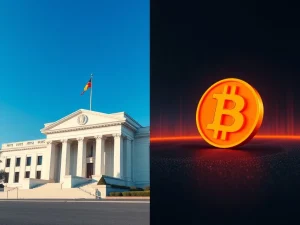
In a revealing parallel, Ark Invest’s report also projects Bitcoin’s market capitalization could reach $16 trillion by 2030. This dual forecast creates a fascinating narrative for the digital asset ecosystem. While Bitcoin operates as a decentralized monetary asset and store of value, tokenized RWAs represent the digitization of the existing financial system. Together, they could form complementary pillars of a new financial architecture.

The following table illustrates the scale of the projected transformation:

Asset ClassCurrent Market Size (Est.)2030 Projection (Ark Invest)Primary Growth Driver
Tokenized RWAs$19-22 Billion$11 TrillionInstitutional efficiency & new access
Bitcoin (BTC)$1.3 Trillion$16 TrillionMonetary policy & institutional adoption

This comparison highlights a key insight: tokenization is not about creating a new asset class, but about radically improving the efficiency and accessibility of existing ones. The potential benefits are substantial:

  • Fractional Ownership: High-value assets like commercial real estate can be divided into affordable digital shares.
  • 24/7 Markets: Trading can occur beyond traditional market hours, increasing liquidity.
  • Reduced Settlement Time: Blockchain enables near-instant settlement, slashing costs and counterparty risk.
  • Enhanced Transparency: Immutable ownership records and audit trails reduce fraud and administrative overhead.

The Real-World Impact of Asset Tokenization

The implications of an $11 trillion tokenized asset market extend far beyond Wall Street. For instance, municipalities could issue tokenized municipal bonds directly to a global pool of investors, potentially lowering borrowing costs for public projects. Similarly, small and medium-sized enterprises (SMEs) could tokenize invoices or future revenue streams to access capital markets currently closed to them. This democratization of finance could unlock economic potential in underserved regions and sectors.

However, significant hurdles remain. Legal frameworks for digital securities are still evolving. The technical challenge of accurately representing off-chain legal rights and obligations on-chain is complex. Moreover, achieving interoperability between different blockchain networks and traditional financial ledgers is a monumental engineering task. Industry consortia like the Tokenized Asset Coalition are actively working to establish standards to overcome these very obstacles.

Evidence from Current Market Activity

Current market activity strongly supports Ark’s long-term thesis. The U.S. Treasury has experimented with tokenized bond issuance. Major asset managers have launched tokenized money market funds on public blockchains like Ethereum and Stellar. Furthermore, financial hubs like Singapore, Hong Kong, and the UAE are advancing clear regulatory regimes to attract tokenization projects. These are not speculative experiments but measured steps by established institutions, validating the trend Ark’s report describes.

Conclusion

Ark Invest’s projection of an $11 trillion tokenized asset market by 2030 presents a compelling and data-backed vision for the future of finance. The path from today’s nascent market to that multi-trillion-dollar reality is clearly mapped, dependent on regulatory maturation and infrastructure build-out. As institutional heavyweights continue to allocate resources and regulators worldwide engage with the technology, the tokenization of real-world assets moves from theoretical promise to an inevitable, systemic upgrade. This transformation promises to reshape liquidity, access, and efficiency across the entire global economy, making Ark Invest’s forecast a critical benchmark for investors and policymakers alike.

FAQs

Q1: What exactly are tokenized real-world assets (RWAs)?
Tokenized RWAs are digital representations of physical or traditional financial assets—like real estate, bonds, or commodities—issued and traded on a blockchain. Each token signifies a share of ownership or a claim on the underlying asset, combining the benefits of blockchain with the value of established assets.

Q2: Why does Ark Invest believe regulatory clarity is so important for growth?
Institutional investors, such as pension funds and insurance companies, operate under strict compliance and fiduciary rules. Without clear regulations defining the legal status, custody requirements, and tax treatment of tokenized assets, these large-scale participants cannot deploy capital at scale, thus limiting market growth.

Q3: How does the $11 trillion projection for tokenized assets compare to Bitcoin’s projection?
Ark Invest projects Bitcoin’s market cap to reach $16 trillion by 2030. The two projections are complementary: Bitcoin is seen as a new, decentralized monetary asset, while tokenized RWAs represent the digitization and efficiency gain for the existing, multi-hundred-trillion-dollar traditional asset universe.

Q4: What are some real-world examples of tokenization happening today?
Current examples include U.S. Treasury bonds issued on blockchain platforms, tokenized shares of private equity funds, and digital representations of commercial real estate properties. Major financial institutions like JPMorgan and Franklin Templeton are actively running live pilots and products in this space.

Q5: What are the biggest risks or challenges facing the tokenized asset market?
The primary challenges include fragmented and evolving global regulations, the technical complexity of bridging legal rights from the physical world to blockchain networks, ensuring robust cybersecurity and custody solutions, and achieving interoperability between different blockchain systems and legacy financial infrastructure.