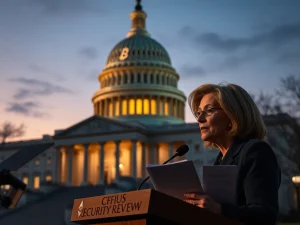
Stablecoins Won’t Trigger $6 Trillion Bank Crisis: Reuters Analysis Debunks Alarmist Predictions

Banking executives recently issued dramatic warnings about stablecoins potentially draining $6 trillion from traditional financial institutions, but a Reuters Breakingviews analysis reveals these claims lack mathematical foundation. The comprehensive investigation demonstrates how money remains within the broader financial system regardless of its form, challenging alarmist predictions about cryptocurrency’s impact on banking stability.
Stablecoins and the $6 Trillion Banking Concern
Bank of America CEO Brian Moynihan recently voiced significant concerns about stablecoins during a financial conference in New York. He specifically warned that these digital assets could potentially pull approximately $6 trillion from traditional banking deposits. Moynihan emphasized the perceived threat, stating that financial institutions must take this challenge seriously. However, financial analysts immediately questioned the underlying assumptions behind these projections.
Reuters Breakingviews conducted a detailed examination of the banking sector’s claims. Their investigation revealed fundamental flaws in the argument that stablecoins would remove money from the financial system entirely. Instead, the analysis shows that funds typically move between different forms within the same broader ecosystem. Financial experts note that this misunderstanding stems from confusion about how digital assets interact with traditional finance.
The Mathematical Reality Behind Banking Deposits
The $6 trillion figure represents approximately one-quarter of all United States bank deposits. Banking industry representatives suggest that as stablecoins gain mainstream adoption, consumers might transfer significant portions of their checking and savings accounts into digital dollar equivalents. This scenario assumes a direct, one-way movement of funds from traditional banks to cryptocurrency platforms.
Financial analysts counter this assumption with several key points:
- Reserve Requirements: Reputable stablecoin issuers maintain substantial reserves in traditional banks
- Circular Flow: Money often returns to banking institutions through various channels
- Regulatory Frameworks: Emerging regulations ensure greater transparency and oversight
- Market Limitations: Current stablecoin markets cannot absorb trillions without structural changes
Furthermore, banking institutions themselves increasingly participate in digital asset markets. Major financial firms now offer cryptocurrency custody services, trading platforms, and blockchain-based products. This participation creates additional channels for funds to circulate between traditional and digital finance.
Historical Context of Financial Innovation Fears
Financial history reveals repeated patterns of established institutions expressing concern about disruptive technologies. Banking leaders voiced similar apprehensions about money market funds in the 1970s, online banking in the 1990s, and peer-to-peer lending in the 2000s. Each innovation initially sparked concerns about deposit outflows, yet the banking system adapted and incorporated these developments.
The current discussion about stablecoins follows this historical pattern. Financial technology typically evolves to complement rather than replace existing systems. Regulatory developments increasingly shape how traditional and digital finance interact, creating frameworks for coexistence rather than displacement.
How Money Actually Moves in Digital Finance
When consumers purchase stablecoins, they typically transfer funds from bank accounts to cryptocurrency exchanges. These exchanges then maintain substantial reserves in traditional banking institutions. Major stablecoin issuers like Circle (USDC) and Tether (USDT) publicly disclose their reserve holdings, which predominantly consist of cash and cash equivalents in regulated banks.
This creates a circular financial flow:
| Transaction Stage | Traditional Banking Impact | Digital Asset Impact |
|---|---|---|
| Initial Purchase | Funds leave consumer accounts | Stablecoins enter consumer wallets |
| Exchange Processing | Funds enter exchange bank accounts | Stablecoin supply increases |
| Reserve Management | Banks hold exchange deposits | Issuers maintain reserve ratios |
| Redemption Process | Funds return to consumer accounts | Stablecoin supply decreases |
This circular movement demonstrates that money doesn’t disappear from the financial system. Instead, it transitions between different forms and custodians while remaining within the broader banking infrastructure. Financial analysts emphasize that this understanding fundamentally contradicts the notion of permanent deposit drainage.
Regulatory Developments and Financial Stability
Recent regulatory advancements significantly address banking sector concerns about stablecoins. The proposed Clarity for Payment Stablecoins Act and similar international frameworks establish clear guidelines for digital asset issuers. These regulations mandate specific reserve requirements, regular audits, and transparency standards that protect consumers and maintain financial stability.
Key regulatory provisions include:
- Reserve Requirements: 100% backing with high-quality liquid assets
- Audit Standards: Monthly attestations by independent auditors
- Custody Rules: Segregation of consumer and issuer funds
- Disclosure Mandates: Public reporting of reserve composition
These regulatory developments create structured pathways for stablecoins to integrate with traditional finance. Rather than operating outside the banking system, regulated digital assets increasingly function as complementary payment instruments with appropriate safeguards.
Expert Perspectives on Financial Integration
Financial technology experts emphasize the evolving relationship between traditional banking and digital assets. Dr. Sarah Johnson, a financial systems analyst at Stanford University, notes that “the narrative of competition between banks and stablecoins overlooks their growing interdependence.” She points to increasing partnerships between financial institutions and blockchain companies as evidence of convergence rather than conflict.
Banking industry representatives increasingly acknowledge this reality. While public statements sometimes emphasize competitive concerns, internal strategies reveal substantial investment in digital asset infrastructure. Major banks now allocate significant resources to blockchain research, cryptocurrency custody solutions, and tokenization platforms.
Market Realities and Practical Limitations
The current stablecoin market presents practical constraints that contradict the $6 trillion outflow scenario. The total market capitalization of all stablecoins currently stands at approximately $160 billion. This represents less than 3% of the alleged potential outflow figure. Even with aggressive growth projections, stablecoins would require decades to reach the scale necessary to impact banking deposits as dramatically as predicted.
Several factors limit rapid expansion:
- Regulatory Approval Processes: New issuers face lengthy review periods
- Infrastructure Requirements: Scaling requires substantial technical development
- Consumer Adoption Patterns: Mainstream usage develops gradually
- Institutional Integration Timelines: Corporate adoption follows careful implementation
Financial analysts emphasize that these practical constraints create natural limits on how quickly stablecoins could potentially impact banking deposits. The gradual nature of financial innovation provides ample time for adaptation and integration.
Conclusion
The Reuters analysis conclusively demonstrates that stablecoins won’t cause a $6 trillion bank crisis despite alarming predictions from some banking executives. The mathematical reality shows that money remains within the financial system regardless of its form, circulating between traditional and digital channels. Regulatory developments, market limitations, and historical patterns of financial innovation all support this conclusion. As digital assets continue evolving, their integration with traditional finance appears more likely than displacement, creating new opportunities rather than existential threats to banking stability.
FAQs
Q1: What exactly are stablecoins and how do they work?
Stablecoins are digital assets designed to maintain stable value by pegging to reserve assets like the U.S. dollar. They function as cryptocurrency tokens that can be transferred on blockchain networks while maintaining price stability through collateralization mechanisms.
Q2: Why are banks concerned about stablecoins?
Banking institutions express concern that widespread stablecoin adoption might reduce traditional deposit bases, potentially impacting their ability to lend and generate revenue. However, analysis shows these concerns may overestimate the actual impact on banking operations.
Q3: How do stablecoin reserves actually work?
Reputable stablecoin issuers maintain reserves equivalent to their circulating supply. These reserves typically consist of cash, cash equivalents, and short-term government securities held in regulated financial institutions, creating a direct connection to traditional banking.
Q4: What regulations govern stablecoins currently?
Stablecoin regulation varies by jurisdiction but increasingly includes reserve requirements, regular audits, transparency mandates, and consumer protection measures. Proposed legislation in multiple countries aims to establish comprehensive frameworks for digital asset oversight.
Q5: Can stablecoins and traditional banks coexist?
Evidence suggests stablecoins and traditional banks increasingly operate as complementary systems rather than competitors. Many financial institutions now offer cryptocurrency services, while stablecoin issuers maintain substantial banking relationships, creating interconnected financial ecosystems.