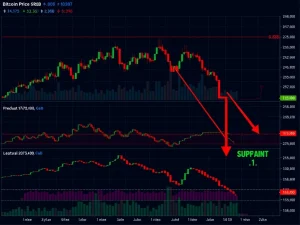
Bitcoin Price Prediction: Options Markets Reveal Bleak 6% Chance for $90K Rebound by March

Bitcoin’s dramatic plunge below $63,000 in early February 2025 has sent shockwaves through cryptocurrency markets, triggering urgent questions about the digital asset’s near-term trajectory. As investors grapple with dismal U.S. economic data, weakening equities, and mounting fears about artificial intelligence sector valuations, derivatives markets now provide a sobering forecast. According to options pricing data from leading exchanges, Bitcoin faces just a 6% probability of reclaiming the $90,000 threshold by late March. This analysis examines the complex interplay between macroeconomic forces, institutional positioning, and derivatives market signals that shape Bitcoin’s current predicament.
Bitcoin Options Market Signals Extreme Caution
Derivatives markets serve as sophisticated sentiment gauges, reflecting collective expectations about future price movements. On February 5, 2025, Deribit exchange data revealed particularly telling pricing dynamics. The right to purchase Bitcoin at $90,000 on March 27 traded at just $522, indicating minimal demand for bullish exposure at that level. Meanwhile, put options granting the right to sell Bitcoin at $50,000 for the same date commanded $1,380, suggesting greater concern about downside risks. These pricing disparities translate to probability assessments using established financial models. Specifically, the Black-Scholes options pricing model indicates less than 6% odds of Bitcoin reaching $90,000 by March expiration. Conversely, the same framework suggests approximately 20% probability of Bitcoin falling to $50,000 or lower. This asymmetric risk assessment highlights the prevailing bearish sentiment among sophisticated market participants.
Macroeconomic Headwinds Intensify Market Pressure
Bitcoin’s 30% decline from its January 28 peak near $90,500 coincides with deteriorating economic indicators across multiple sectors. U.S. employment data released in early February revealed significant weakness, with employers announcing 108,435 layoffs in January alone. This figure represents a staggering 118% increase from the same period in 2024 and marks the highest January total since 2009. Such labor market deterioration typically correlates with reduced risk appetite across financial markets. Furthermore, technology sector concerns have amplified volatility. Google’s projection of $180 billion in capital expenditure for 2026, nearly double its 2025 outlay, has raised questions about sustainable growth in artificial intelligence investments. Qualcomm’s subsequent 8% decline after issuing weaker growth guidance further underscored these concerns. These macroeconomic and sector-specific pressures have created a challenging environment for speculative assets like Bitcoin.
Institutional Bitcoin Holdings Face Liquidation Risks
Public company Bitcoin reserves have emerged as a potential source of selling pressure during market downturns. MicroStrategy, the largest corporate Bitcoin holder, recently saw its enterprise value dip to $53.3 billion against a $54.2 billion acquisition cost for its Bitcoin treasury. Japan’s Metaplanet faced a similar valuation gap, with its market capitalization at $2.95 billion compared to a $3.78 billion Bitcoin acquisition cost. These discrepancies raise concerns about potential forced liquidations if companies need to cover debt obligations during prolonged bear markets. The situation echoes broader risk reduction across institutional portfolios. In mid-January, Christopher Wood of Jefferies removed his recommended 10% Bitcoin allocation from model portfolios, citing emerging quantum computing risks that could theoretically compromise cryptocurrency security. While such risks remain largely theoretical, their inclusion in institutional decision-making reflects heightened caution.
Comparative Asset Performance Reveals Broader Trends
Bitcoin’s 27% weekly decline in early February mirrored losses across multiple asset classes, suggesting systemic rather than cryptocurrency-specific factors. Traditional financial companies including Thomson Reuters, PayPal, Robinhood, and Applovin experienced comparable percentage declines during the same period. Even silver, typically viewed as a safe-haven asset, suffered a dramatic 36% weekly drop after reaching a $121.70 all-time high on January 29. This correlation across disparate assets indicates broad-based risk reduction rather than targeted cryptocurrency selling. The synchronized movement highlights Bitcoin’s increasing integration with traditional financial markets and its sensitivity to macroeconomic sentiment shifts. Market participants appear to be reducing exposure to volatile assets regardless of their underlying characteristics or narratives.
Technical and Structural Market Factors
Beyond macroeconomic concerns, several cryptocurrency-specific factors contribute to current market dynamics. Exchange data reveals declining open interest across derivatives platforms, suggesting reduced speculative positioning. Funding rates have normalized from previously elevated levels, indicating diminished leverage in the system. On-chain metrics show reduced transaction volumes and slowing network activity, typically associated with consolidation phases. The options market term structure has flattened considerably, with near-term volatility expectations declining relative to longer-dated contracts. This normalization suggests traders anticipate reduced price swings in the immediate future. Additionally, the put-call skew has shifted toward puts, reflecting greater demand for downside protection. These technical indicators collectively paint a picture of cautious, defensive positioning among cryptocurrency traders and investors.
Historical Context and Recovery Scenarios
Bitcoin has experienced similar corrections throughout its history, with recovery timelines varying based on market structure and external conditions. The current 30% decline from local highs compares to previous corrections of 20-40% that typically resolved within 30-90 days during bull markets. However, the presence of macroeconomic headwinds distinguishes the current environment from purely technical corrections. Historical analysis suggests that Bitcoin often bottoms when fear reaches extreme levels, as measured by sentiment indicators and derivatives positioning. The options market’s current pricing implies such fear exists but hasn’t yet reached capitulation levels seen during major market bottoms. Recovery toward $90,000 would require either a significant improvement in macroeconomic conditions or a decoupling from traditional risk assets—neither scenario appears imminent according to current data.
Expert Perspectives on Market Trajectory
Financial analysts emphasize the interconnected nature of current market dynamics. “Bitcoin’s correlation with technology stocks has increased significantly during this downturn,” notes a derivatives strategist at a major trading firm. “This suggests institutional investors view digital assets through a similar risk framework as growth equities.” Another analyst specializing in cryptocurrency options observes, “The volatility surface tells us traders are pricing for range-bound action with slight downside skew. The market doesn’t expect dramatic moves in either direction over the next six weeks.” These professional assessments align with the quantitative signals from options markets, reinforcing the low-probability assessment for a rapid $90,000 recovery. Experts also highlight the importance of monitoring credit markets, as stress in corporate debt could trigger further risk reduction across all speculative assets.
Potential Catalysts for Market Reversal
While current probabilities appear low, several developments could alter Bitcoin’s trajectory before March expiration. Unexpected positive economic data, particularly regarding employment or inflation, could restore risk appetite. Regulatory clarity in major jurisdictions might provide fundamental support. Institutional adoption milestones, such as new ETF approvals or corporate treasury announcements, could generate positive momentum. Technological developments addressing quantum computing concerns might alleviate security fears. However, options pricing suggests traders assign low likelihood to these catalysts materializing within the relevant timeframe. The market essentially bets on continuation of current trends rather than disruptive positive developments. This conservative positioning reflects the prevailing uncertainty across global financial markets as multiple sectors face simultaneous challenges.
Conclusion
Bitcoin options markets deliver a clear, data-driven message about near-term expectations. With just 6% probability priced in for a return to $90,000 by late March 2025, derivatives traders express extreme skepticism about rapid recovery. This assessment stems from converging macroeconomic pressures, institutional risk reduction, and broader financial market weakness. While Bitcoin has historically recovered from similar corrections, the current environment presents unique challenges through its correlation with deteriorating economic indicators and technology sector concerns. Market participants should monitor options pricing dynamics alongside traditional indicators for signals of shifting sentiment. The Bitcoin price prediction landscape remains dominated by caution, with derivatives markets suggesting range-bound action rather than dramatic rebounds in the coming weeks.
FAQs
Q1: What probability do options markets assign to Bitcoin reaching $90,000 by March 2025?
Derivatives pricing suggests approximately 6% probability based on Black-Scholes modeling of March $90,000 call options.
Q2: What factors are driving Bitcoin’s current price decline?
Multiple converging factors including weak U.S. employment data, technology sector concerns, institutional risk reduction, and broader financial market weakness.
Q3: How are corporate Bitcoin holdings affecting market dynamics?
Companies like MicroStrategy and Metaplanet face valuation gaps that raise concerns about potential forced selling if bear market conditions persist and debt obligations require coverage.
Q4: How does Bitcoin’s performance compare to other assets during this downturn?
Bitcoin’s 27% weekly decline closely mirrored losses in companies like PayPal and Robinhood, plus a 36% drop in silver prices, indicating broad-based risk reduction.
Q5: What would need to change for Bitcoin to rebound to $90,000 by March?
A significant improvement in macroeconomic conditions, decoupling from traditional risk assets, or unexpected positive catalysts would be required—none appear imminent according to current market pricing.