Spot Gold Price Plummets: Precious Metal Crashes Below $5,000 Threshold
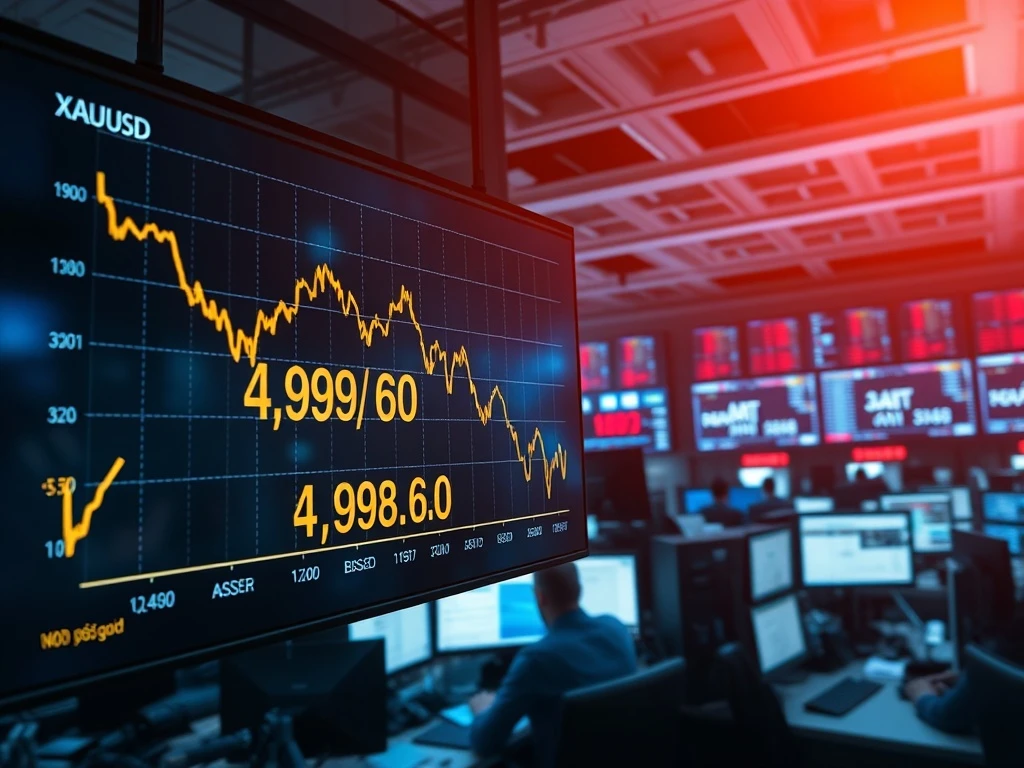
LONDON, February 1, 2025 – Global financial markets witnessed a sharp correction in the precious metals sector as the spot gold price decisively broke below the critical $5,000 per ounce level. This significant drop represents a dramatic reversal from the record-setting highs seen just 48 hours prior, sending ripples through commodity markets and investor portfolios worldwide. The sudden decline highlights the extreme volatility currently characterizing the haven asset class.
Spot Gold Price Experiences Sharp Volatility
Spot gold is currently trading at $4,988.600 per ounce. Consequently, this marks a steep 7.08% decline from the previous trading session. Moreover, this downturn follows an extraordinary peak of $5,598.750 reached on January 29. The two-day swing of over $610 per ounce underscores a period of intense market turbulence. Analysts immediately began scrutinizing the catalysts behind this rapid price movement. Historically, gold maintains a reputation as a stable store of value. However, recent trading patterns demonstrate its susceptibility to sharp macro-driven corrections.
Several interconnected factors typically drive such pronounced moves in the gold market. Firstly, shifts in central bank policy expectations can dramatically alter opportunity costs. Secondly, movements in the US Dollar Index (DXY) exert inverse pressure on dollar-denominated commodities. Thirdly, large-scale liquidations in derivative markets, such as futures and options, can accelerate price trends. Finally, changes in real Treasury yields directly impact gold’s attractiveness as a non-yielding asset. Market participants are currently evaluating the weight of each factor.
Analyzing the Broader Precious Metals Sell-Off
The sell-off extended aggressively beyond gold. Spot silver mirrored and exceeded gold’s downward trajectory. Specifically, silver prices declined more than 15% to trade at $98.697 per ounce. This parallel drop confirms a broad-based retreat from the precious metals complex. Silver often exhibits higher volatility than gold due to its dual role as both a monetary and industrial metal. Therefore, its sharper decline frequently amplifies trends seen in the gold market.
Other precious metals like platinum and palladium also registered losses during the session. This sector-wide weakness suggests a macro-driven event rather than a commodity-specific issue. Traders reported elevated trading volumes across all major precious metals exchanges. The table below summarizes the key price movements:
| Metal | Price (per oz) | Daily Change | Note |
|---|---|---|---|
| Spot Gold (XAU) | $4,988.60 | -7.08% | Fell below $5,000 support |
| Spot Silver (XAG) | $98.697 | -15.2% | Outperformed gold to the downside |
Expert Perspective on Market Mechanics
Dr. Anya Sharma, Chief Commodities Strategist at Global Markets Insight, provided context for the move. “The velocity of this decline points to a technical breakdown following a parabolic rally,” Sharma noted. “The $5,000 level represented a major psychological and technical support zone. Its breach likely triggered automated selling programs and stop-loss orders, creating a self-reinforcing downward spiral.” Sharma further emphasized that fundamental drivers, such as a sudden shift in interest rate expectations or a strengthening dollar, often provide the initial spark for such events.
Market structure also plays a crucial role. The proliferation of leveraged ETF products and futures contracts can magnify price swings. When prices fall, margin calls force leveraged holders to liquidate positions. This liquidation then adds further selling pressure. This process, known as a cascade, can decouple prices from underlying fundamentals in the short term. Observers are now watching physical market demand, particularly from central banks and major ETFs, for signs of stabilization.
Historical Context and Comparative Analysis
While a 7% single-day drop is significant, gold has experienced larger historical drawdowns. For instance, during the 2013 taper tantrum, gold fell over 25% in a six-month period. Similarly, the 2008 financial crisis saw gold decline sharply in its initial phase before its historic bull run. The current price, even after the drop, remains elevated within a multi-year uptrend. This context is vital for long-term investors.
The gold-to-silver ratio, a key metric watched by traders, experienced a notable shift. The ratio measures how many ounces of silver it takes to buy one ounce of gold. A rising ratio often indicates risk-off sentiment where gold outperforms silver. The recent sell-off, with silver falling faster, caused this ratio to increase sharply. This movement suggests the market is pricing in broader economic concerns beyond simple inflation hedging. Key drivers for such a shift often include:
- Liquidity Crunches: A scramble for cash (USD) can force selling of all assets, including gold.
- Real Yield Spikes: A rapid rise in inflation-adjusted bond yields diminishes gold’s appeal.
- Technical Breakdowns: The breach of major chart levels triggers algorithmic and momentum selling.
- Regulatory Changes: Unforeseen policy announcements impacting commodity markets.
The Role of Central Banks and Macro Data
Central bank activity remains a cornerstone of gold demand. In recent years, institutions like the People’s Bank of China and the Central Bank of Russia have been consistent net buyers. A pause or reversal in this accumulation could remove a major source of structural demand. Conversely, continued buying on price dips would provide a powerful support floor. The next set of central bank gold reserve statistics will be scrutinized for clues.
Simultaneously, macroeconomic data releases preceding the drop are under review. Strong US employment or GDP figures could reinforce expectations for a “higher for longer” interest rate environment. Higher rates increase the opportunity cost of holding gold, which pays no interest. Any data suggesting robust economic growth can dampen safe-haven demand. Market participants are now recalculating their Fed policy path projections based on the latest information.
Implications for Investors and the Global Economy
The sudden drop in gold prices carries implications across multiple domains. For miners, declining margins could impact production forecasts and capital expenditure plans. For national economies reliant on gold exports, fiscal revenues may face pressure. For retail and institutional investors, portfolio rebalancing is often necessary following such a large move in a core asset class. The event serves as a stark reminder of the inherent volatility in all financial markets, even traditional havens.
Furthermore, the price action may influence currency markets, particularly those of commodity-exporting nations. It could also affect inflation expectations, as gold is sometimes viewed as a leading indicator for price pressures. However, analysts caution against drawing immediate, broad economic conclusions from a single day’s move. The focus now shifts to whether this is a healthy correction within a bull market or the start of a more profound trend reversal. Monitoring trading volumes and price action around the new $4,900-$5,000 range will be critical.
Conclusion
The spot gold price breaking below $5,000 per ounce marks a significant moment for commodity markets. This 7% decline, coupled with an even steeper fall in silver, underscores the current volatility in precious metals. While technical selling and shifting macro expectations provided the immediate catalyst, the long-term trend will depend on fundamental drivers like central bank demand, real yields, and geopolitical stability. Investors should view this move through a lens of historical context and maintain a focus on diversified, risk-managed portfolio strategies. The coming sessions will be crucial in determining whether this is a brief correction or a more sustained shift in the spot gold price narrative.
FAQs
Q1: What caused the spot gold price to fall below $5,000?
A1: The drop is attributed to a combination of factors, likely including a strengthening US dollar, rising real bond yields, and a technical breakdown after a parabolic rally. The breach of the key $5,000 support level triggered automated and momentum-based selling.
Q2: How does silver’s performance compare to gold’s in this sell-off?
A2: Silver fell more sharply, declining over 15% compared to gold’s 7% drop. This is typical as silver generally exhibits higher volatility due to its smaller market and dual role as an industrial and monetary metal.
Q3: Is this a good time to buy gold after the price drop?
A3: Investment decisions depend on individual strategy and outlook. Some view corrections as buying opportunities in a long-term bull trend, while others await confirmation of a new support level. Consulting a financial advisor based on your goals is recommended.
Q4: What is the historical significance of a move like this?
A4: While sharp, single-day drops of this magnitude have occurred before (e.g., 2013, 2008). Historically, they have often been corrections within longer-term trends rather than definitive reversals, but each event has unique drivers.
Q5: What should investors watch to gauge the next direction for gold?
A5: Key indicators include the US Dollar Index (DXY), 10-year Treasury real yields, central bank gold buying data, physical demand from major markets, and trading volume around the new price range of $4,900-$5,000.