SpaceCoin’s Revolutionary Partnership with Midnight: Securing Global Privacy Through Satellite Messaging
In a groundbreaking development for decentralized communications, SpaceCoin (SPACE) announced a strategic partnership with Midnight, the privacy-focused blockchain led by Cardano founder Charles Hoskinson, on March 15, 2025. This collaboration aims to develop satellite-based privacy messaging technology that could fundamentally transform how people communicate in regions with internet restrictions or surveillance concerns. The partnership represents a significant convergence of satellite infrastructure and advanced cryptographic technology at a time when digital privacy concerns are reaching unprecedented levels globally.
SpaceCoin and Midnight: A Strategic Alliance for Privacy
The SpaceCoin and Midnight partnership brings together two complementary technological visions. SpaceCoin, a decentralized satellite internet project, provides the physical infrastructure for global communication bypassing traditional internet service providers. Meanwhile, Midnight contributes sophisticated privacy-preserving technology developed by Input Output Global (IOG), the research and development company behind Cardano. Their joint technical review will focus specifically on implementing peer-to-peer messaging applications that operate independently of centralized servers. This approach addresses growing concerns about data sovereignty and surveillance capitalism that have dominated technology discussions throughout the 2020s.
Industry analysts immediately recognized the partnership’s significance. According to blockchain infrastructure reports from 2024, satellite-based blockchain networks represent one of the fastest-growing segments in decentralized technology. The global market for privacy-focused communication tools has expanded by approximately 300% since 2022, driven by increasing government surveillance and corporate data collection practices. This collaboration positions both projects at the forefront of addressing these concerns through technological innovation rather than regulatory compliance alone.
Technical Architecture: How Satellite Privacy Messaging Works
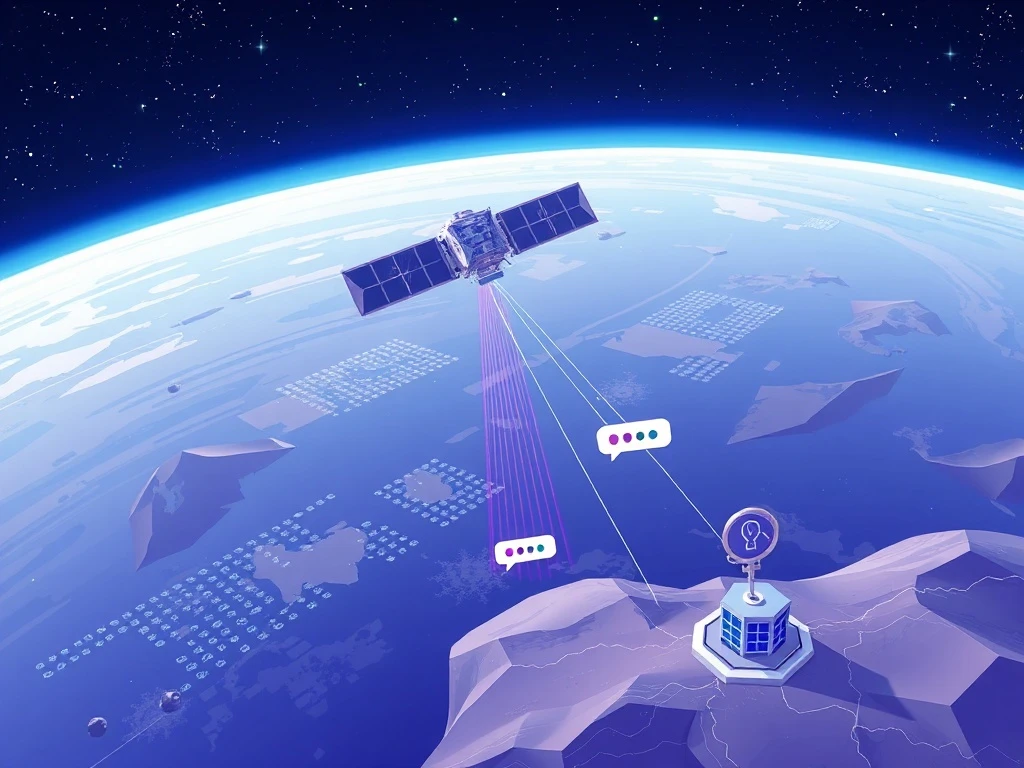
The proposed system combines several advanced technologies to create a unique privacy solution. SpaceCoin’s satellite constellation will serve as the communication backbone, transmitting encrypted messages between users globally. Midnight’s zero-knowledge proof (ZKP) technology will enable verification protocols that confirm user authorization without revealing sensitive information. This dual-layer approach addresses both the transmission and authentication aspects of private communications.
The technical implementation involves three key components:
- Satellite Infrastructure: SpaceCoin’s low-earth orbit satellites provide the physical communication layer
- Privacy Protocol: Midnight’s ZKP technology enables anonymous authentication
- Decentralized Architecture: Peer-to-peer networking eliminates central points of failure
This architecture offers distinct advantages over existing encrypted messaging platforms. Traditional services like Signal or Telegram still rely on centralized servers and internet service providers, creating potential vulnerabilities. The satellite-based approach bypasses terrestrial infrastructure entirely, making it particularly valuable for users in regions with internet censorship or unreliable connectivity. Additionally, the zero-knowledge proof implementation represents a significant advancement over current end-to-end encryption methods by protecting metadata as well as message content.
Zero-Knowledge Proofs: The Privacy Revolution
Zero-knowledge proofs represent one of the most significant cryptographic advancements of the past decade. These protocols allow one party to prove to another that a statement is true without revealing any information beyond the validity of the statement itself. In the context of the SpaceCoin-Midnight collaboration, ZKPs would enable users to verify their authorization to communicate without exposing their identity, location, or any other identifying information.
The technology has evolved considerably since its theoretical inception in the 1980s. Practical implementations became feasible only in the 2010s, with blockchain projects driving much of the recent innovation. Midnight’s specific approach builds upon years of research conducted by IOG’s cryptography team, which has published multiple peer-reviewed papers on efficient ZKP implementations. Their technology reportedly achieves verification times under 100 milliseconds even on mobile devices, making it practical for real-time messaging applications.
Market Context and Competitive Landscape
The privacy technology sector has experienced remarkable growth since the early 2020s. Several factors have driven this expansion, including increased awareness of data privacy rights, regulatory developments like the EU’s Digital Services Act, and growing concerns about state surveillance. The table below illustrates key market segments relevant to the SpaceCoin-Midnight initiative:
| Market Segment | 2024 Market Size | Projected 2026 Growth | Key Players |
|---|---|---|---|
| Encrypted Messaging | $4.2B | 45% | Signal, Telegram, WhatsApp |
| Satellite Communications | $28.7B | 32% | Starlink, OneWeb, Iridium |
| Privacy Blockchain | $1.8B | 210% | Monero, Zcash, Secret Network |
| Zero-Knowledge Technology | $0.9B | 340% | zkSync, StarkWare, Polygon |
SpaceCoin and Midnight enter a competitive but rapidly expanding market. Their unique positioning at the intersection of satellite infrastructure and advanced cryptography creates differentiation from existing solutions. While traditional encrypted messaging apps focus on software-based encryption, and satellite providers concentrate on connectivity, this partnership addresses both layers simultaneously. This comprehensive approach could potentially capture market share from multiple segments as the technology matures.
Implementation Timeline and Development Roadmap
The collaboration follows a structured development approach with clear milestones. The initial phase involves a comprehensive technical review scheduled for completion by Q2 2025. This review will assess compatibility between SpaceCoin’s satellite network and Midnight’s privacy protocols. Following successful completion, the teams plan to develop a minimum viable product (MVP) by Q4 2025, with full deployment targeted for mid-2026.
The development roadmap includes several critical stages:
- Phase 1 (Q1-Q2 2025): Technical review and protocol design
- Phase 2 (Q3-Q4 2025): MVP development and limited testing
- Phase 3 (Q1-Q2 2026): Expanded beta testing with selected users
- Phase 4 (Q3 2026 onward): Full deployment and scaling
This measured approach reflects the technical complexity of integrating satellite communications with zero-knowledge proofs. Both teams have emphasized their commitment to rigorous testing and security audits before any public release. The development process will include multiple external security reviews by established blockchain auditing firms, following industry best practices for critical infrastructure projects.
Regulatory Considerations and Compliance Framework
Privacy technology exists within a complex regulatory environment that varies significantly across jurisdictions. The SpaceCoin-Midnight initiative must navigate regulations concerning telecommunications, data privacy, encryption standards, and financial technology. Notably, satellite communications fall under international telecommunications regulations, while privacy-preserving technologies face scrutiny under various national security frameworks.
The development teams have engaged legal experts specializing in technology regulation across multiple jurisdictions. Their compliance strategy focuses on several key principles: transparency about technical capabilities, cooperation with legitimate law enforcement requests through appropriate legal channels, and adherence to international telecommunications standards. This balanced approach aims to create technology that protects individual privacy while respecting legitimate regulatory concerns.
Potential Applications and Use Cases
The satellite-based privacy messaging technology could serve numerous applications beyond basic communication. Journalists operating in restrictive environments could benefit from secure channels for source communication and information transmission. Humanitarian organizations working in conflict zones or disaster areas could maintain operational security while coordinating relief efforts. Businesses requiring secure communications for sensitive negotiations or intellectual property protection might find value in the system’s robust security guarantees.
Additional potential applications include:
- Disaster Response: Maintaining communications when terrestrial infrastructure fails
- Financial Services: Secure transmission of sensitive financial data
- Healthcare: Private exchange of medical information in remote areas
- Academic Research: Collaboration between researchers in politically sensitive fields
- Diplomatic Communications: Secure channels for international diplomacy
These diverse applications demonstrate the technology’s potential impact across multiple sectors. The versatility stems from the fundamental design principles: decentralization prevents single points of failure, satellite connectivity ensures global coverage, and zero-knowledge proofs provide unprecedented privacy guarantees. This combination addresses limitations present in current communication technologies.
Technical Challenges and Innovation Requirements
Developing satellite-based privacy messaging presents several significant technical challenges. Latency in satellite communications, particularly for low-earth orbit constellations, typically ranges from 20-40 milliseconds for one-way transmission. This creates constraints for real-time messaging applications that require rapid response times. Additionally, bandwidth limitations on satellite networks necessitate efficient data compression and transmission protocols.
The integration of zero-knowledge proofs introduces computational requirements that must function within the constraints of satellite communication systems. Midnight’s research team has reportedly developed optimized ZKP implementations specifically designed for resource-constrained environments. These optimizations reduce computational overhead by approximately 60% compared to standard implementations, making them suitable for satellite-based applications.
Other technical considerations include:
- Network Handoffs: Maintaining connections as users move between satellite coverage areas
- Power Management: Optimizing energy consumption for mobile devices
- Protocol Efficiency: Minimizing data overhead for satellite transmission
- Security Auditing: Ensuring robust protection against emerging threats
Addressing these challenges requires innovative approaches across multiple technical domains. The collaboration brings together expertise in satellite communications, cryptography, distributed systems, and network optimization. This multidisciplinary approach increases the likelihood of developing practical solutions to these complex problems.
Conclusion
The SpaceCoin and Midnight partnership represents a significant advancement in privacy technology and decentralized communications. By combining satellite infrastructure with zero-knowledge proof cryptography, the collaboration addresses fundamental limitations in current communication systems. The technology could provide unprecedented privacy guarantees while maintaining global accessibility, particularly valuable for users in regions with internet restrictions or surveillance concerns. As development progresses through 2025 and 2026, this initiative will likely influence broader trends in both blockchain technology and privacy-preserving communications. The SpaceCoin and Midnight collaboration demonstrates how innovative combinations of existing technologies can create novel solutions to pressing global challenges in digital privacy and communication freedom.
FAQs
Q1: What makes satellite-based messaging more private than traditional internet messaging?
Satellite-based messaging bypasses terrestrial internet infrastructure entirely, eliminating potential interception points at internet service providers or network hubs. When combined with zero-knowledge proof technology, it creates a system where not even the network operators can determine who is communicating or what they’re saying.
Q2: How does zero-knowledge proof technology work in messaging applications?
Zero-knowledge proofs allow users to prove they have authorization to communicate without revealing their identity, location, or any other identifying information. The protocol mathematically verifies permissions while keeping all personal data completely private, including from the network operators themselves.
Q3: When will the SpaceCoin-Midnight messaging system be available to the public?
The development roadmap indicates a minimum viable product could be available for limited testing by Q4 2025, with full public deployment targeted for mid-2026. The timeline depends on successful completion of technical reviews, security audits, and regulatory compliance assessments.
Q4: Will this technology be accessible to users in countries with internet restrictions?
Yes, one of the primary design goals is to provide communication capabilities in regions with internet censorship or surveillance. The satellite-based approach operates independently of national internet infrastructure, potentially bypassing government-imposed restrictions on digital communications.
Q5: How does this partnership benefit the broader blockchain and cryptocurrency ecosystem?
The collaboration demonstrates practical applications of blockchain-adjacent technologies beyond financial transactions. It showcases how cryptographic innovations developed for cryptocurrencies can solve real-world problems in communications infrastructure, potentially increasing mainstream adoption and understanding of privacy-preserving technologies.