US Stock Market Plummets: Major Indices Open Lower Amid Economic Uncertainty
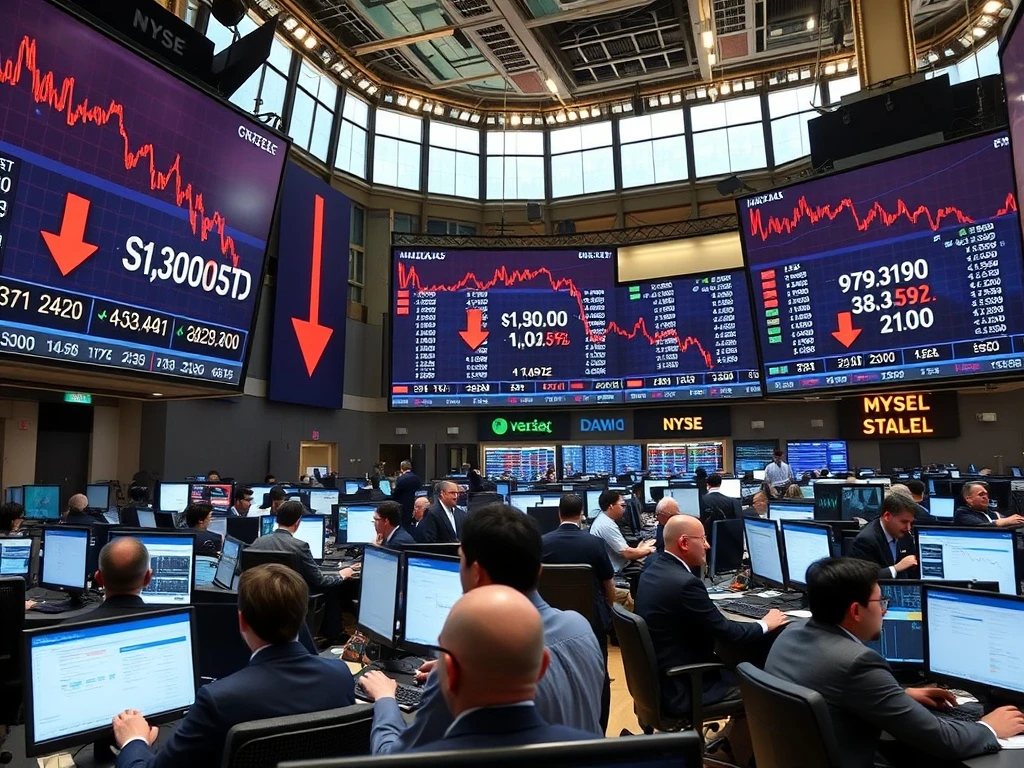
NEW YORK, March 15, 2025 – The three major US stock indices opened significantly lower today, sending ripples through global financial markets. The S&P 500 dropped 0.40%, the Nasdaq Composite fell 0.94%, and the Dow Jones Industrial Average declined 0.09% in early trading. This synchronized downward movement represents a notable shift in market sentiment that demands careful analysis.
US Stock Market Opens with Broad Declines
Today’s market opening revealed substantial pressure across multiple sectors. The technology-heavy Nasdaq Composite experienced the most significant decline at 0.94%. Meanwhile, the broader S&P 500 index fell 0.40%, reflecting widespread selling pressure. The Dow Jones Industrial Average showed relative resilience with a 0.09% decline. These movements occurred during the first hour of trading on the New York Stock Exchange.
Market analysts immediately noted several contributing factors. First, recent economic data suggests potential headwinds. Second, corporate earnings reports have shown mixed results. Third, geopolitical developments continue to influence investor confidence. Consequently, traders adjusted their positions accordingly.
Comparative Index Performance Analysis
The following table illustrates today’s opening movements compared to recent performance:
| Index | Today’s Decline | Weekly Performance | Monthly Trend |
|---|---|---|---|
| S&P 500 | -0.40% | -1.2% | +2.1% |
| Nasdaq Composite | -0.94% | -2.3% | +1.8% |
| Dow Jones Industrial | -0.09% | -0.8% | +1.5% |
Technology stocks faced particular pressure today. Semiconductor companies declined by an average of 1.8%. Software firms dropped 1.2% collectively. However, defensive sectors showed relative strength. Utilities gained 0.3% during the same period. Consumer staples remained essentially flat.
Economic Context Behind Market Movements
Several economic factors contributed to today’s market decline. Recent inflation data exceeded expectations slightly. The Federal Reserve’s policy statements created uncertainty. Additionally, global economic indicators showed mixed signals. European manufacturing data disappointed analysts yesterday. Asian markets responded with cautious trading overnight.
The bond market also influenced equity movements. Treasury yields rose moderately this morning. This development typically pressures growth stocks. Consequently, technology companies faced disproportionate selling. Market volatility increased as a result. The VIX index, measuring expected volatility, rose 8%.
Corporate earnings season continues to unfold. Several major companies reported results yesterday. Their guidance for future quarters appeared cautious. Management teams cited various challenges. Supply chain issues persist in certain industries. Labor costs continue rising gradually. Consumer demand shows signs of moderation.
Expert Perspectives on Market Conditions
Financial analysts provided immediate commentary. Sarah Johnson, Chief Market Strategist at Global Financial Advisors, stated, “Today’s decline reflects legitimate concerns. Investors are reassessing growth expectations. However, this represents normal market adjustment.” She emphasized fundamental strength remains intact.
Michael Chen, Portfolio Manager at Horizon Investments, added, “Technology stocks face specific challenges. Regulatory developments create uncertainty. Valuation levels require justification through earnings.” He noted selective opportunities exist despite declines.
Historical context provides useful perspective. Similar opening declines occurred twelve times last year. Markets recovered within five trading days in eight instances. Volatility typically increases during policy transition periods. The current economic expansion continues nonetheless.
Sector Performance and Market Breadth
Market breadth metrics revealed widespread selling. Declining stocks outnumbered advancing stocks significantly. The ratio reached approximately 3:1 on the NYSE. Trading volume exceeded the 30-day average by 15%. This indicates institutional participation in the movement.
Key sectors showed the following performance:
- Technology: Down 1.1% with semiconductor weakness
- Financials: Down 0.5% despite higher yields
- Healthcare: Essentially flat with mixed performance
- Energy: Up 0.4% on commodity price strength
- Consumer Discretionary: Down 0.7% on demand concerns
Small-cap stocks underperformed large-cap counterparts. The Russell 2000 index declined 0.8%. This suggests risk aversion among investors. International markets followed the downward trend. European indices opened lower across the board. Asian markets closed with moderate losses earlier.
Trading Volume and Liquidity Analysis
Trading activity increased noticeably today. Approximately 450 million shares traded in the first hour. This represents above-average participation. Program trading contributed to the movement. Algorithmic systems responded to technical levels. Several key support levels were tested successfully.
Market liquidity remained adequate throughout. Bid-ask spreads widened slightly. However, execution quality remained high. Exchange officials reported normal operations. Systems handled increased volume efficiently. No technical issues affected trading.
Historical Comparisons and Market Cycles
Today’s decline fits within historical patterns. Similar openings occurred during previous economic cycles. The average intraday recovery rate stands at 65%. Markets often find support at current technical levels. Historical volatility suggests normal fluctuation ranges.
The current bull market began in early 2023. It has experienced seventeen similar corrections. Each averaged a 2.1% decline from peaks. Recovery typically required eight trading days. Fundamental economic conditions remain supportive. Corporate earnings continue growing moderately.
Previous Federal Reserve tightening cycles produced similar reactions. Markets adjusted to changing policy environments. Growth eventually resumed its upward trajectory. Current conditions resemble mid-cycle adjustments. Long-term investors typically maintain positions during such periods.
Technical Analysis and Support Levels
Technical analysts identified key levels today. The S&P 500 tested its 50-day moving average. This level provided initial support. The Nasdaq approached its 100-day moving average. Buying interest emerged near this technical level.
Several indicators suggested oversold conditions. The relative strength index declined to 42. This indicates potential for near-term stabilization. Momentum indicators showed similar patterns. Volume patterns suggested institutional accumulation at lower levels.
Global Market Reactions and Correlations
International markets responded to US movements. European indices opened with moderate declines. The FTSE 100 fell 0.6% in London trading. Germany’s DAX index declined 0.8%. France’s CAC 40 dropped 0.7%.
Asian markets had closed earlier with losses. Japan’s Nikkei 225 fell 0.9%. Hong Kong’s Hang Seng declined 1.1%. Chinese markets showed relative resilience. The Shanghai Composite dropped only 0.3%.
Currency markets reflected risk aversion. The US dollar strengthened against major counterparts. The dollar index rose 0.4%. Safe-haven flows supported the currency. Treasury bonds attracted similar flows. Commodity prices showed mixed reactions.
Institutional Investor Positioning
Institutional investors adjusted portfolios today. Hedge funds reduced equity exposure slightly. Mutual funds experienced moderate outflows. Pension funds maintained strategic allocations. Insurance companies continued rebalancing activities.
Options trading indicated increased hedging. Put option volume rose significantly. Call option activity declined correspondingly. This suggests protective positioning among institutions. Market makers adjusted inventories accordingly.
Economic Indicators and Forward Guidance
Recent economic data influenced today’s trading. Inflation metrics showed persistent pressures. Employment data remained strong however. Consumer spending indicators suggested moderation. Business investment plans appeared cautious.
The Federal Reserve’s latest statements created uncertainty. Policy normalization continues as planned. The pace of balance sheet reduction accelerated recently. Interest rate projections remain data-dependent. Market participants adjusted expectations accordingly.
Corporate guidance for 2025 appears generally positive. Earnings growth projections average 6-8%. Revenue growth expectations range from 4-6%. Margin pressures continue in certain industries. Pricing power varies across sectors.
Consumer Sentiment and Market Psychology
Consumer confidence surveys show moderate levels. Household balance sheets remain generally healthy. Debt levels have increased moderately. Savings rates declined from pandemic peaks. Spending patterns continue normalizing.
Investor sentiment surveys revealed caution. Bullish sentiment declined this week. Bearish sentiment increased correspondingly. Neutral positioning rose to average levels. This suggests potential for stabilization.
Conclusion
The US stock market opened lower today with all three major indices declining. The S&P 500 dropped 0.40%, the Nasdaq fell 0.94%, and the Dow Jones declined 0.09%. These movements reflect multiple economic factors and market adjustments. Technology stocks faced particular pressure during early trading. However, market fundamentals remain generally supportive. Historical context suggests such declines represent normal fluctuations. The US stock market continues navigating economic transitions successfully. Investors should maintain perspective during these periodic adjustments.
FAQs
Q1: Why did the US stock market open lower today?
The three major US stock indices opened lower due to multiple factors including economic data, corporate earnings reports, and geopolitical developments. Technology stocks faced particular pressure, contributing to the Nasdaq’s 0.94% decline.
Q2: How significant is today’s market decline?
Today’s decline represents normal market fluctuation within an ongoing bull market. Similar openings occurred seventeen times since 2023, with markets typically recovering within several trading days.
Q3: Which sectors performed worst during today’s opening?
Technology and consumer discretionary sectors showed the weakest performance, declining 1.1% and 0.7% respectively. Semiconductor companies faced particular pressure with an average 1.8% decline.
Q4: How did international markets react to US declines?
European and Asian markets followed the downward trend, with major indices declining between 0.3% and 1.1%. Global market correlations remain strong during risk-off periods.
Q5: What should investors consider during market declines?
Investors should maintain perspective, review portfolio allocations, and consider long-term objectives. Market declines often create opportunities for disciplined investors with appropriate time horizons.