BTC Perpetual Futures Long/Short Ratio Reveals Critical Market Equilibrium in 2025
Global cryptocurrency markets witnessed a remarkable equilibrium in trading sentiment on March 15, 2025, as the BTC perpetual futures long/short ratio across major exchanges revealed an almost perfect balance between bullish and bearish positions. This critical data point provides traders with valuable insights into market psychology and potential price direction. The BTC perpetual futures market, representing billions in open interest, serves as a crucial barometer for institutional and retail sentiment alike.
Understanding BTC Perpetual Futures Long/Short Ratios
Perpetual futures contracts represent one of cryptocurrency’s most innovative financial instruments. Unlike traditional futures with expiration dates, perpetual futures remain open indefinitely. Consequently, traders utilize funding rates to maintain price alignment with spot markets. The long/short ratio measures the percentage of open positions betting on price increases versus those anticipating declines. This metric offers a real-time snapshot of market sentiment across different trading platforms.
Major exchanges calculate these ratios using sophisticated algorithms that analyze all open positions. Typically, ratios above 50% indicate bullish dominance, while figures below 50% suggest bearish control. However, extreme readings often signal potential market reversals. For instance, excessively high long ratios might indicate overcrowded trades and vulnerability to liquidations. Conversely, extreme short ratios could foreshadow short squeezes.
Current Market Analysis: A State of Equilibrium
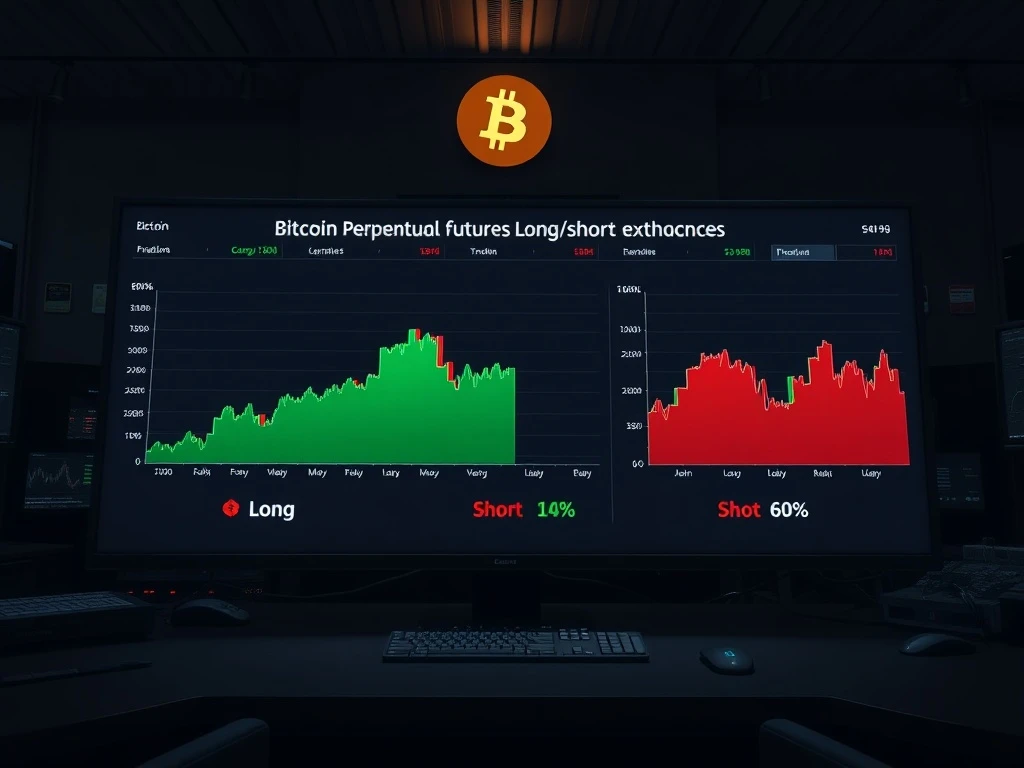
The latest 24-hour data reveals an unprecedented balance in BTC perpetual futures positioning. Across the three largest exchanges by open interest, the aggregate ratio shows 49.74% long positions versus 50.26% short positions. This near-perfect equilibrium suggests market participants remain deeply divided about Bitcoin’s immediate direction. Such balanced sentiment often precedes significant price movements as one side eventually gains dominance.
Exchange-specific data provides additional context for this analysis. Binance, the world’s largest cryptocurrency exchange, reports 50.07% long positions against 49.93% short positions. Bybit shows a similar pattern with 50.14% long versus 49.86% short. Meanwhile, OKX demonstrates slightly more bullish positioning at 50.36% long against 49.64% short. These minor variations reflect different user demographics and trading strategies across platforms.
| Exchange | Long Positions | Short Positions |
|---|---|---|
| Overall Aggregate | 49.74% | 50.26% |
| Binance | 50.07% | 49.93% |
| Bybit | 50.14% | 49.86% |
| OKX | 50.36% | 49.64% |
Historical Context and Market Implications
Historical data analysis reveals that balanced long/short ratios frequently occur during consolidation periods. For example, similar patterns emerged before Bitcoin’s major breakout in late 2024. Market analysts typically interpret balanced ratios as accumulation phases where neither bulls nor bears establish clear control. This creates conditions for volatile breakouts once new information enters the market.
Several factors contribute to the current equilibrium. First, macroeconomic uncertainty persists regarding interest rate policies. Second, regulatory developments continue to influence institutional participation. Third, Bitcoin’s upcoming halving event creates conflicting narratives about supply dynamics. These competing forces create the balanced sentiment reflected in the BTC perpetual futures data.
Technical Analysis of Perpetual Futures Markets
Perpetual futures markets employ sophisticated mechanisms to maintain price stability. The funding rate mechanism represents a crucial component of this ecosystem. When long positions dominate, funding rates typically turn positive, requiring longs to pay shorts. Conversely, negative funding rates occur during short-dominated markets. Current funding rates across major exchanges remain neutral, confirming the balanced long/short ratio data.
Open interest represents another critical metric for understanding market depth. The three exchanges analyzed collectively manage billions in BTC perpetual futures open interest. This substantial volume ensures price discovery remains efficient and liquid. High open interest during balanced sentiment periods often indicates institutional participation and sophisticated hedging strategies.
- Funding Rates: Neutral across exchanges, confirming balanced positioning
- Open Interest: Remains near all-time highs despite balanced ratios
- Liquidation Levels: Clustered around current price, increasing volatility potential
- Volume Patterns: Show increased activity during Asian and European trading sessions
Expert Perspectives on Market Sentiment
Financial analysts emphasize the importance of context when interpreting long/short ratios. “Balanced ratios don’t indicate market indecision,” explains derivatives analyst Maria Chen. “They reflect sophisticated positioning where institutions hedge both directions. The BTC perpetual futures market has matured significantly since 2023.” This perspective highlights how professional traders utilize complex strategies beyond simple directional bets.
Risk management professionals note additional considerations. “Traders should monitor changes in these ratios alongside other metrics,” advises risk manager David Park. “Sudden shifts in BTC perpetual futures positioning often precede liquidations. The current equilibrium suggests reduced immediate liquidation risk but increased potential for sharp moves.” This analysis underscores the importance of comprehensive market monitoring.
Comparative Analysis with Traditional Markets
BTC perpetual futures markets demonstrate unique characteristics compared to traditional financial derivatives. Unlike equity futures, cryptocurrency derivatives trade 24/7 across global exchanges. This continuous operation creates different sentiment patterns and reaction times. Additionally, the absence of centralized clearinghouses introduces distinct risk profiles that sophisticated traders must navigate carefully.
The correlation between BTC perpetual futures and spot markets has strengthened significantly since 2023. Regulatory improvements and institutional adoption have enhanced market efficiency. Consequently, long/short ratios now provide more reliable sentiment indicators than during earlier cryptocurrency market phases. This maturation benefits all market participants through improved price discovery.
Conclusion
The BTC perpetual futures long/short ratio reveals a market at equilibrium in March 2025. This balanced sentiment across major exchanges suggests sophisticated positioning rather than indecision. Traders should monitor this metric alongside funding rates, open interest, and macroeconomic developments. The BTC perpetual futures market continues evolving as a crucial sentiment indicator for cryptocurrency participants worldwide. Understanding these dynamics remains essential for navigating volatile market conditions effectively.
FAQs
Q1: What does the BTC perpetual futures long/short ratio measure?
The ratio measures the percentage of open positions betting on price increases (long) versus decreases (short) across cryptocurrency exchanges. It provides real-time sentiment indicators for market participants.
Q2: Why is a balanced long/short ratio significant?
Balanced ratios often indicate market equilibrium where neither bulls nor bears dominate. This frequently precedes significant price movements as new information breaks the stalemate between competing positions.
Q3: How do exchanges calculate these ratios?
Exchanges use proprietary algorithms analyzing all open perpetual futures positions. They typically update these metrics continuously, providing traders with real-time sentiment data across different timeframes and trading pairs.
Q4: What other metrics should traders consider alongside long/short ratios?
Traders should monitor funding rates, open interest, liquidation levels, and trading volume. Additionally, macroeconomic factors and regulatory developments significantly impact BTC perpetual futures markets.
Q5: How have BTC perpetual futures markets evolved since 2023?
Markets have matured through increased institutional participation, regulatory clarity, and improved risk management tools. This evolution has strengthened correlations with spot markets and enhanced price discovery mechanisms.