XRP Price Crash: The 2 Devastating Reasons January’s Rally Imploded in 24 Hours
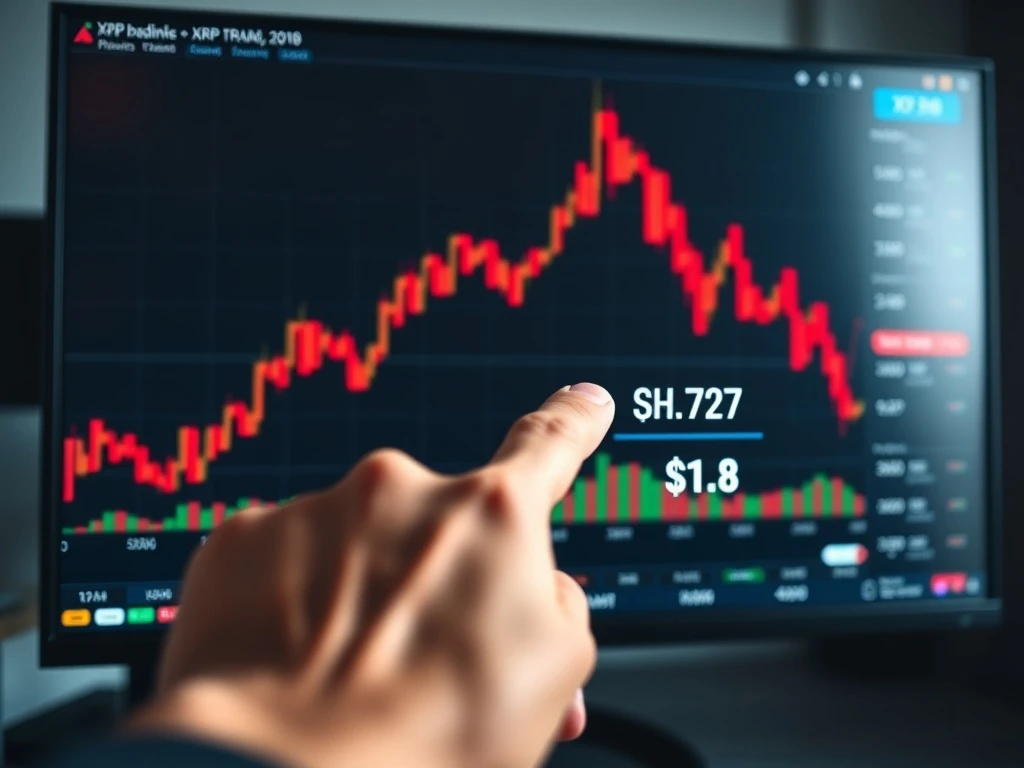
On January 26, 2026, the cryptocurrency market witnessed a stark reversal as XRP, the digital asset associated with Ripple, surrendered its entire January advance in a single, volatile trading session. The altcoin plunged to $1.88, with a wick extending near $1.81, abruptly halting what appeared to be a promising recovery. This dramatic event sent shockwaves through the trading community, forcing a rapid reassessment of the token’s near-term trajectory and underlying strength. The swift erosion of gains highlights the fragile nature of cryptocurrency recoveries and underscores the critical interplay between technical indicators and institutional sentiment.
Technical Breakdown: The Anatomy of XRP’s Sharp Reversal
The collapse of XRP’s price was not an isolated event but the culmination of weakening technical foundations. Momentum indicators, which traders heavily rely on to gauge market strength, had been flashing warning signs prior to the drop. The Relative Strength Index (RSI), a key oscillator measuring the speed and change of price movements, remained in a subdued state, failing to exhibit the solid bullish momentum typically associated with a sustainable rally. Concurrently, the Moving Average Convergence Divergence (MACD) indicator—a tool for identifying trend changes and momentum—persisted in a weak configuration, signaling a distinct lack of conviction among buyers.
Also read: Ethereum's $2,500 Challenge: Market Data and the Rise of Pepeto
This technical deterioration left XRP vulnerable at a key juncture. The asset was testing a key resistance zone that had previously acted as a ceiling. When buying pressure failed to materialize, it triggered a cascade of sell orders. Consequently, the focus for traders and analysts swiftly shifted from potential upside targets to critical support levels. The immediate question became whether XRP could stabilize at the $1.88 level or if a breakdown toward the next significant support at $1.73 was imminent. A failure to hold $1.88 would technically expose the token to accelerated selling pressure, potentially deepening the correction significantly.
Institutional Inflows vs. Market Psychology: A Critical Disconnect
Interestingly, the price collapse occurred against a seemingly contradictory backdrop of continued institutional interest. Data from fund flow aggregators revealed that XRP-focused exchange-traded funds (ETFs), particularly those managed by Bitwise, recorded a net inflow of $3.43 million on the very day of the price disaster. Furthermore, cumulative inflows into XRP ETFs had surpassed $1.36 billion by January 23, 2026, indicating sustained institutional allocation. This data suggests that large, long-term oriented investors—often referred to as “whales” and institutions—were not engaging in panic selling.
Also read: Crypto Listing Scams: Binance CEO Changpeng Zhao Issues Critical Warning to Investors
However, this institutional confidence failed to translate into immediate price support. The disconnect reveals a nuanced market dynamic: while strategic capital may be accumulating for a longer-term horizon, short-term market sentiment and technical structure are often driven by a different set of actors, including retail traders, algorithmic systems, and leveraged positions. The aggressive accumulation by whales, as noted by on-chain analytics firm CryptoQuant, particularly when XRP dipped below $2 and then $1.88, acted as a buffer but was insufficient to counteract the broader wave of selling pressure from other market participants. This created a tense standoff between long-term accumulation and short-term technical breakdown.
Macro Context and Leadership Sentiment Amidst the Sell-Off
The volatility in XRP’s price also unfolded within a broader macroeconomic and regulatory context. At the World Economic Forum in Davos, Ripple CEO Brad Garlinghouse maintained a publicly bullish stance, stating on record that he anticipated the cryptocurrency would reach new all-time highs. His optimism was rooted in perceived tailwinds, including growing enterprise adoption of Ripple’s underlying technology and improving regulatory clarity in key jurisdictions like the United States. Nevertheless, the market’s immediate reaction demonstrated a clear divergence between executive optimism and trader pragmatism.
Traders, by necessity, often prioritize near-term price action and chart structure over long-range fundamental forecasts. In January 2026, their focus remained fixed on XRP’s inability to hold key levels and its weak momentum profile. The market’s message was clear: without a catalyst strong enough to shift the immediate supply-demand balance, positive long-term narratives would struggle to provide price support during a technical downturn. This period served as a case study in how market structure can temporarily override fundamental sentiment.
Key Data Points from the January 2026 XRP Move:
- Price Peak (Pre-Collapse): Approximately ~$2.40+ (varies by exchange)
- Crash Low (Wick): ~$1.81
- Stabilization Point: $1.88
- Next Major Support: $1.73
- Daily ETF Inflow (Jan 26): $3.43 million (Bitwise-led)
- Total ETF Inflows (by Jan 23): >$1.36 billion
- Key Indicator Status: RSI (Subdued), MACD (Weak)
Comparative Market Analysis and Trader Implications
The event also prompted analysis against the behavior of other major digital assets. While the broader cryptocurrency market often experiences correlated movements, the sharp, session-specific wipeout of XRP’s monthly gains highlighted asset-specific vulnerabilities. Analysts examined whether this was a symptom of XRP underperforming the broader market or part of a wider risk-off move. The persistence of ETF inflows suggested the former—that this was a technical correction within XRP’s own trading range, exacerbated by its failure to sustain momentum above key psychological levels like $2.00.
For active traders, the episode reinforced several critical principles. First, it underscored the importance of confirmation from multiple indicators; a price rally lacking support from strong RSI or MACD readings is inherently fragile. Second, it highlighted the different timeframes used by market participants—institutional accumulation (long-term) versus algorithmic and retail trading (short-term). Finally, it placed intense focus on precise support levels. The $1.88 zone transformed from a mere number on a chart into a critical battleground determining the token’s immediate future direction, teaching a clear lesson about the importance of dynamic support and resistance in crypto volatility.
Conclusion
The unraveling of XRP’s January 2026 advance in a single session was a multifaceted event driven primarily by a breakdown in technical momentum and a disconnect between institutional accumulation and short-term market sentiment. While long-term indicators like sustained ETF inflows and bullish executive commentary provided a foundational narrative, they were insufficient to counteract the immediate selling pressure triggered by weak momentum indicators and a failure to hold key resistance. The XRP price crash served as a stark reminder that in cryptocurrency markets, technical structure often dictates short-term price action, regardless of longer-term fundamental beliefs. The market’s attention now remains fixed on whether key support levels can hold, determining if this event was a healthy correction or the start of a deeper retracement.
FAQs
Q1: What exactly happened to XRP’s price on January 26, 2026?
The XRP cryptocurrency experienced a severe price drop that erased all the gains it had accumulated throughout January 2026 in just one trading session. It fell to a low of $1.88, testing support and wiping out its monthly advance.
Q2: Why did the price crash happen despite positive ETF inflows?
There was a disconnect between timeframes. Institutional investors via ETFs were making long-term allocations, but short-term market sentiment and technical selling pressure from other traders (retail, algorithmic) overwhelmed this buying support, causing the immediate crash.
Q3: What were the key technical reasons for the XRP reversal?
The primary technical reasons were weak momentum indicators. The Relative Strength Index (RSI) was subdued, and the Moving Average Convergence Divergence (MACD) was weak, signaling a lack of strong buying conviction to sustain the rally, making it vulnerable to a sell-off.
Q4: What is the significance of the $1.88 and $1.73 price levels for XRP?
In technical analysis, these are identified as critical support levels. $1.88 was the immediate stabilization point after the crash. If XRP fails to hold $1.88, analysts view $1.73 as the next major support zone; a break below that could trigger further significant selling.
Q5: Did Ripple’s leadership comment on this market volatility?
Yes. Ripple CEO Brad Garlinghouse, speaking at the World Economic Forum around that time, maintained a bullish long-term outlook, predicting new all-time highs for XRP based on adoption and regulation. However, this optimism did not prevent the short-term technical sell-off.

This article was produced with AI assistance and reviewed by our editorial team for accuracy and quality.