XRP Price Breakout Looms as Polygon Faces Resistance; BlockDAG’s Essential March 4 Trading Launch at $0.00016
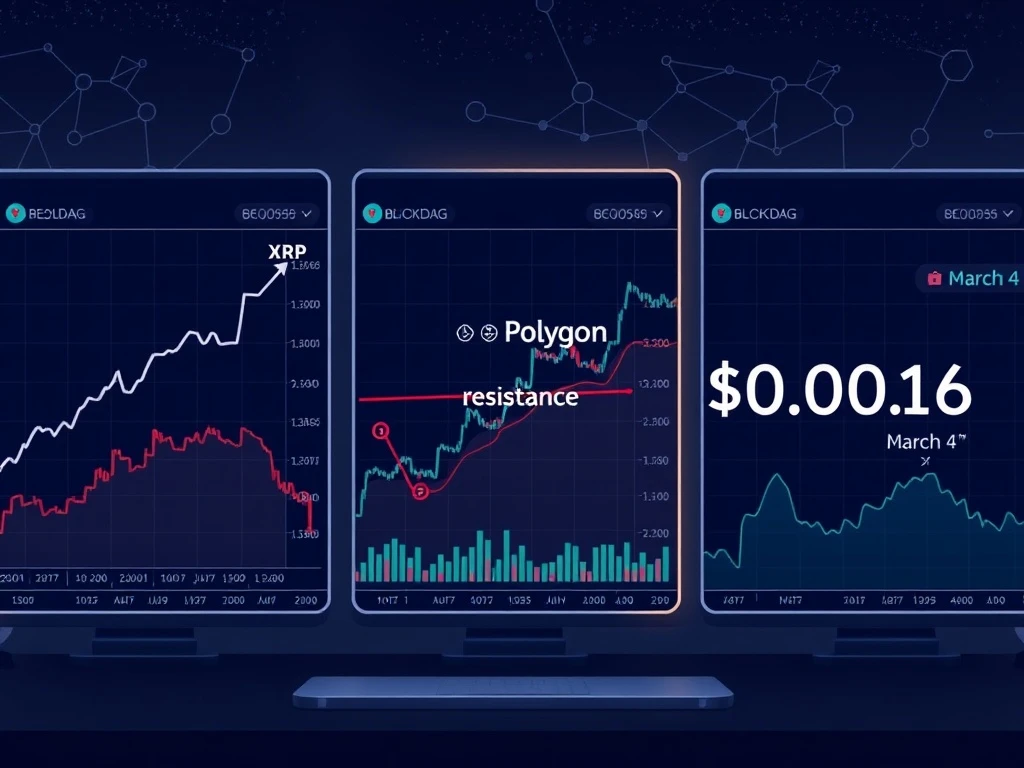
Global cryptocurrency markets exhibit divergent patterns in early 2025, with XRP testing critical technical thresholds, Polygon confronting established resistance barriers, and BlockDAG Network preparing for a significant trading milestone on March 4 at $0.00016 per token. These simultaneous developments highlight the fragmented yet interconnected nature of the digital asset ecosystem, where individual project trajectories can signal broader market sentiment shifts. Market analysts closely monitor these movements for clues about capital rotation and sector-specific momentum.
XRP Price Analysis: Handling the Breakout Threshold
XRP currently trades within a consolidation pattern that has persisted for several weeks. The asset faces a decisive technical juncture, with its price compressed between key support and resistance levels identified by historical trading data. A successful breakout above the immediate resistance zone, approximately 15% above current levels based on recent chart analysis, could trigger renewed bullish momentum. Conversely, failure to breach this barrier may result in extended consolidation or a retest of lower support.
Also read: Crypto Listing Scams: Binance CEO Changpeng Zhao Issues Critical Warning to Investors
Several fundamental factors contribute to this technical setup. Ongoing developments in Ripple’s legal proceedings with the U.S. Securities and Exchange Commission continue to influence investor sentiment, although recent court rulings have provided incremental clarity. Additionally, adoption metrics for Ripple’s On-Demand Liquidity (ODL) service show steady growth in cross-border payment corridors, particularly in regions like Southeast Asia and the Middle East. Transaction volume on the XRP Ledger has remained resilient, averaging over 1.2 million daily transactions throughout February 2025 according to public ledger data.
Market Context and Liquidity Factors
Broader market conditions significantly impact XRP’s breakout potential. Bitcoin’s dominance rate and overall cryptocurrency market capitalization create the liquidity environment in which altcoins like XRP operate. Institutional flow data from regulated exchanges indicates mixed sentiment, with some funds increasing exposure to payment-focused cryptocurrencies while others maintain cautious positions. The relative strength index (RSI) for XRP suggests the asset is neither overbought nor oversold, providing technical space for movement in either direction.
Polygon’s Resistance Challenge: Technical and Fundamental Perspectives
Polygon’s MATIC token encounters substantial resistance near price levels last tested in late 2024. This resistance zone represents a concentration of historical selling pressure where previous rally attempts have stalled. Technical analysts note that overcoming this barrier requires sustained buying volume, which has been inconsistent in recent trading sessions. The resistance coincides with a 38.2% Fibonacci retracement level from the 2024 high-low range, a common technical obstacle in asset price discovery.
Fundamentally, Polygon continues to execute its Polygon 2.0 roadmap, which aims to transform the network into a value layer of the internet through zero-knowledge technology. Network activity metrics show healthy usage, with daily active addresses consistently exceeding 400,000 and total value locked in Polygon’s DeFi ecosystem maintaining stability above $1.1 billion. However, competitive pressure from other Layer 2 scaling solutions and emerging Layer 1 blockchains has intensified, potentially diverting developer attention and capital from the Polygon ecosystem.
Ecosystem Development and Competitive Sector
The Polygon network’s technical development progresses steadily, with several zkEVM upgrades deployed successfully in recent months. These enhancements improve transaction throughput and reduce costs for decentralized applications. Despite these improvements, the broader Layer 2 sector has become increasingly crowded, with solutions like Arbitrum, Optimism, and newer entrants competing for market share. This competitive dynamic may influence Polygon’s ability to attract the sustained capital inflow necessary to break through technical resistance levels.
BlockDAG Network: Approaching the March 4 Trading Milestone
BlockDAG Network prepares for its trading commencement on March 4, 2025, with an initial reference price of $0.00016 per token. The project utilizes a directed acyclic graph (DAG) structure combined with blockchain security principles, aiming to address scalability limitations of traditional linear blockchains. This hybrid approach theoretically enables higher transaction throughput while maintaining decentralized security guarantees, though the implementation faces significant technical challenges that the development team must overcome.
The project’s pre-launch phase included several development milestones, including testnet deployment and wallet infrastructure development. According to the project’s technical documentation, BlockDAG employs a consensus mechanism called PHANTOM, which optimizes for both security and parallel processing capability. The network architecture purportedly allows for asynchronous transaction confirmation, potentially reducing latency compared to conventional blockchain designs.
| Metric | XRP | Polygon (MATIC) | BlockDAG |
|---|---|---|---|
| Current Focus | Breakout above resistance | Overcoming price resistance | March 4 trading launch |
| Key Price Level | Breakout threshold | Resistance zone | $0.00016 reference |
| Primary Use Case | Cross-border payments | Ethereum scaling | Scalable DAG infrastructure |
| Network Status | Established, operational | Established, evolving | Pre-launch, upcoming |
| Market Position | Top 10 cryptocurrency | Top 20 cryptocurrency | New entrant |
Technical Architecture and Market Positioning
BlockDAG’s technical whitepaper describes a novel approach to distributed ledger technology that differs from both traditional blockchains and existing DAG implementations. The system reportedly employs a blockDAG structure where multiple blocks can reference multiple predecessors, creating a directed acyclic graph of blocks rather than a single chain. This design theoretically enables higher parallelism and throughput, though it introduces complexity in consensus determination and security assurance. The project enters a crowded infrastructure sector where established solutions already serve developer needs.
Cryptocurrency Market Dynamics in Early 2025
The broader cryptocurrency market context significantly influences all three assets. Macroeconomic factors including interest rate policies, regulatory developments, and institutional adoption trends create the environment in which these technical patterns unfold. Several key trends characterize the current market phase:
- Institutional Participation: Traditional financial institutions continue expanding cryptocurrency services, though the pace varies by region and asset type.
- Regulatory Evolution: Multiple jurisdictions are developing clearer regulatory frameworks, affecting market structure and participant behavior.
- Technological Convergence: Blockchain infrastructure increasingly integrates with traditional systems, particularly in finance and digital identity.
- Market Maturation: Correlation between major cryptocurrencies remains high during volatility spikes but diverges during stable periods.
These factors collectively shape the trading environment where XRP seeks breakout momentum, Polygon confronts resistance, and BlockDAG prepares for its market debut. Market participants must consider both project-specific fundamentals and these broader contextual elements when evaluating investment decisions.
Risk Considerations and Volatility Management
All cryptocurrency investments carry inherent risks, particularly during periods of technical inflection or project launches. Price volatility often increases around key technical levels and new listing events. Investors should consider several risk management principles:
- Technical breakouts sometimes fail, resulting in false signals and rapid price reversals.
- New project launches face liquidity challenges and potential price discovery volatility.
- Correlation with Bitcoin and Ethereum remains significant during market stress events.
- Regulatory developments can rapidly alter project fundamentals and market access.
Conclusion
The cryptocurrency market presents three distinct narratives as March 2025 approaches. XRP price action tests a critical breakout level that could determine its near-term trajectory, while Polygon’s MATIC token confronts established resistance that has previously halted advances. Simultaneously, BlockDAG Network prepares for its March 4 trading debut at $0.00016, introducing a new technical architecture to the competitive blockchain infrastructure sector. These developments collectively illustrate the dynamic, multi-faceted nature of digital asset markets, where established projects deal with technical patterns while new entrants attempt to demonstrate innovative approaches. Market participants should monitor these situations with attention to both technical signals and fundamental developments, recognizing that cryptocurrency markets remain influenced by complex interactions between technology, adoption, regulation, and market structure.
FAQs
Q1: What technical factors indicate XRP might be preparing for a breakout?
XRP’s price has consolidated within a narrowing range for several weeks, approaching a historical resistance level. Technical indicators including volume patterns, Bollinger Band compression, and momentum oscillators suggest building pressure for directional movement. A sustained close above this resistance with increased volume would confirm breakout conditions.
Q2: Why is Polygon facing significant resistance at current price levels?
Polygon’s resistance zone represents a concentration of historical selling pressure where previous rally attempts have failed. This price area aligns with key Fibonacci retracement levels and coincides with overhead supply from investors who purchased at higher prices during previous market cycles. Overcoming this barrier requires substantial buying interest.
Q3: What distinguishes BlockDAG’s technology from traditional blockchains?
BlockDAG employs a directed acyclic graph structure where multiple blocks can reference multiple predecessors, enabling greater parallelism than linear blockchains. This design theoretically increases transaction throughput but introduces complexity in achieving consensus across the network’s distributed nodes.
Q4: How might broader market conditions affect these individual cryptocurrency movements?
Bitcoin dominance rates, overall market capitalization trends, and macroeconomic factors significantly influence altcoin performance. During risk-off periods, correlation between cryptocurrencies typically increases, potentially overwhelming individual project fundamentals. Conversely, during stable or bullish conditions, project-specific developments often drive relative outperformance.
Q5: What should investors consider when evaluating new cryptocurrency projects like BlockDAG?
Investors should examine technical whitepapers for innovation and feasibility, assess development team experience, review tokenomics and distribution plans, evaluate competitive positioning within the sector, and consider initial liquidity conditions. New projects face particular challenges in establishing network effects and developer adoption.

This article was produced with AI assistance and reviewed by our editorial team for accuracy and quality.