Web3 Revenue Surge: Dramatic Shift from Blockchains to Wallets and DeFi Apps Reshapes Crypto Investment
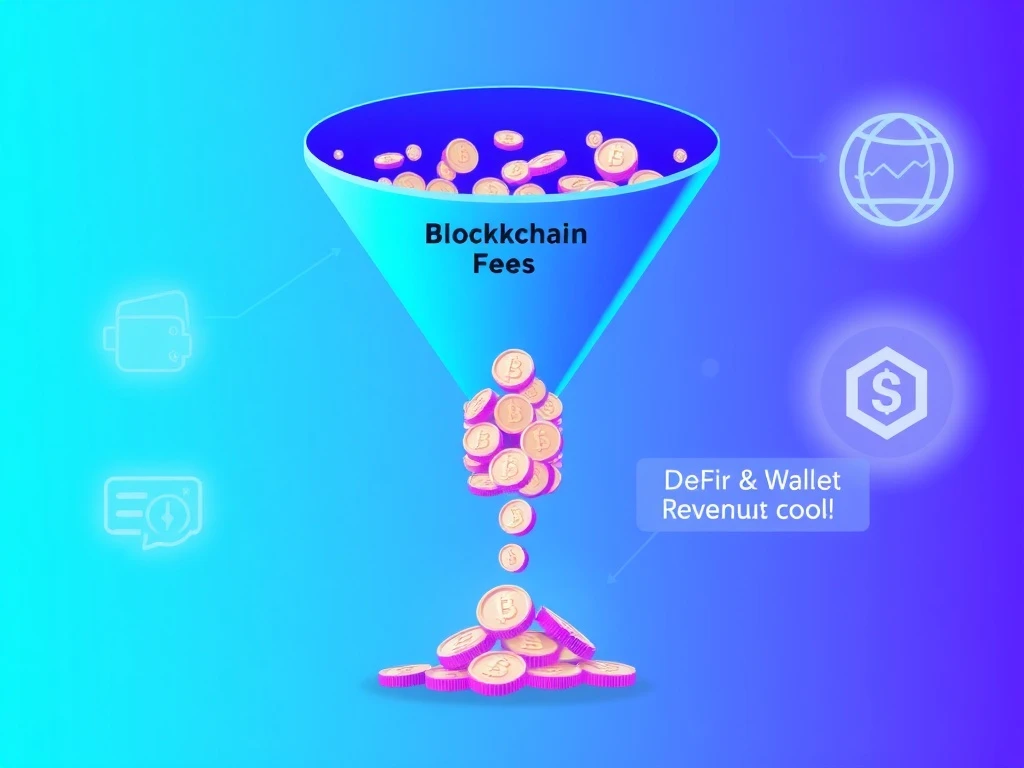
A seismic shift is redefining value capture in the cryptocurrency sector as of early 2025. Recent data confirms a dramatic pivot, with Web3 revenue flowing decisively away from foundational blockchain networks and toward user-facing decentralized finance (DeFi) applications and digital wallets. This trend signals a fundamental change in where developers and institutional capital are concentrating their efforts, moving closer to the end-user experience.
Web3 Revenue Captured by DeFi Protocols and Wallets
Industry analysis reveals a stark new reality for blockchain economics. According to data from crypto intelligence platform Real Vision, decentralized finance applications now capture an astonishing five times the fees generated by the underlying base-layer blockchains themselves. This represents a complete reversal from mid-2024, when fee generation between the two layers was roughly equal. Consequently, the financial upside of the Web3 ecosystem is increasingly concentrated in the applications built on top of networks, not the networks alone.
Also read: Crypto Clarity Act Gains Significant Backing as Armstrong Shifts Stance, Pressuring Congress
Jamies Coutts, Chief Crypto Analyst at Real Vision, contextualized this shift in a recent analysis. “While I am a believer that blockchain’s network effects will always command a premium,” Coutts noted, “it makes sense that more value than what is currently ascribed should drift to the front end — wallets, DeFi apps, and protocols closest to users.” This statement underscores a maturation in the market, where utility and user interaction become primary drivers of value.
DeFi Dominance in Fee Generation Rankings
Data from analytics firm DeFiLlama provides concrete evidence of this revenue migration. Over the past 30 days, the top 17 fee-generating entities in the entire crypto industry were all applications or protocols, not base-layer blockchains. The leader by a massive margin was stablecoin issuer Tether, generating approximately $563 million in fees. This figure dwarfs the earnings of even the most active blockchains.
Also read: XRP Price Prediction: Analyst Eyes $2 Target Before Potential Retest of Gaussian Channel Support
Solana was the sole blockchain to break into the top 20, capturing over $20.4 million in fees. Meanwhile, Ethereum, often considered the bedrock of decentralized applications, ranked 27th with $10.3 million generated. This ranking dynamic powerfully illustrates where economic activity and, by extension, investor attention, is now focused. The narrative is no longer solely about which blockchain is most used, but about which applications on those blockchains are capturing the most value.
Expert Analysis on the Investment Implications
This revenue shift carries significant implications for investment strategy and developer incentives. For years, a primary investment thesis centered on accumulating the native tokens of high-throughput blockchains. However, the current data suggests a more nuanced approach is emerging. Investors are now scrutinizing the economic models of specific DeFi protocols, wallet services, and decentralized exchanges (DEXs) that sit atop these networks.
The trend indicates that simply providing settlement and security—the core functions of a base layer—may not be enough to capture the lion’s share of ecosystem value. Instead, protocols that enable complex financial transactions, manage user assets, or provide critical liquidity are becoming the industry’s cash engines. This could accelerate development in application-specific areas like decentralized identity, advanced wallet security, and cross-chain interoperability solutions.
User Activity Underpins the Revenue Shift
The driving force behind this revenue reallocation is clear: user activity. According to on-chain data from Nansen, Solana led all networks with over 68 million active addresses in a 30-day period, a 14% increase. This high level of user engagement directly fuels the fee generation for applications built on its network. Ethereum, while sixth in active addresses with 13 million, saw a remarkable 53% growth in activity, suggesting a resurgence that may also benefit its application layer.
This correlation between active users and application revenue highlights a virtuous cycle. Engaging applications attract users, whose transactions generate fees for the protocols, which in turn funds further development and attracts more users. The base blockchain benefits from increased transaction volume and security, but the premium financial rewards are increasingly captured one layer up. This model mirrors the evolution of the traditional internet, where immense value accrued to applications like Google and Facebook, not just to the underlying TCP/IP protocol.
Conclusion
The evidence is conclusive: a major Web3 revenue shift is underway, moving value capture from blockchain infrastructure to the DeFi applications and wallets that users interact with daily. This transition marks a maturation phase for the cryptocurrency industry, moving beyond infrastructure battles toward a focus on utility, user experience, and sustainable economic models at the application layer. For investors, developers, and analysts, the imperative is now to evaluate not just the chain, but the strength and fee-generating potential of the ecosystem built upon it. The era of application-layer value dominance has arrived.
FAQs
Q1: What does “Web3 revenue shift” mean?
It refers to the trend where a growing percentage of total fees and value generated in the cryptocurrency ecosystem is captured by user-facing applications like DeFi protocols and wallets, rather than by the underlying blockchain networks themselves.
Q2: Which DeFi protocol is currently generating the most fees?
According to DeFiLlama data, stablecoin issuer Tether is the leading fee-generating protocol, earning approximately $563 million over a recent 30-day period, far surpassing any single blockchain.
Q3: How does this shift affect blockchain investments?
It suggests investors may need to look beyond simply investing in a blockchain’s native token. The new focus includes evaluating the economic strength and user adoption of the specific applications and DeFi protocols built on top of that blockchain.
Q4: Why are DeFi apps capturing more revenue than blockchains?
DeFi apps allow complex financial services like lending, trading, and yield generation, which often involve multiple steps and higher fees per user interaction. Blockchains primarily collect simpler transaction fees for security and settlement.
Q5: Does this mean blockchains are becoming less important?
No. Blockchains remain the essential, secure foundation. However, their role is evolving into a utility layer. The data indicates that while critical, they may capture a smaller relative share of the total economic value created in the Web3 ecosystem as it grows.

This article was produced with AI assistance and reviewed by our editorial team for accuracy and quality.