Ethereum Linux Vision: Vitalik Buterin’s Revolutionary Blueprint for Web3’s Open-Source Future
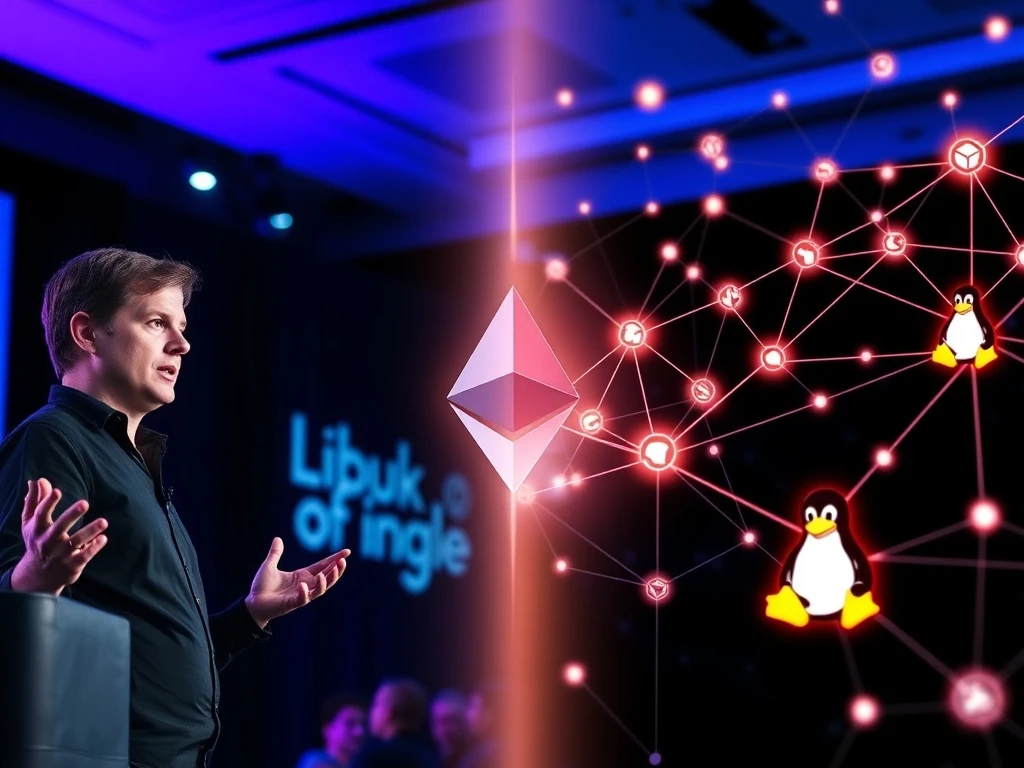
In a defining statement that could shape blockchain development for years, Ethereum co-founder Vitalik Buterin has positioned his creation as “the Linux of the blockchain world” during January 2025 discussions about Web3’s infrastructure future. This comparison carries profound implications for decentralized technology’s evolution, drawing direct parallels between open-source software movements and blockchain’s philosophical foundations. Buterin’s analogy emerges as Ethereum approaches its tenth anniversary, facing both historic adoption and complex scalability challenges that mirror Linux’s own historical growth trajectory.
Ethereum Linux Comparison: Historical Parallels and Philosophical Alignment
Buterin’s comparison draws from deep historical understanding of computing evolution. Linux emerged in 1991 as Linus Torvalds’ response to proprietary Unix systems, creating a collaborative development model that eventually powered everything from Android smartphones to supercomputers. Similarly, Ethereum launched in 2015 as an alternative to both Bitcoin’s limited scripting language and traditional financial systems’ closed architectures. Both platforms share foundational principles: open-source development, community governance, permissionless innovation, and resistance to centralized control.
Also read: AI Trading Agents: The Revolutionary Path to Mastering Your Crypto Portfolio in 2025
The philosophical alignment extends beyond technical specifications. Linux succeeded by providing a stable kernel upon which countless distributions (Ubuntu, Fedora, Debian) could build customized solutions. Ethereum now follows this pattern with its base layer supporting numerous Layer 2 solutions and application-specific chains. This modular approach enables specialization while maintaining core compatibility standards. Industry analysts note that Ethereum’s smart contract functionality serves as blockchain’s equivalent to Linux’s kernel modules—extensible components that developers can combine in novel ways.
Technical Architecture Parallels
Examining the technical parallels reveals why Buterin’s analogy resonates with developers. Linux’s success stems from its monolithic kernel design with loadable modules, balancing performance with flexibility. Ethereum’s execution layer (formerly Eth1) and consensus layer (formerly Eth2) now function similarly after The Merge, with beacon chain validators operating like kernel processes managing system resources. The Ethereum Virtual Machine (EVM) serves as blockchain’s equivalent to Linux’s POSIX standard—a consistent environment ensuring application portability across different implementations.
Also read: RunBot AI Trading Bot: Revolutionizing Automated Cryptocurrency Strategies with Machine Learning
Data from Electric Capital’s 2024 Developer Report shows Ethereum maintaining the largest developer ecosystem in blockchain, with over 4,000 monthly active developers. This community size and engagement pattern mirrors Linux’s historical growth, where volunteer contributors gradually built an ecosystem that now underpins 96.3% of the world’s top one million web servers according to W3Techs. The parallel suggests Ethereum might follow similar adoption curves in decentralized applications.
Layer 2 Solutions: Ethereum’s Distribution Ecosystem Challenge
The proliferation of Layer 2 solutions presents both opportunity and fragmentation risk, directly mirroring Linux’s distribution diversity challenges. According to L2Beat’s January 2025 data, Ethereum now hosts 127 active Layer 2 networks with a combined total value locked exceeding $45 billion. These solutions employ various scaling approaches:
- Optimistic Rollups (Arbitrum, Optimism): Assume transaction validity unless challenged
- ZK-Rollups (zkSync, StarkNet): Use cryptographic proofs for instant finality
- Validiums: Combine ZK-proofs with off-chain data availability
- State Channels: Enable off-chain transactions between parties
This diversity stimulates innovation but creates interoperability challenges. Developers must choose which chains to support, while users handle bridging assets between ecosystems. The situation parallels Linux’s early fragmentation between competing distributions, eventually addressed through standards like the Linux Standard Base and freedesktop.org specifications. Ethereum now faces similar standardization pressures, with initiatives like the Ethereum Improvement Proposal process and cross-chain communication protocols attempting to maintain cohesion.
Scalability Versus Cohesion Trade-off
Buterin acknowledges the inherent tension between scalability through Layer 2 proliferation and network cohesion. In recent technical writings, he proposes “enshrined zk-EVMs” as potential long-term solutions—native zero-knowledge proof verification built directly into Ethereum’s protocol. This approach would maintain Layer 2 innovation while ensuring stronger base-layer compatibility guarantees. The strategy mirrors how Linux eventually incorporated containerization (Docker) and orchestration (Kubernetes) support directly into its kernel, standardizing what began as fragmented third-party solutions.
Transaction data reveals the scaling imperative driving this evolution. Ethereum mainnet currently processes approximately 15-20 transactions per second, while major Layer 2 networks collectively handle over 300 transactions per second. However, this scaling comes with fragmentation costs: moving assets between chains typically requires multiple steps and incurs bridging fees. The ecosystem must balance specialization benefits against network effects dilution, a challenge Linux distributions solved through package managers and standardized software repositories.
Web3 Operating System Ambition: Beyond Financial Applications
Buterin’s Linux comparison extends beyond technical architecture to span broader Web3 ambitions. Just as Linux became the foundation for internet infrastructure (web servers, cloud computing, networking equipment), Ethereum aims to become the foundational layer for decentralized applications across multiple domains:
| Application Domain | Ethereum-Based Examples | Linux Parallel |
|---|---|---|
| Decentralized Finance | Uniswap, Aave, Compound | Apache web server |
| Digital Identity | ENS, Proof of Humanity | PAM authentication system |
| Supply Chain | IBM Food Trust, VeChain | Enterprise resource planning |
| Governance | DAO tooling, Snapshot | Collaborative development |
| Gaming/NFTs | Decentraland, Axie Infinity | Graphics/gaming libraries |
This expansion beyond financial applications represents Ethereum’s maturation from “world computer” to “world operating system.” The transition mirrors Linux’s evolution from hobbyist project to enterprise infrastructure backbone. Critical to this vision is Ethereum’s account abstraction progress (ERC-4337), which enables more flexible user experiences similar to how Linux’s user space provides abstraction from hardware complexities.
Community Governance Parallels
Both systems rely on decentralized governance models with interesting parallels. Linux development follows a “benevolent dictator” model where Torvalds maintains final authority over kernel changes, guided by community feedback and maintainer hierarchies. Ethereum employs a more formalized governance process through Ethereum Improvement Proposals (EIPs), but Buterin’s continued influence creates similar centralization concerns. The Ethereum Foundation’s role resembles the Linux Foundation’s—providing resources and coordination without direct control over development directions.
Recent governance debates around Ethereum’s fee market redesign (EIP-1559) and Proof-of-Stake transition demonstrate both systems’ capacity for major protocol evolution through community consensus. These processes inevitably involve conflicts between different stakeholder groups—core developers, application builders, miners/validators, and end users—mirroring Linux’s historical debates between distributions, desktop environments, and systemd adoption.
Technical Challenges and Future Development Roadmap
Ethereum’s path toward becoming “blockchain’s Linux” faces several technical hurdles that Buterin’s comparison highlights. The network must achieve greater decentralization in client diversity, with current data showing Prysm and Lighthouse clients dominating the validator set. This situation parallels early Linux distributions’ reliance on specific kernels or libraries before achieving true implementation diversity. The upcoming Verge, Purge, and Splurge upgrades aim to address these concerns through stateless clients and history expiration.
Security considerations present another critical parallel. Linux’s security model evolved through decades of addressing vulnerabilities in a transparent, community-driven process. Ethereum must similarly mature its security practices as value locked in smart contracts grows exponentially. Formal verification tools like Certora and runtime security solutions like Forta Network represent early steps toward enterprise-grade security standards. The 2022 Merge to Proof-of-Stake reduced Ethereum’s energy consumption by approximately 99.95%, addressing environmental concerns that often plagued both blockchain and data center industries.
Adoption Metrics and Ecosystem Health
Quantitative comparisons reveal Ethereum’s growth trajectory relative to Linux’s historical adoption. While Linux took approximately 15 years to achieve significant enterprise adoption, Ethereum has reached comparable institutional interest within 8 years. Key metrics show:
- Monthly active Ethereum addresses: 15-20 million (January 2025)
- Smart contracts deployed: Over 50 million cumulative
- Annual transaction volume: Approximately 350 million transactions
- Developer activity: Leading all blockchain platforms by contributor count
These metrics suggest Ethereum follows adoption curves similar to foundational technologies rather than application-specific platforms. The network effects created by EVM compatibility across multiple chains (Polygon, BSC, Avalanche) further reinforce this position, similar to how Linux compatibility across hardware architectures fueled its expansion from embedded systems to supercomputers.
Conclusion
Vitalik Buterin’s Ethereum Linux comparison provides more than just a clever analogy—it offers a strategic framework for understanding blockchain’s evolution toward becoming Web3’s foundational infrastructure. The parallel highlights how open-source principles, community governance, and modular architecture can create resilient systems that outlast proprietary alternatives. As Ethereum navigates scalability challenges through Layer 2 solutions while maintaining base-layer cohesion, it follows a path Linux successfully traveled decades earlier. The ultimate test will be whether Ethereum can achieve similar ubiquity across decentralized applications while preserving the permissionless innovation that defines both platforms. Buterin’s vision positions Ethereum not merely as another blockchain but as the potential operating system for a more open, user-controlled internet—a goal worthy of its Linux inspiration.
FAQs
Q1: What exactly does Vitalik Buterin mean by comparing Ethereum to Linux?
Buterin draws parallels between Ethereum’s role in blockchain and Linux’s role in computing. Both serve as open-source foundations upon which diverse applications can be built without centralized control. The comparison emphasizes philosophical alignment around permissionless innovation, community governance, and creating standardized infrastructure for broader ecosystems.
Q2: How does Ethereum’s Layer 2 ecosystem relate to Linux distributions?
Ethereum’s Layer 2 solutions (Arbitrum, Optimism, zkSync) function similarly to Linux distributions (Ubuntu, Fedora, Debian). They offer specialized implementations with different features and optimizations while maintaining compatibility with the base protocol. This diversity enables innovation but creates interoperability challenges that require standardization efforts.
Q3: What are the main technical challenges Ethereum faces in becoming “blockchain’s Linux”?
Key challenges include achieving true client diversity to prevent centralization risks, maintaining interoperability across proliferating Layer 2 networks, developing enterprise-grade security practices for smart contracts, and balancing protocol evolution with backward compatibility. These mirror Linux’s historical challenges in standardizing across distributions while enabling innovation.
Q4: How does Ethereum’s governance compare to Linux’s development model?
Both employ decentralized governance with influential founders (Buterin/Torvalds) and formal processes for proposing changes (EIPs for Ethereum, kernel patches for Linux). Ethereum has more structured governance through its improvement proposal process, while Linux relies more on maintainer hierarchies and community consensus, but both ultimately depend on widespread adoption of changes.
Q5: What timeframe might Ethereum need to achieve Linux-level ubiquity in blockchain?
Based on adoption curves, Ethereum has reached significant developer and institutional adoption faster than Linux did historically. However, achieving comparable infrastructure ubiquity across Web3 applications may require another 5-10 years of protocol maturation, scalability solutions, and user experience improvements, particularly in areas like account abstraction and cross-chain interoperability.

This article was produced with AI assistance and reviewed by our editorial team for accuracy and quality.