Vitalik Buterin DAOs Face Critical Human Attention Scarcity, Proposes AI as a Revolutionary Shield
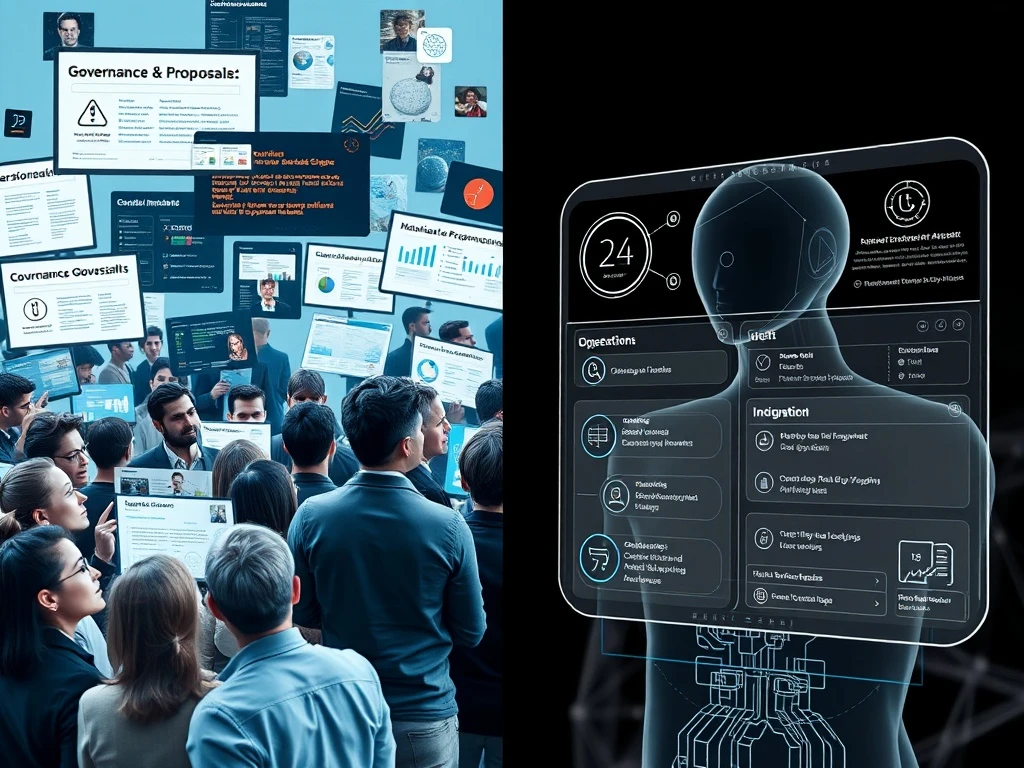
In a important statement that could redefine decentralized governance, Ethereum co-founder Vitalik Buterin has identified a fundamental, non-technological barrier crippling Decentralized Autonomous Organizations (DAOs): the severe scarcity of human attention. Speaking from a global perspective in early 2025, Buterin warns that DAO voters are drowning in complexity, but his proposed lifeline—personal AI agents—aims to empower, not replace, human decision-makers.
Vitalik Buterin DAOs and the Inescapable Bottleneck of Human Cognition
Buterin’s analysis, shared via a detailed social media post, moves beyond typical discussions of smart contract security or tokenomics. He targets a biological limit. DAOs, by design, generate vast numbers of proposals, technical reports, and community discussions. Consequently, even dedicated participants face cognitive overload. This attention scarcity leads to several critical failures:
Also read: Binance ETH Supply Plummets to Critical Low as Stablecoin Reserves Explode
- Voter Apathy and Low Participation: Overwhelmed members disengage, undermining the “broad consensus” ideal.
- Centralization by Default: Power unintentionally flows to small, highly dedicated groups or whales who have the time to analyze everything.
- Poor Decision Quality: Rushed or uninformed votes on complex treasury management or protocol upgrades can have catastrophic financial effects.
This problem is not new in organizational theory, but its impact on trustless, global digital organizations is uniquely acute. A 2024 study by the Crypto Governance Research Collective found that median voter participation for major DAOs rarely exceeded 10% of token holders for non-controversial proposals.
AI as a Governance Ally, Not a Sovereign Ruler
Buterin’s proposal carefully navigates a major pitfall. He explicitly warns against directly handing governance power to monolithic AI systems, which would simply recreate centralized authorities with inscrutable decision-making. Instead, he envisions a future of personal AI agents. These would act as customizable assistants for each DAO member. For example, an agent could perform several key functions:
Also read: Coinbase x402 Protocol Surrendered to Linux Foundation as Tech Giants Unite for AI Payment Standard
- Summarize lengthy governance forum posts into concise briefs.
- Analyze a proposal’s historical context and flag potential conflicts of interest.
- Cross-reference on-chain data to verify a proposal’s financial claims.
- Learn a user’s values and priorities to highlight relevant discussions.
This model preserves human agency. The individual makes the final vote, but with dramatically enhanced understanding and efficiency. Crucially, these agents would operate with strong privacy guarantees, processing information locally or through encrypted channels to prevent the formation of manipulative behavioral profiles.
The Technical and Social Roadmap for AI-Augmented DAOs
Implementing this vision requires parallel advancements in cryptography and social governance. Technologically, zero-knowledge proofs (ZKPs) could allow an AI agent to prove it performed a correct analysis of a proposal without revealing the user’s private preferences. On-chain reputation systems, like those explored by projects such as Optimism’s AttestationStation, could help agents weigh the credibility of different community voices.
Socially, DAOs must establish standards for machine-readable proposal formatting and data provision. A proposal lacking structured, verifiable data would be flagged as opaque by most agents. This creates a positive pressure for transparency. Legal scholars like Primavera De Filippi have noted that such hybrid human-AI systems may require new frameworks for accountability, ensuring the human-in-the-loop remains legally and ethically responsible for their assisted decisions.
The Competitive Arena and Immediate Implications
Buterin’s commentary arrives as several projects actively experiment at this intersection. For instance:
| Project/Initiative | Focus Area | Relation to Buterin’s Vision |
|---|---|---|
| OpenAI’s “DAOs & AI” Research Track | Automated Proposal Analysis | Developing the underlying AI tools for summarization and impact prediction. |
| Polygon’s AI-focused Grants | ZKML (Zero-Knowledge Machine Learning) | Building the privacy-preserving infrastructure for trustworthy agent operations. |
| Aragon’s “Governance OS” | Modular Governance Frameworks | Creating the plugin architecture where personal AI agents could integrate. |
The immediate impact is a reframing of priorities for DAO tooling developers. The focus shifts from merely facilitating votes to building interfaces and data pipelines that support intelligent agent assistance. Furthermore, DAOs with clear governance processes and well-structured data will likely attract more engaged participation, creating a competitive advantage in the ecosystem.
Conclusion
Vitalik Buterin’s analysis of human attention scarcity exposes a foundational vulnerability in the current DAO model. His forward-looking solution—privacy-centric, personal AI agents—charts a pragmatic path to scale decentralized governance without abandoning its core democratic principles. This approach does not seek to automate democracy but to augment human intelligence within it. As DAOs continue to manage billions in assets and govern critical digital infrastructure, solving the attention bottleneck through assisted, informed participation may well determine their long-term viability and legitimacy. The evolution of Vitalik Buterin DAOs now hinges on this symbiotic relationship between human judgment and artificial intelligence.
FAQs
Q1: What is “human attention scarcity” in the context of DAOs?
Human attention scarcity refers to the limited cognitive capacity of DAO participants to thoroughly read, understand, and analyze the high volume of complex proposals and discussions, leading to voter fatigue, apathy, and potentially poor governance outcomes.
Q2: Why is Vitalik Buterin against letting AI directly govern DAOs?
Buterin warns that handing direct control to AI systems would centralize power in opaque algorithms, defeating the decentralized, transparent ethos of DAOs and creating unaccountable points of failure.
Q3: How would a personal AI agent for DAO voting protect my privacy?
Agents could use advanced cryptography like zero-knowledge proofs to analyze data and provide insights without exposing your personal voting history or preferences to the network, operating as a private assistant.
Q4: Are any DAOs currently using AI tools for governance?
Several are in early experimental phases, using AI for tasks like summarizing forum posts or sentiment analysis. However, fully integrated, privacy-preserving personal AI agents, as described by Buterin, remain a near-future development.
Q5: Could AI agents lead to groupthink or manipulation in DAOs?
This is a recognized risk. Mitigations include agent diversity (users choosing different AI models), transparency in agent reasoning where possible, and maintaining the human’s ultimate veto and vote-casting authority to override agent suggestions.

This article was produced with AI assistance and reviewed by our editorial team for accuracy and quality.