US Stock Market Surges: Major Indices Close Higher Amid Economic Optimism
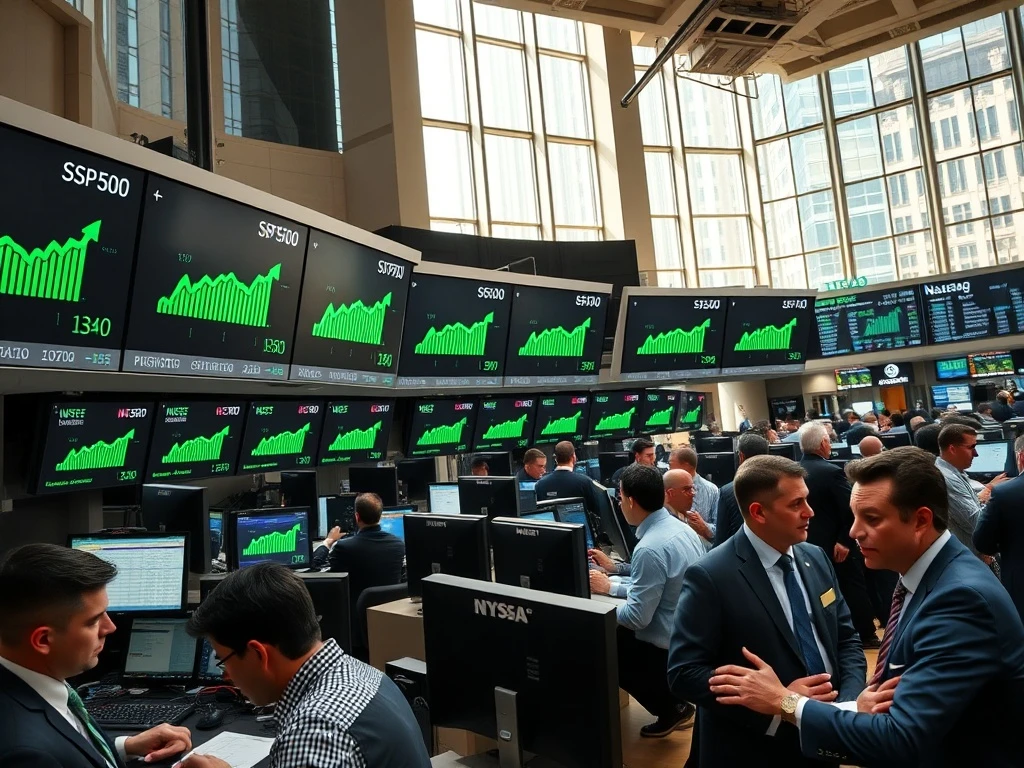
NEW YORK, NY – In a display of resilient market momentum, the three primary US stock market benchmarks closed firmly in positive territory today. The S&P 500 rose 0.16%, the technology-heavy Nasdaq Composite gained 0.26%, and the blue-chip Dow Jones Industrial Average advanced 0.17%. This synchronized upward movement across major indices signals a cautiously optimistic trading session, reflecting a complex interplay of corporate earnings, macroeconomic data, and shifting investor sentiment. Consequently, market participants continue to address a field defined by interest rate expectations and global economic crosscurrents.
US Major Indices Close Higher: A Detailed Breakdown
The session’s gains, while modest in percentage terms, represent significant capital appreciation given the massive market capitalization of these indices. The S&P 500’s 0.16% increase added billions in market value to the broad-based benchmark of 500 leading US companies. Similarly, the Nasdaq Composite’s 0.26% climb was driven by selective strength in mega-cap technology and semiconductor stocks. Meanwhile, the Dow Jones Industrial Average’s 0.17% uptick reflected stability among its thirty constituent industrial and financial giants. These movements occurred on trading volume that was slightly above the 30-day average, indicating genuine participation rather than thin, speculative action.
Market analysts immediately contextualized the gains within the broader monthly and quarterly performance. For instance, the S&P 500 has now posted positive returns in four of the last five weeks. This trend suggests a building foundation of support rather than a one-day anomaly. Furthermore, the equal-weight S&P 500 index, which reduces the influence of mega-cap stocks, also finished higher. This detail often indicates broader market health beyond just a handful of top performers. Sector performance within the indices was mixed but leaned positive, with notable contributions from healthcare and industrials offsetting minor weakness in the energy sector.
Drivers Behind the Market’s Positive Momentum
Several tangible factors contributed to the session’s gains. First, a key inflation report, the Personal Consumption Expenditures (PCE) price index, met economist forecasts. This data point is the Federal Reserve’s preferred inflation gauge. Its in-line reading alleviated fears of an accelerating price spiral that could force more aggressive monetary tightening. Second, Treasury yields stabilized after a recent climb, providing relief to rate-sensitive growth stocks. Third, a batch of better-than-expected quarterly earnings reports from major retailers bolstered confidence in consumer resilience. These reports countered narratives of an imminent sharp economic slowdown.
Also read: Bitcoin Treasury Companies Face New Pressure as US-Iran Tensions Shift
Additionally, commentary from Federal Reserve officials, while remaining vigilant on inflation, did not introduce new hawkish surprises. This steadiness in communication allowed markets to price interest rate expectations with greater certainty. Internationally, easing tensions in certain geopolitical hotspots reduced a layer of risk premium. Corporate news flow was also generally positive, with several large companies announcing share buyback programs and dividend increases. These actions signal corporate confidence in future cash flows and often provide direct support to share prices.
Expert Analysis on Index Performance and Sustainability
Financial strategists emphasize that the day’s action should be viewed through a multi-lens framework. “While the point gains are encouraging, the underlying market internals tell a more nuanced story,” notes a Chief Investment Officer at a major asset management firm, referencing data like advance-decline ratios and new highs versus new lows. “The fact that all three major indices moved in unison is a classic sign of macro-driven trading, likely focused on the inflation and interest rate outlook rather than stock-specific news.”
Historical data provides further context. According to market statistics, the S&P 500 has historically produced an average annual return of approximately 10% before inflation. Therefore, a single day’s move of 0.16% is well within normal volatility parameters. However, stringing together multiple such positive days compounds into meaningful returns over time. Technical analysts point to the S&P 500 holding above its 50-day and 200-day moving averages as a constructive short-to-medium-term signal. This technical footing often attracts systematic and trend-following investors.
Comparative Performance and Sector Rotation
A closer examination reveals divergences beneath the headline index numbers. The following table illustrates the performance differentials between the three major indices over recent periods, highlighting their unique sensitivities:
| Index | Today’s Return | Month-to-Date | Primary Driver Sensitivity |
|---|---|---|---|
| S&P 500 | +0.16% | +2.1% | Broad Economic Health, Interest Rates |
| Nasdaq Composite | +0.26% | +3.4% | Technology Earnings, Long-Duration Yield Moves |
| Dow Jones Industrial Average | +0.17% | +1.8% | Industrial Output, Global Trade, Dollar Strength |
This sector rotation is a critical dynamic. For example, the Nasdaq’s outperformance often correlates with falling or stable long-term bond yields, as seen today. Conversely, the Dow’s composition makes it more reactive to manufacturing data and international trade flows. The day’s sector leadership came from:
- Healthcare: Benefiting from regulatory clarity and strong product pipelines.
- Industrials: Gaining on optimistic infrastructure spending forecasts.
- Consumer Discretionary: Supported by resilient retail sales data.
This rotation away from purely defensive sectors like utilities and consumer staples suggests a modest increase in investors’ risk appetite. Market breadth, measured by the number of stocks rising versus falling, was positive but not overwhelmingly so. This indicates selective buying rather than a wholesale rush into equities.
The Economic Backdrop and Future Catalysts
The current economic environment presents a mixed picture. On one hand, employment remains strong and corporate balance sheets are generally healthy. On the other hand, concerns persist about the lagged effects of previous interest rate hikes and elevated consumer debt levels. The market’s positive reaction today suggests investors are focusing on the former while discounting the latter, at least for the moment. Upcoming economic releases will be important in determining whether this trend continues. Key reports to watch include:
- The next Federal Open Market Committee (FOMC) meeting statement and projections.
- Monthly Non-Farm Payrolls and wage growth data.
- Consumer Price Index (CPI) and Producer Price Index (PPI) reports.
- Quarterly Gross Domestic Product (GDP) revisions.
Furthermore, the corporate earnings season is entering a quieter phase. However, guidance for future quarters will be scrutinized for any signs of demand deterioration or margin pressure. Analysts are particularly focused on commentary regarding consumer spending patterns and business investment intentions. Global factors also remain in play, including central bank policies in Europe and Asia, as well as commodity price fluctuations, especially in oil and industrial metals.
Investor Sentiment and Positioning Data
Surveys of investor sentiment, such as the American Association of Individual Investors (AAII) survey, recently showed a slight increase in bullishness but remain far from euphoric levels. This is often considered a contrarian positive, as extreme bullishness can signal a market top. Positioning data from futures markets also indicates that speculative net-long positions in equity index futures are not at extreme levels. This suggests there is potential for additional buying if positive catalysts emerge. However, volatility expectations, as measured by the VIX index (often called the “fear gauge”), remain subdued but above their historic lows, reflecting a balanced level of caution.
Conclusion
The closing bell confirmed a positive session as US major indices closed higher, with the S&P 500, Nasdaq Composite, and Dow Jones Industrial Average all posting gains. This collective advance, though measured, underscores a market digesting complex economic signals and finding a tentative path forward. The movement was supported by in-line inflation data, stable yields, and resilient corporate fundamentals. While daily fluctuations are normal, the alignment of all three benchmarks provides a snapshot of cautious optimism among investors. Ultimately, the sustainability of this trend will hinge on forthcoming economic data, corporate earnings guidance, and the evolving monetary policy sector. For now, the market action reflects a delicate balance between recognized risks and underlying economic strength.
FAQs
Q1: What does it mean when all three major US indices close higher?
When the S&P 500, Nasdaq Composite, and Dow Jones Industrial Average all finish a trading session with gains, it typically indicates broad-based buying pressure across the market. This synchronized movement often reflects a macro-driven response to economic data, monetary policy news, or a widespread positive shift in investor sentiment, rather than strength in just one sector.
Q2: Why did the Nasdaq outperform the S&P 500 and Dow today?
The Nasdaq Composite, heavily weighted toward technology and growth stocks, is particularly sensitive to changes in long-term interest rates. Its slightly stronger gain of 0.26% (compared to 0.16% for the S&P and 0.17% for the Dow) likely resulted from stability or a slight decline in Treasury yields, which increases the present value of future earnings for growth-oriented companies.
Q3: Are modest daily gains like 0.16% significant for long-term investors?
While a single day’s move of 0.16% may seem small, compounding such gains over time is how wealth is built in the markets. The historical average annual return for the S&P 500 is roughly 10%. A 0.16% daily gain, if sustained, would far exceed that average. Long-term investors focus on the trend and fundamental drivers rather than any single day’s performance.
Q4: What economic data most directly influences these major indices?
The indices are most sensitive to data influencing Federal Reserve policy and corporate profits. Key reports include the Personal Consumption Expenditures (PCE) and Consumer Price Index (CPI) for inflation; employment data like Non-Farm Payrolls; and quarterly Gross Domestic Product (GDP). Corporate earnings reports and forward guidance are equally critical drivers of individual stocks and, by aggregation, the indices.
Q5: How can investors track the performance of these major indices?
Investors can monitor these indices through financial news networks, major financial websites, and trading platforms. Their performance is tracked by exchange-traded funds (ETFs) like SPY (for the S&P 500), QQQ (for the Nasdaq-100, a subset of the Nasdaq Composite), and DIA (for the Dow Jones Industrial Average). These provide a direct, tradable reflection of the indices’ movements.

This article was produced with AI assistance and reviewed by our editorial team for accuracy and quality.