Breaking: US CPI Holds Steady, But $108 Oil Threatens New Inflation Spike
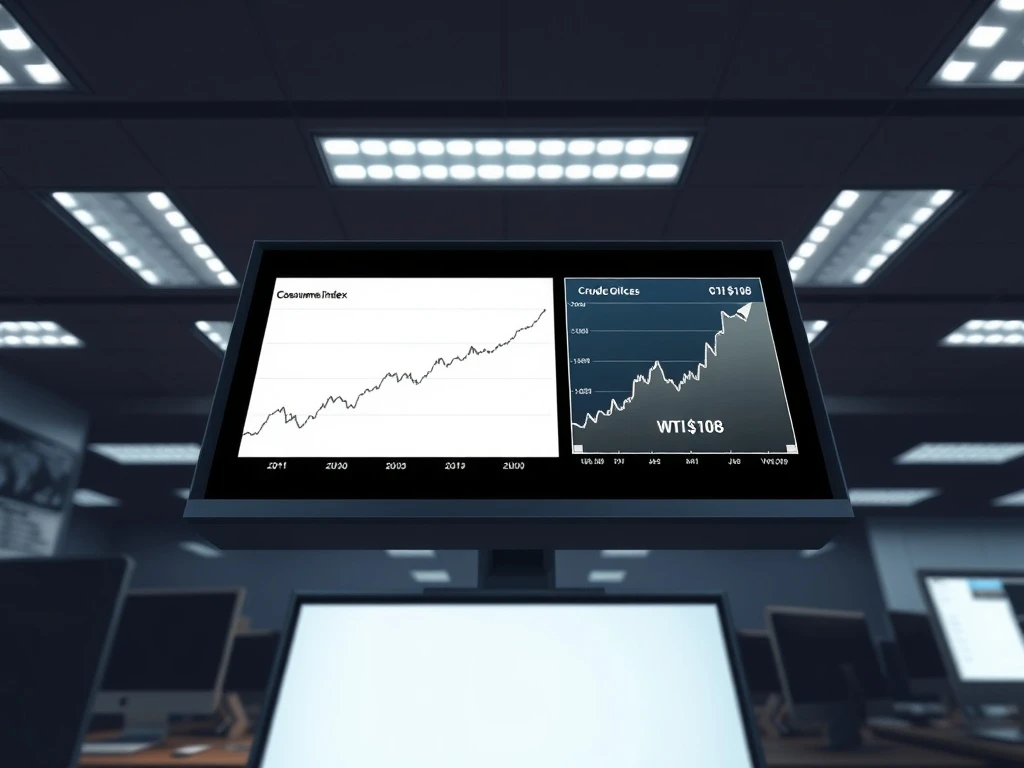
WASHINGTON, D.C. — May 13, 2026: The U.S. Bureau of Labor Statistics reported this morning that the Consumer Price Index (CPI) for March 2026 met economist forecasts, rising 0.3% month-over-month and 3.1% year-over-year. However, this apparent stability masks a growing threat as benchmark West Texas Intermediate (WTI) crude oil prices surged past $108 per barrel in early trading—a level not seen since late 2023. This divergence between headline inflation data and soaring energy costs creates a precarious situation for the Federal Reserve and American consumers, potentially reigniting the inflationary pressures that had shown signs of moderating. The core CPI, which excludes volatile food and energy prices, also rose 0.3% for the month, aligning with the Federal Reserve’s ongoing vigilance.
US CPI Meets Expectations Amid Volatile Energy Market
The March 2026 CPI report presented a mixed picture that financial analysts immediately began dissecting. The 3.1% annual increase matched the median forecast from a Bloomberg survey of economists. Shelter costs, which carry significant weight in the index, continued their gradual deceleration, rising 0.4% for the month compared to 0.6% in March. Conversely, food prices edged up 0.2%, with notable increases in categories like cereals and bakery products. “The April data shows the disinflation process remains intact, but it’s fragile,” stated Dr. Anya Sharma, Chief Economist at the Brookings Institution, in a press call. “The moderation in shelter inflation is welcome, but it’s a lagging indicator. The real-time pressure from energy markets presents a more immediate concern.” The report’s timing is critical, arriving just one week before the Federal Open Market Committee’s (FOMC) May policy meeting, where officials will debate the path of interest rates.
Also read: American Bitcoin Holdings Surge to 7,000 BTC as Trump Family Doubles Down on Crypto Strategy
This month’s data continues a trend of gradual cooling from the peak inflation rates of 2022-2023. However, the path has been uneven. A comparison of key components reveals the underlying tensions. For instance, used car and truck prices fell 1.5% in April, providing some relief. Meanwhile, medical care services rose 0.5%, continuing a persistent upward trend. The Federal Reserve Bank of Cleveland’s nowcast model had accurately predicted the core CPI figure, highlighting the advanced analytical tools now monitoring price pressures. The central challenge for policymakers is determining whether the meeting of expectations represents true stability or merely the calm before another inflationary storm driven by external shocks.
The $108 Oil Price Shock and Its Direct Inflation Impact
While the CPI report captured data through April, the seismic shift in oil markets occurred in early May, meaning its full effect will hit the May and June inflation readings. The jump to $108 per barrel stems from a confluence of geopolitical and supply-side factors. Renewed tensions in the Middle East following incidents in critical shipping lanes, combined with unexpected production discipline from OPEC+ members extending into the third quarter, have tightened global supplies. Furthermore, U.S. strategic petroleum reserve levels remain below their five-year average, limiting a key tool for price stabilization. “Every $10 sustained increase in the price of a barrel of oil typically adds about 0.4 percentage points to headline inflation over the following year,” explained Michael Chen, a veteran energy analyst at S&P Global Commodity Insights, citing historical models. “At $108, we are looking at a direct, mechanical uplift to transportation and goods costs that will filter through to consumers within weeks.”
Also read: Binance Oil and Gas Futures Launch with 100x Utilize: A High-Stakes Gamble for Traders
- Gasoline and Transportation Costs: The most immediate impact will be felt at the pump. The AAA forecasts gasoline prices could rise 15-25 cents per gallon nationally in the coming fortnight, reversing a period of gradual decline.
- Goods and Logistics: Higher diesel prices increase shipping and freight costs for virtually all physical goods, from groceries to manufactured products, embedding inflation deeper into the supply chain.
- Consumer Sentiment and Spending: Rising energy costs act as a tax on household budgets, potentially forcing cuts in discretionary spending and slowing economic growth, a scenario known as stagflation.
Federal Reserve and Expert Reactions to the Diverging Data
Initial reactions from Federal Reserve officials and independent economists highlighted the policy dilemma. In a speech at the Economic Club of New York yesterday, Fed Governor Lisa Cook acknowledged the “crosscurrents” in the data, noting that “while progress on core services inflation is encouraging, we cannot be complacent in the face of commodity price shocks.” This sentiment was echoed by researchers at the Peterson Institute for International Economics, who published a brief today warning that energy-driven inflation is particularly pernicious as it both raises prices and dampens growth. Conversely, some market analysts pointed to the stable core CPI as evidence that the economy’s underlying inflation dynamics are improving. David Park of Evercore ISI noted, “The Fed’s preferred gauge, core PCE, is likely to remain on its downward trajectory. They may look through a temporary oil spike unless it bleeds into wage expectations.” This debate sets the stage for a contentious FOMC meeting.
Historical Context and Comparison to Previous Inflation Cycles
To understand the potential trajectory, it is instructive to compare the current situation to past episodes where energy shocks disrupted disinflation. The table below contrasts key metrics from three periods: the peak of the 2022 inflation surge, the moderate period of late 2025, and the current March 2026 snapshot.
| Metric | June 2022 (Peak) | December 2025 | March 2026 (Current) |
|---|---|---|---|
| Headline CPI (YoY) | 9.1% | 3.2% | 3.1% (Apr.) |
| WTI Oil Price (per barrel) | $122 | $78 | $108 |
| Federal Funds Rate Target | 1.50%-1.75% | 4.25%-4.50% | 4.25%-4.50% |
| Unemployment Rate | 3.6% | 4.0% | 4.1% |
The critical difference between 2022 and today is the stance of monetary policy. In 2022, the Fed was in the early stages of a rapid hiking cycle. Today, rates are at a restrictive level and have been held steady for several months, theoretically giving the economy less momentum that could amplify an oil shock. However, the labor market remains tight, which could make the passthrough to wages more likely than in periods of higher unemployment. Historical analysis from the San Francisco Fed suggests that the second-round effects of an oil shock—where businesses and workers adjust their price and wage expectations upward—are the primary determinant of whether it causes a sustained inflationary spiral.
What Happens Next: Policy Pathways and Market Implications
The immediate focus turns to the Federal Reserve’s May 20-21 meeting. The consensus view, as reflected in CME Group’s FedWatch Tool, still heavily favors the Fed holding rates steady. However, the probability of a rate cut later in 2026 has diminished significantly in futures markets over the past 48 hours. The Fed’s subsequent communications will be scrutinized for any shift in tone regarding its assessment of the inflation outlook. Beyond the Fed, the White House faces political pressure. Analysts expect the administration to continue releases from the Strategic Petroleum Reserve (SPR) in a measured fashion and to engage diplomatically with major oil producers. The Department of Energy confirmed yesterday that it has postponed a planned replenishment of the SPR, a signal it is prioritizing price stability over rebuilding reserves in the short term.
Consumer and Business Sector Preparedness
The reaction on Main Street will be swift. Trucking associations have already issued fuel surcharge advisories to clients. Airlines, which had enjoyed a period of lower jet fuel costs, may revisit fare structures and profitability forecasts for the peak summer travel season. For the average household, the calculus of summer travel and back-to-school shopping may change. Jennifer Morrow, who runs a small bakery in Columbus, Ohio, told us, “Flour prices were finally coming down. Now my delivery cost is going back up. I either absorb it or raise prices again, and customers are tired of that.” This micro-level decision-making, replicated across millions of businesses, will ultimately determine the breadth and persistence of the incoming price pressures.
Conclusion
The March 2026 CPI report provides a snapshot of an economy where underlying inflation is gradually cooling, meeting analyst expectations. However, this stability is under direct threat from a sudden and severe surge in oil prices to $108 per barrel. The divergence creates a significant policy challenge for the Federal Reserve, which must decide whether to prioritize the backward-looking stability in core inflation or the forward-looking risk from energy markets. For consumers and businesses, the message is clear: a period of relief at the gas pump is ending, and higher costs for transportation and goods are imminent. The key watchpoints in the coming weeks will be the Fed’s May policy statement, the next OPEC+ meeting in June, and the May CPI report due in mid-June, which will capture the initial effects of today’s oil price shock.
Frequently Asked Questions
Q1: What does it mean that the US CPI “met expectations”?
The March 2026 Consumer Price Index rose 0.3% from March and 3.1% from a year ago, exactly matching the median forecast from economists surveyed by Bloomberg. This suggests the disinflation process was on track as of mid-spring, with no major upside or downside surprises in the data.
Q2: How do higher oil prices directly affect consumer inflation?
Higher oil prices increase the cost of gasoline, diesel, and jet fuel. This raises transportation costs for all goods, from food to furniture, and directly increases household energy bills. Historically, a $10 per barrel sustained increase adds roughly 0.4 percentage points to the annual inflation rate.
Q3: Will the Federal Reserve raise interest rates because of rising oil prices?
Most analysts believe the Fed will hold rates steady at its May meeting. The Fed typically focuses on “core” inflation, which excludes food and energy. However, if high oil prices start affecting broader consumer and business inflation expectations, it could delay planned rate cuts later in 2026.
Q4: What is causing oil prices to rise to $108 per barrel?
The surge is driven by geopolitical tensions disrupting shipping, extended production cuts by OPEC+ nations, and stronger-than-expected global demand. Supply constraints are the primary driver, with global inventories tightening significantly in recent weeks.
Q5: How does this situation compare to the peak inflation of 2022?
While oil prices are high, they are below the $122 peak of June 2022. More importantly, the Federal Reserve’s benchmark interest rate is now much higher (over 4.25% vs. 1.75% in 2022), which should help prevent the shock from sparking a broader wage-price spiral.
Q6: What can consumers expect in the next month regarding gas prices and grocery bills?
Consumers should expect a rapid increase in gasoline prices, potentially 15-25 cents per gallon. Grocery bills may see slower increases as higher transportation costs work through the supply chain, with noticeable effects likely in 4-8 weeks, particularly on perishable goods.

This article was produced with AI assistance and reviewed by our editorial team for accuracy and quality.