Top Cryptos Right Now: 4 Unstoppable Assets Showing Strong Growth Signals for 2026
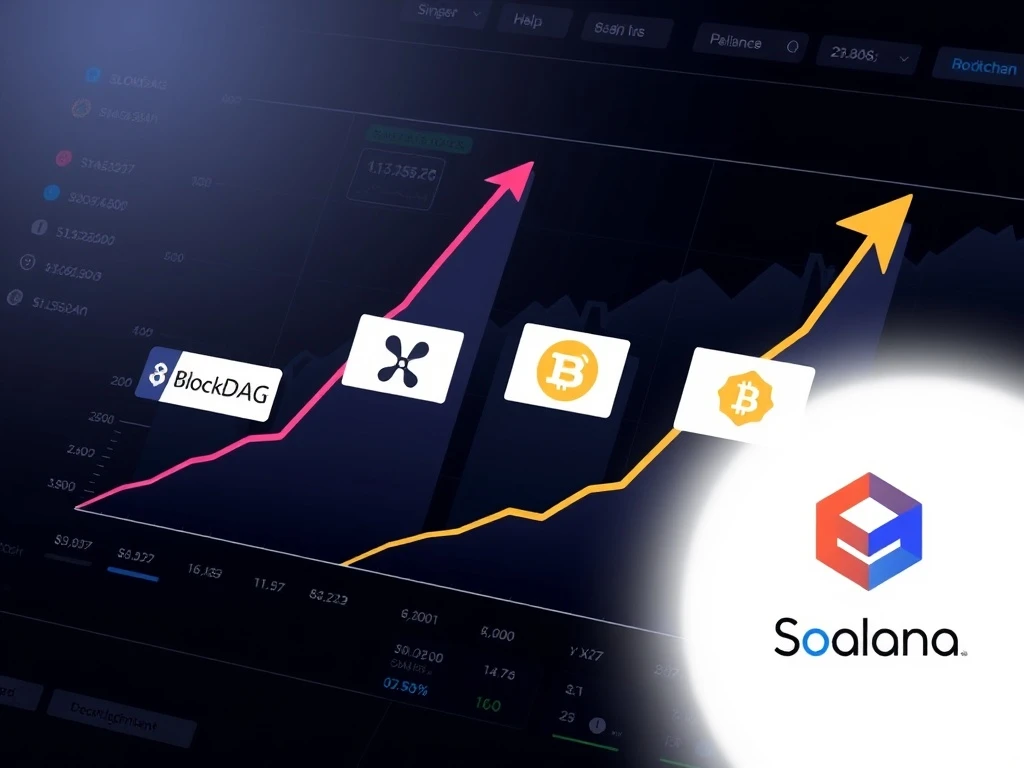
As the digital asset market evolves toward 2026, four cryptocurrencies consistently demonstrate strong functional growth signals. BlockDAG, XRP, Dogecoin, and Solana each present unique value propositions and market roles. This analysis examines their technological foundations, recent developments, and potential trajectories within the broader 2026 market cycle context. Market data from Q1 2025 indicates these assets are attracting significant developer and institutional attention, positioning them for sustained relevance.
Analyzing the Top Cryptos Right Now: A Framework for 2026
Identifying assets with strong growth signals requires a multi-faceted approach. Analysts now evaluate technological utility, ecosystem development, regulatory standing, and on-chain metrics. Consequently, the 2026 cycle may favor projects with proven use cases over pure speculation. BlockDAG, XRP, Dogecoin, and Solana represent diverse blockchain philosophies. From payment solutions to smart contract platforms, their continued development provides a window into the market’s future direction. Industry reports from groups like CoinShares and Messari highlight a shift toward real-world utility as a primary growth driver.
Also read: Pi Network KYC Reward Milestone: First Distribution Pays 0.0504 Pi at 21x Rate
The BlockDAG Protocol: A Novel Consensus Mechanism
BlockDAG (Directed Acyclic Graph) represents a significant departure from traditional linear blockchain architectures. This technology allows for parallel transaction processing, which theoretically increases throughput and reduces fees. Unlike conventional blockchains, a DAG structure does not require miners to compete to create the next single block. Several projects implementing DAG-like structures, such as Kaspa, have shown notable performance gains in test environments. The core growth signal for BlockDAG technology lies in its potential to solve the blockchain trilemma—decentralization, security, and scalability. However, widespread adoption requires further battle-testing in live, high-value environments.
Development activity around DAG-based protocols surged throughout 2024. GitHub commit histories and developer surveys indicate growing interest. The primary challenge remains achieving the same level of security assurance as the sturdy Proof-of-Work behind Bitcoin. For the 2026 cycle, the success of BlockDAG will hinge on demonstrating superior performance without compromising on decentralization. Network upgrades and partnership announcements in early 2025 will be critical indicators.
Also read: Ethereum's Sharp Drop Below $2,100: What Holders Must Understand About the Emerging Opportunity
XRP: Handling Regulation and Reinforcing Utility
XRP operates as a digital asset built for payments and settlements, primarily through Ripple’s solutions. Its growth signal is uniquely tied to regulatory clarity and institutional adoption. The conclusion of Ripple’s lengthy lawsuit with the U.S. Securities and Exchange Commission in 2023 provided a more defined legal framework. Subsequently, financial institutions have cautiously re-engaged with RippleNet for cross-border transactions. On-chain data shows a steady increase in wallet addresses holding substantial XRP balances, suggesting accumulation.
The functional growth of XRP centers on its role as a bridge currency. It aims to allow efficient transfers between different fiat currencies. Ripple’s ongoing partnerships with central banks for exploring Central Bank Digital Currencies (CBDCs) could significantly impact its 2026 utility. Metrics to watch include quarterly transaction volume on the XRP Ledger and the expansion of its decentralized exchange. Market analysts note that XRP’s price often exhibits lower correlation with Bitcoin, potentially offering portfolio diversification.
Dogecoin: From Meme to Mainstream Payment Experiment
Dogecoin maintains a formidable position as a top crypto, primarily driven by brand recognition and community strength. Its growth signal is now increasingly linked to its utility as a medium of exchange. Major companies, including Tesla and AMC Theatres, have accepted Dogecoin for payments. The Dogecoin community actively funds charitable causes and small business initiatives using the token. This real-world usage provides a fundamental layer of support beyond speculative trading.
Technologically, Dogecoin benefits from its merge-mined status with Litecoin, ensuring strong security. Development updates, though less frequent than other projects, focus on improving efficiency and reliability. For the 2026 cycle, Dogecoin’s trajectory depends on sustaining its payment adoption and potentially integrating more advanced features like smart contracts through sidechain proposals. Its inflationary supply model, with a fixed annual issuance, contrasts with Bitcoin’s hard cap, creating a different long-term economic dynamic.
Solana: High-Performance Smart Contracts and Ecosystem Expansion
Solana stands out for its high throughput and low transaction costs, targeting scalable decentralized applications. Its strong growth signal is evident in its rapidly expanding ecosystem. The total value locked in Solana’s DeFi protocols, along with its vibrant NFT and consumer app scene, has recovered robustly from network outages in prior years. Developer migration to Solana, as tracked by Electric Capital’s developer report, remains a key positive indicator.
The network’s performance stems from its unique Proof-of-History consensus combined with Proof-of-Stake. This allows for faster block times and higher capacity. Solana’s focus on consumer-grade applications—from decentralized social media to gaming—positions it for the next wave of users. Key challenges for the 2026 cycle include maintaining network stability under load and continuing to decentralize its validator set. Upgrades like Firedancer, an independent validator client, aim to address these points directly.
Comparative Analysis: Functional Roles for 2026
A side-by-side examination reveals how these top cryptos right now serve different purposes. The following table summarizes their core functions and primary growth drivers:
| Asset | Primary Function | Key Growth Driver (2025-2026) | Notable Metric |
|---|---|---|---|
| BlockDAG Tech | Scalable Consensus Layer | Mainnet Performance & Adoption | Transactions Per Second (TPS) |
| XRP | Cross-Border Settlement | Institutional/CBDC Partnerships | On-Chain Payment Volume |
| Dogecoin | Medium of Exchange / Community | Merchant Adoption & Utility | Active Payment Addresses |
| Solana | High-Performance dApp Platform | Ecosystem TVL & User Growth | Daily Active Addresses |
This functional diversity suggests the 2026 market cycle may support multiple winners across sectors. Investors and builders are not simply betting on one technology but on several parallel visions for blockchain’s future. The interplay between these assets will likely shape industry narratives around scalability, regulation, and real-world use.
Conclusion
The top cryptos right now—BlockDAG, XRP, Dogecoin, and Solana—exhibit strong growth signals rooted in distinct functional pathways. BlockDAG explores novel scalability, XRP leverages regulatory progress for payments, Dogecoin builds on unique cultural utility, and Solana drives a high-speed application ecosystem. For the 2026 cycle, their success will depend on executing technological roadmaps, expanding real-world adoption, and working through an evolving macroeconomic environment. Observers should monitor on-chain metrics, developer activity, and partnership announcements as leading indicators for these promising digital assets.
FAQs
Q1: What makes a “strong growth signal” for a cryptocurrency?
A strong growth signal is based on multiple verifiable factors, not just price. These include increasing developer activity (GitHub commits), growth in fundamental utility (transaction volume, active addresses), positive regulatory developments, and expansion of the project’s ecosystem (partnerships, dApp deployment).
Q2: How is BlockDAG technology different from a traditional blockchain?
Traditional blockchains order transactions in a single, linear chain of blocks. A Directed Acyclic Graph (DAG) structure allows transactions to be processed in parallel, forming a web-like structure. This aims to significantly increase transaction throughput and reduce confirmation times compared to linear chains.
Q3: Why is regulatory clarity important for XRP’s growth?
XRP is designed primarily for institutional cross-border payments. Banks and financial service providers require legal certainty before integrating an asset. The resolution of Ripple’s SEC case helped define XRP’s status, reducing a major barrier to adoption for its intended use case.
Q4: Does Dogecoin have development activity, or is it just a meme?
While it began as a meme, Dogecoin has a dedicated core development team that maintains and updates its codebase. Development focuses on stability, security, and efficiency. Its growth driver is less about technological novelty and more about its established brand and proven utility as a fast, low-cost payment method.
Q5: What is Solana’s main advantage for the 2026 cycle?
Solana’s main advantage is its demonstrated ability to support a high-throughput, low-cost environment for decentralized applications. This has already fostered a large and active ecosystem of DeFi, NFT, and consumer apps. Its growth depends on maintaining network reliability while continuing to attract developers and users to this ecosystem.

This article was produced with AI assistance and reviewed by our editorial team for accuracy and quality.