Tether USAT Stablecoin Launch: A Bold Move for U.S. Regulatory Compliance
In a landmark development for digital finance, Tether has officially announced the launch of USAT, a dollar-pegged stablecoin specifically engineered for full compliance with evolving U.S. federal regulations. This strategic move, confirmed on April 2, 2025, represents a major shift toward institutional-grade digital assets within the American financial ecosystem. Consequently, the cryptocurrency sector now faces a new benchmark for regulatory alignment.
Tether USAT Stablecoin and the GENIUS Framework
Tether designed the USAT stablecoin to align precisely with the proposed U.S. stablecoin bill, commonly called the GENIUS Act. This legislative framework aims to establish clear federal standards for payment stablecoin issuers. Therefore, USAT’s structure proactively addresses core requirements like redemption rights, reserve composition, and issuer licensing. The company explicitly built this new token to operate within anticipated regulatory guardrails.
Also read: Bitcoin Spot ETFs Shatter Positive Streak With $296 Million Outflow
Furthermore, this launch follows years of regulatory scrutiny surrounding stablecoins. Tether’s decision to create a distinct, compliant product signals a mature industry response. Major financial analysts view this as a necessary step for broader institutional adoption. The move also separates USAT’s regulatory profile from Tether’s global USDT token, which operates under different jurisdictions.
Institutional Architecture and Key Partnerships
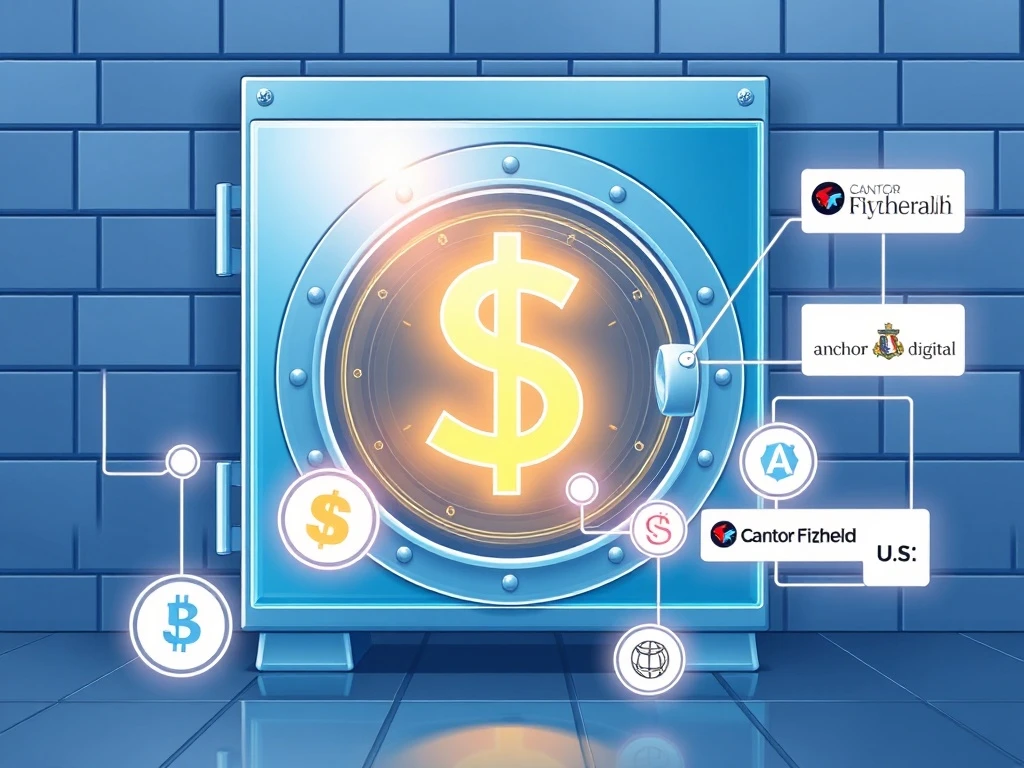
Tether established a sturdy institutional framework for USAT, involving premier regulated entities. Anchorage Digital, a federally chartered digital asset bank, will serve as the official issuer. This partnership provides USAT with a foundational layer of regulatory legitimacy. Simultaneously, Cantor Fitzgerald, a leading global financial services firm, will manage reserve custody and act as the primary dealer.
Also read: Bitcoin Strategy Divide: GameStop's 4,710 BTC Hold Contrasts With Nation's Massive Sell-Off
This custody and distribution model ensures high transparency and security standards. Cantor Fitzgerald’s role involves overseeing the asset reserves backing each USAT token. These reserves will reportedly consist of cash and cash equivalents, specifically U.S. Treasury bills. The structure aims to provide users with strong assurance of one-to-one redeemability.
- Issuer: Anchorage Digital (Federal Charter)
- Reserve Custodian & Primary Dealer: Cantor Fitzgerald
- Reserve Composition: Cash and U.S. Treasury Bills
- Regulatory Aim: Full compliance with proposed GENIUS Act standards
Expert Analysis on the Compliance Strategy
Financial regulation experts note that Tether’s partnership model is strategically significant. By engaging a federally chartered bank and a major primary dealer, Tether embeds USAT within the existing U.S. financial regulatory perimeter. This approach contrasts with earlier stablecoin models that operated in more ambiguous spaces. According to analysts, this pre-emptive compliance could accelerate legislative progress by demonstrating a workable model.
Market observers also highlight the timing. The launch precedes potential final passage of stablecoin legislation, positioning USAT as a ready-made solution. This demonstrates practical industry alignment with policymakers’ goals for consumer protection and financial stability. The structure directly addresses historical concerns about reserve transparency and issuer accountability.
Initial Distribution and Exchange Integration
Initial distribution for the USAT stablecoin will commence on several leading cryptocurrency exchanges. Confirmed launch platforms include Bybit, Crypto.com, Kraken, and OKX. These exchanges will enable the first wave of liquidity and access for both retail and institutional traders. The selective rollout focuses on platforms with strong U.S. compliance programs or significant American user bases.
Exchange integration involves technical and legal steps to list the new asset. Each partner exchange must ensure its own systems comply with relevant state and federal money transmission laws. This process underscores the complexity of launching a regulated digital asset. The phased distribution allows market infrastructure to adapt gradually to the new token’s requirements.
| Exchange | Notable Feature |
|---|---|
| Bybit | Major global derivatives and spot platform |
| Crypto.com | Strong regulatory licensing across multiple jurisdictions |
| Kraken | One of the longest-operating U.S. exchanges |
| OKX | Leading global exchange with advanced trading features |
Market Impact and Competitive Market
The introduction of USAT immediately alters the competitive sector for U.S.-focused stablecoins. It enters a market segment currently occupied by tokens like Paxos Standard (PAX) and Circle’s USDC, which also emphasize regulatory compliance. However, USAT’s explicit linkage to the pending GENIUS bill creates a distinct value proposition. Its success may hinge on the final form of that legislation and its adoption by other issuers.
Moreover, the launch could influence broader cryptocurrency market dynamics. A fully compliant, transparent stablecoin may attract capital from traditional finance entities previously hesitant to engage. This includes hedge funds, family offices, and corporate treasuries seeking digital dollar exposure without regulatory uncertainty. Increased institutional inflows could enhance overall market liquidity and stability.
The Road Ahead for Stablecoin Regulation
Tether’s announcement adds tangible momentum to the ongoing stablecoin regulatory discussion in Washington D.C. Lawmakers now have a concrete example of how industry can implement proposed rules. This practical demonstration may help bridge gaps between different legislative proposals in the House and Senate. The focus shifts from theoretical risks to operational details of reserve management and consumer redemption.
Future developments will depend on several factors. These include the final text of any passed stablecoin law, regulatory interpretations by the SEC and CFTC, and responses from other major issuers. The market will closely watch whether USAT’s structure becomes a de facto standard. Its performance will also test the demand for a stablecoin explicitly designed under a U.S.-only regulatory framework.
Conclusion
Tether’s launch of the USAT stablecoin marks a definitive turn toward regulatory-first digital asset design. By partnering with Anchorage Digital and Cantor Fitzgerald, Tether built an institutional framework aimed at full U.S. compliance. The token’s alignment with the GENIUS bill showcases a proactive industry strategy. Initial distribution through major exchanges will test its market acceptance. Ultimately, the success of the Tether USAT stablecoin may set a critical precedent for the future of regulated digital currency in America.
FAQs
Q1: What is the Tether USAT stablecoin?
Tether USAT is a new U.S. dollar-pegged stablecoin designed specifically to comply with proposed U.S. federal regulations, notably the GENIUS Act. It operates under a different structure than Tether’s global USDT token.
Q2: How is USAT different from USDT?
USAT is issued by the federally chartered Anchorage Digital bank and targets compliance specifically with U.S. regulations. USDT is issued by Tether internationally and operates under a different regulatory framework.
Q3: Who holds the reserves for USAT?
Cantor Fitzgerald acts as the reserve custodian and primary dealer, managing the cash and U.S. Treasury bill reserves that back the USAT tokens on a one-to-one basis.
Q4: Where can I buy or trade USAT?
Initial distribution begins on exchanges including Bybit, Crypto.com, Kraken, and OKX. Availability may expand to other platforms following the initial launch phase.
Q5: What is the GENIUS Act?
The GENIUS Act is proposed U.S. legislation aiming to create a federal regulatory framework for payment stablecoin issuers, establishing rules for reserves, redemption, and consumer protection.
Q6: Why did Tether launch a separate U.S. stablecoin?
Launching USAT allows Tether to offer a product built for the specific and evolving U.S. regulatory environment, potentially accessing institutional and retail users who prioritize compliance within the American financial system.

This article was produced with AI assistance and reviewed by our editorial team for accuracy and quality.