Critical Strait of Hormuz Crisis Sends Oil to $110 as Bitcoin Holds $67K
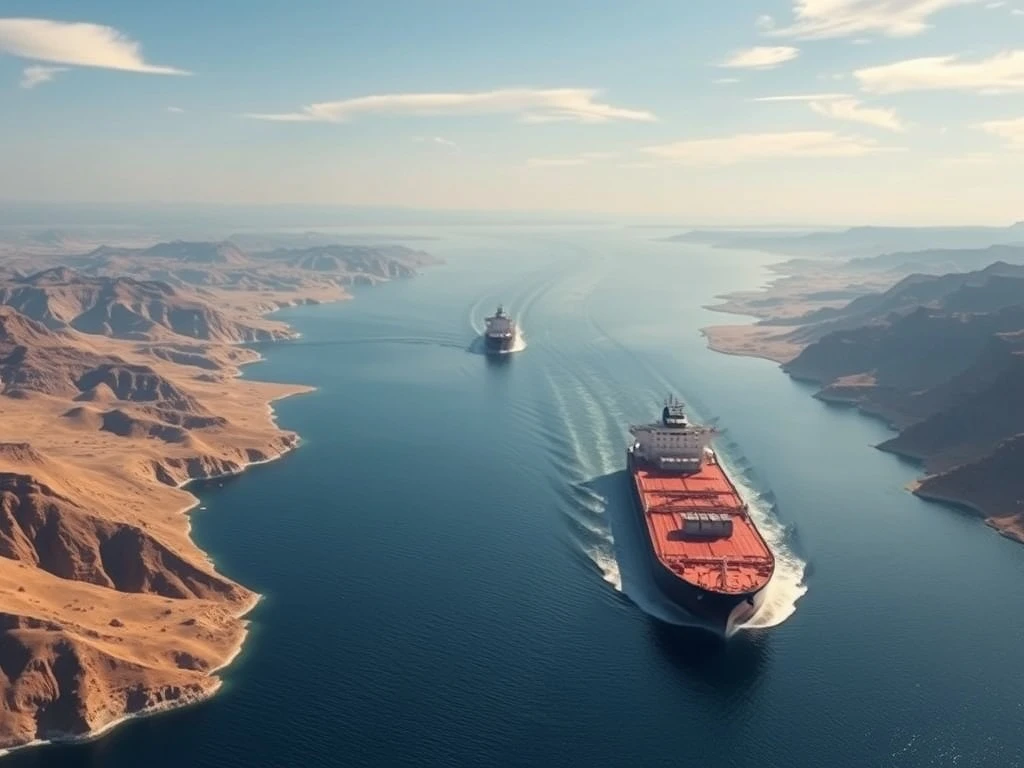
DUBAI, United Arab Emirates — March 15, 2026: A critical maritime incident in the Strait of Hormuz has triggered a sharp geopolitical risk premium, sending global benchmark Brent crude oil prices soaring past $110 per barrel for the first time in over two years. Meanwhile, in a notable display of divergent market behavior, the price of Bitcoin has demonstrated remarkable resilience, holding steady near the $67,000 level. This simultaneous event highlights the complex interplay between traditional energy security shocks and the evolving role of digital assets as potential macroeconomic hedges.
Strait of Hormuz Incident Triggers Global Energy Alarm
Early reports from maritime security firms and regional authorities confirm that a commercial vessel sustained significant damage from what appears to be a targeted attack while transiting the Strait of Hormuz. Consequently, the vital waterway, through which approximately 21 million barrels of oil pass daily—representing nearly 21% of global petroleum liquid consumption—faces severe operational disruptions. The United States Fifth Fleet has increased patrols, and the Iranian Revolutionary Guard Corps Navy has issued statements denying involvement while mobilizing its own forces. This immediate escalation follows months of heightened regional tensions over nuclear negotiations and proxy conflicts.
Also read: Crypto Listing Scams: Binance CEO Changpeng Zhao Issues Critical Warning to Investors
Market reaction was swift and severe. Within hours of the news breaking, front-month Brent crude futures on the Intercontinental Exchange (ICE) surged by over 8%, breaching the $110 mark. Similarly, West Texas Intermediate (WTI) crude jumped to $106.50. “The market is pricing in a significant and sustained disruption to flows,” stated Fatima Al-Jaber, Chief Energy Analyst at the Gulf Research Center in Riyadh. “The Strait is not just a transit route; it’s the world’s most critical energy artery. Any threat there immediately recalibrates global risk models and inventory calculations.” Historical context underscores the sensitivity; previous incidents in 2019 and 2021 led to price spikes of 15-20%, though those events saw a quicker de-escalation.
Bitcoin’s Surprising Stability Amid Commodity Chaos
While traditional energy and equity markets convulsed, the cryptocurrency market presented a starkly different picture. Bitcoin (BTC), the leading digital asset by market capitalization, fluctuated within a tight 3% band, consolidating around the $67,000 support level it has maintained for the past week. This stability occurred despite the crisis triggering a sell-off in major stock indices like the S&P 500, which fell 1.8%, and a flight to safety that boosted the U.S. Dollar Index (DXY).
Analysts point to several structural factors behind Bitcoin’s composure. First, the asset’s 24/7 global trading allows for continuous price discovery, absorbing shocks more fluidly than markets with set hours. Second, its increasing correlation with macro liquidity conditions, rather than short-term geopolitical events, may be insulating it. “We’re observing a maturation in Bitcoin’s price action,” explained Dr. Marcus Chen, Head of Digital Asset Research at the Cambridge Centre for Alternative Finance. “Its narrative is gradually shifting from a purely speculative risk-on asset to one that some institutional portfolios treat as a non-sovereign store of value, akin to digital gold. During periods of regionalized conflict that don’t directly threaten the global financial system’s core, it can exhibit decoupled behavior.”
- Decoupling from Traditional Risk Assets: Bitcoin’s 30-day correlation with the S&P 500 has fallen to 0.15, near its lowest point in 18 months.
- Institutional Inflow Buffer: Spot Bitcoin ETFs in the U.S. have seen net positive inflows for 12 consecutive days, providing underlying demand support.
- Geographic Diversification: Trading activity remained solid across Asian, European, and American sessions, preventing a liquidity vacuum.
Expert Analysis on Diverging Market Paths
The contrasting reactions have sparked intense debate among economists and strategists. Caroline Vance, a former IMF economist now with the Brookings Institution, provided context: “Oil is a physical commodity with immediate, inelastic demand. A supply shock in Hormuz translates directly into higher prices for gasoline, diesel, and feedstock. Bitcoin, while volatile, is ultimately a financial asset whose value is derived from network adoption, monetary policy, and future utility expectations. Today’s event tests the hypothesis that Bitcoin can act as a hedge against specific types of systemic risk.” She referenced a recent Bank for International Settlements (BIS) working paper that examined cryptocurrency behavior during periods of “regional geopolitical stress,” finding mixed and context-dependent results.
Broader Economic Impacts and Historical Comparisons
The immediate consequences extend far beyond trading screens. Airlines have begun announcing fuel surcharges, and shipping companies are rerouting vessels around the Cape of Good Hope, adding 10-14 days and significant cost to Asia-Europe voyages. The U.S. Department of Energy confirmed it is monitoring the situation closely and is prepared to authorize releases from the Strategic Petroleum Reserve (SPR) if the disruption persists. Meanwhile, European natural gas prices, already elevated, rose a further 12% on fears of secondary effects.
This event invites comparison to previous market-stressing incidents. The table below contrasts key metrics from the 2019 tanker attacks, the 2021 Suez Canal blockage, and the current 2026 Strait of Hormuz crisis.
| Event | Oil Price Spike | Duration of Peak Disruption | Bitcoin Price Reaction (7-Day) |
|---|---|---|---|
| 2019 Strait of Hormuz Attacks | +19% | ~10 days | -5% |
| 2021 Suez Canal Blockage | +6% | 6 days | +22% |
| 2026 Current Crisis | +8% (and ongoing) | TBD | ~0% (initial) |
The data reveals no consistent pattern for Bitcoin, underscoring its evolving market drivers. The 2021 event occurred during a massive bull run fueled by institutional adoption, while the 2019 incident saw Bitcoin still largely correlated with tech stocks.
What Happens Next: De-escalation or Protracted Crisis?
The immediate trajectory hinges on diplomatic and military developments. Backchannel negotiations, reportedly facilitated by Oman, are underway to prevent a miscalculation. The U.S. Department of Defense has stated its priority is ensuring freedom of navigation and de-escalation. Energy analysts at Rystad Energy project that if the strait remains partially obstructed for more than a week, global commercial oil inventories could draw down at a rate of 3 million barrels per day, pushing prices toward $120. Conversely, a swift resolution could see a retracement of half the price gain within 48 hours.
Market and Policy Maker Reactions
Reactions from key stakeholders have been measured but firm. The Group of Seven (G7) finance ministers issued a joint statement expressing concern over energy market stability and calling for a peaceful resolution. Major oil-consuming nations in Asia, including Japan and India, have activated emergency energy coordination committees. Within the cryptocurrency community, major exchange platforms reported no unusual withdrawal patterns or system stress, suggesting holders are not panicking. “The market is watching, but not fleeing,” noted a spokesperson for a leading crypto custody firm.
Conclusion
The Strait of Hormuz crisis serves as a stark reminder of the fragility of global energy supply chains and their immediate impact on the oil price. The event’s second-order lesson, however, may be found in the relative stability of Bitcoin. While it is premature to declare Bitcoin a proven safe haven, its ability to hold the $67,000 level amid a classic geopolitical shock marks a potential inflection point in its market maturity. Investors and policymakers alike will watch closely to see if the decoupling holds as the situation develops. The coming days will test both the resilience of global diplomacy and the evolving narrative around digital assets in a multipolar world.
Frequently Asked Questions
Q1: What exactly happened in the Strait of Hormuz?
A commercial oil tanker was reportedly attacked by unmanned surface vessels (USVs) while transiting the narrow channel. The incident caused significant damage, leading to a partial blockage and prompting security forces from multiple nations to respond, escalating regional tensions.
Q2: Why does this crisis affect global oil prices so dramatically?
The Strait of Hormuz is the world’s most important oil transit chokepoint. Approximately 21 million barrels of oil, or one-fifth of global daily consumption, pass through it. Any threat to this flow forces markets to price in immediate scarcity and higher transportation costs.
Q3: How long could high oil prices last?
The duration depends entirely on the security resolution. If the strait reopens fully within days, prices could fall quickly. A protracted crisis lasting weeks could keep prices above $100, impacting global inflation and economic growth forecasts.
Q4: Is Bitcoin now considered a safe-haven asset like gold?
Not definitively. Its reaction today shows potential decoupling, but its short history includes periods of high correlation with tech stocks. Most analysts view it as a unique, volatile asset class that can sometimes, but not always, behave independently during specific types of market stress.
Q5: What does this mean for gasoline prices?
U.S. and European consumers should expect a rapid increase in pump prices within the next 5-7 days, as the higher cost of crude oil feeds through the refining and distribution system. The magnitude will depend on how long the price spike persists.
Q6: How are major oil companies responding?
Integrated majors like Shell and BP are activating business continuity plans, which may include rerouting shipments, drawing on stored inventories, and adjusting refinery feedstock. They are also in close contact with government security agencies for guidance.

This article was produced with AI assistance and reviewed by our editorial team for accuracy and quality.