SG-Forge And SWIFT Bridge Crypto And Traditional Finance in a Revolutionary Leap for Global Banking
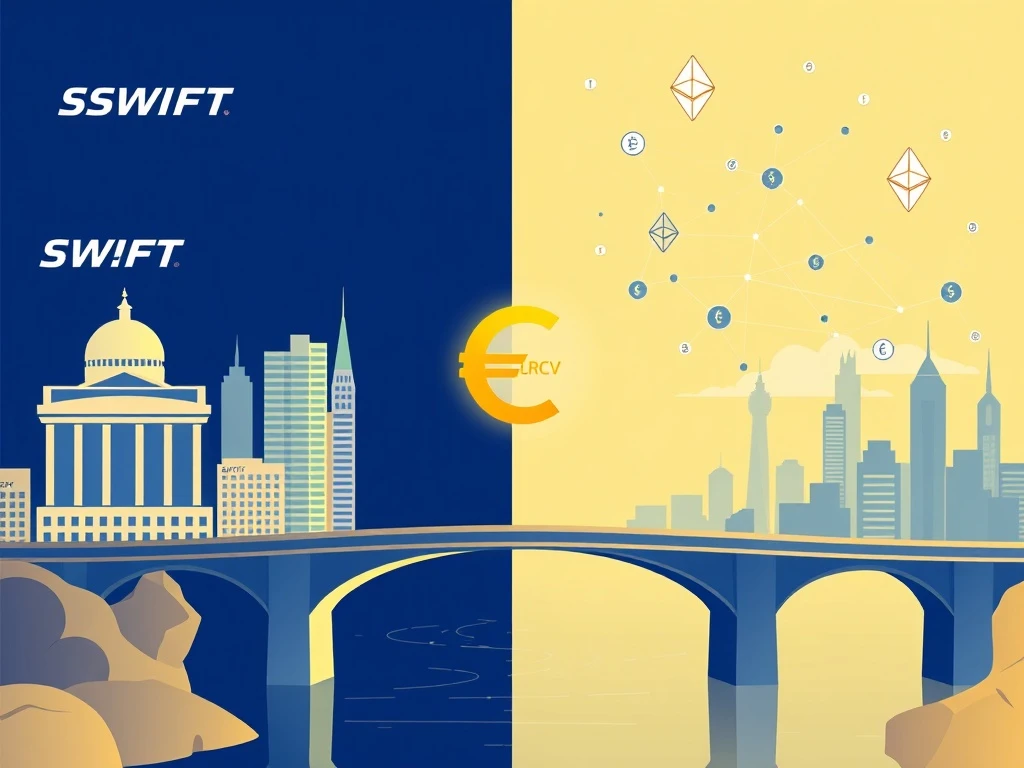
In a landmark demonstration that could redefine the future of global finance, Société Générale’s digital assets subsidiary SG-Forge and the international banking messaging giant SWIFT have successfully bridged the worlds of cryptocurrency and traditional banking. This key experiment, conducted in early 2026, executed the full lifecycle settlement of tokenized bonds using a regulated euro stablecoin, proving that blockchain-based assets can seamlessly integrate with legacy financial infrastructures. Consequently, this collaboration signals a major shift towards institutional adoption of digital assets, offering a compliant and interoperable blueprint for the future of hybrid finance.
SG-Forge and SWIFT Execute Historic Tokenized Bond Settlement
The core of this new initiative involved a comprehensive test of several critical financial operations on the blockchain. SG-Forge and SWIFT did not merely transfer a digital asset; they demonstrated a complete, regulated financial instrument lifecycle. The experiment meticulously tested the issuance of tokenized bonds, their delivery-versus-payment (DvP) settlement, subsequent coupon payments, and final redemption. Significantly, all these transactions utilized the EUR CoinVertible (EURCV), a euro-backed stablecoin issued by SG-Forge on the Ethereum blockchain in 2023.
Also read: AI Trading Agents: The Revolutionary Path to Mastering Your Crypto Portfolio in 2025
This operation moves beyond theoretical proofs-of-concept. It provides a tangible, working model for how regulated financial institutions can employ blockchain technology. The use of EURCV, designed explicitly for compliance with the European Union’s Markets in Crypto-Assets (MiCA) regulation, is a critical detail. It ensures the experiment operates within a clear legal and regulatory framework, addressing a primary concern for traditional banks. Furthermore, the technical architecture relied on the open-source CAST (Compliance Architecture for Security Tokens) standard to govern both the bonds and the stablecoin, ensuring resilient security and operational rules.
The Technical Backbone: ISO 20022 and SWIFT Interoperability
A key to the experiment’s success was its deliberate use of existing global standards. The integration of the ISO 20022 messaging standard is particularly noteworthy. This standard forms the backbone of modern international payment systems used by banks worldwide. By ensuring the tokenized assets and transactions were compatible with ISO 20022, SG-Forge and SWIFT demonstrated that blockchain transactions can “speak the same language” as traditional finance. This technical compatibility drastically reduces the friction and cost for banks to adopt such technology, as they can build upon their current investments in SWIFT’s network and messaging protocols.
Also read: RunBot AI Trading Bot: Revolutionizing Automated Cryptocurrency Strategies with Machine Learning
Thomas Dugauquier, Head of Tokenized Assets at SWIFT, emphasized this point, stating the operation “proves that SWIFT can orchestrate multi-platform tokenized asset transactions.” This orchestration role is central to SWIFT’s strategy. Rather than replacing existing bank ledgers, SWIFT envisions itself as a secure, neutral orchestrator that connects disparate blockchain platforms and traditional systems, enabling streamlined cross-border and cross-asset transactions.
The Strategic Vision: SWIFT’s Blockchain Ambitions for a 24/7 Global Market
This collaboration with SG-Forge is not an isolated project. It is a cornerstone of a broader, ambitious strategy announced by SWIFT in September 2025. SWIFT is actively developing and integrating a shared blockchain ledger into its global infrastructure. The ultimate goal is to enable real-time, cross-border payments that operate 24 hours a day, 7 days a week, a stark contrast to the batch-processing and time-zone limitations of current systems.
SG-Forge is one of approximately 30 global financial institutions participating in this foundational initiative. Early phases of this work have involved collaboration with blockchain technology firm Consensys, utilizing the Ethereum network for its smart contract capabilities and developer ecosystem. The shared ledger concept relies on smart contracts—self-executing code on a blockchain—to automatically validate and execute transaction terms, ensuring immediate settlement and immutable traceability. This experiment with tokenized bonds serves as a critical validation of that larger architectural vision.
| Component | Description | Significance |
|---|---|---|
| Asset | Tokenized Bonds | Represents a regulated, income-generating traditional security on-chain. |
| Settlement Medium | EUR CoinVertible (EURCV) | A MiCA-compliant, euro-backed stablecoin providing regulatory certainty. |
| Technical Standard | CAST Framework | Ensures compliant governance and operation of security tokens. |
| Messaging Protocol | ISO 20022 | Enables interoperability with existing global banking payment systems. |
| Strategic Goal | SWIFT Shared Ledger | Part of a move towards 24/7 real-time global transaction orchestration. |
The Regulatory Imperative: MiCA as a Catalyst, Not a Barrier
The timing and design of this experiment are deeply intertwined with the evolving regulatory market in Europe. The Markets in Crypto-Assets (MiCA) regulation, which began its phased implementation, provides the first comprehensive regulatory framework for digital assets in a major global jurisdiction. For risk-averse financial institutions, regulatory uncertainty has long been a primary barrier to crypto adoption. SG-Forge’s proactive development of a MiCA-compliant stablecoin in EURCV directly addresses this hurdle.
By conducting this settlement experiment within the anticipated boundaries of MiCA, the partners have created a powerful template. They show that innovation and compliance are not mutually exclusive. In fact, a clear regulatory framework like MiCA can act as a catalyst, giving institutions the confidence to innovate. This approach paves the way for what industry observers term “hybrid finance,” where the efficiency and programmability of blockchain coexist with the legal security and consumer protections of the traditional financial system.
Implications for the Future of Finance and Institutional Crypto Adoption
The successful experiment carries profound implications for multiple stakeholders across the financial ecosystem. For traditional asset managers and banks, it demonstrates a viable, low-friction path to tokenizing assets like bonds, equities, or funds. Tokenization can unlock benefits such as fractional ownership, increased liquidity for traditionally illiquid assets, and automated compliance and reporting. For the cryptocurrency industry, it represents a key validation by one of the most entrenched pillars of global finance, SWIFT, signaling that blockchain infrastructure is maturing to meet institutional demands for security, scalability, and compliance.
Moreover, this development accelerates the trend toward real-world asset (RWA) tokenization. While the experiment used financial bonds, the same technical and regulatory principles can apply to tokenizing real estate, commodities, or intellectual property. The involvement of a major global bank like Société Générale through SG-Forge also highlights the growing institutional competition in the digital asset space, following similar moves by other financial giants exploring blockchain-based services.
- Enhanced Liquidity: Tokenized bonds can be traded in smaller denominations and on digital markets, potentially attracting a wider investor base.
- Operational Efficiency: Automated settlement via smart contracts reduces manual processing, counterparty risk, and the need for reconciliation.
- Global Access: SWIFT’s network connects over 11,000 institutions, offering a ready-made distribution channel for tokenized assets worldwide.
- Regularity Blueprint: The MiCA-compliant model sets a precedent for other jurisdictions developing their own crypto asset regulations.
Conclusion
The collaboration between SG-Forge and SWIFT to bridge crypto and traditional finance through the settlement of tokenized bonds is a definitive milestone. It moves the conversation from theoretical potential to practical, regulated implementation. By successfully integrating a MiCA-compliant stablecoin with existing ISO 20022 banking messaging via SWIFT’s network, the experiment provides a clear, interoperable pathway for the future of finance. This development strongly indicates that the evolution of global markets will not be a disruptive replacement of old systems by new ones, but rather a strategic convergence. The bridge between crypto and traditional finance, demonstrated so effectively by SG-Forge and SWIFT, is now open for institutional traffic, setting the stage for a new era of hybrid, efficient, and inclusive global finance.
FAQs
Q1: What exactly did SG-Forge and SWIFT accomplish in this experiment?
They successfully executed the full lifecycle of a tokenized bond—including issuance, delivery-versus-payment settlement, coupon payments, and redemption—using a regulated euro stablecoin (EURCV) on a blockchain, while seamlessly connecting to the traditional SWIFT banking messaging network.
Q2: Why is the use of the EUR CoinVertible (EURCV) stablecoin significant?
EURCV is significant because it was issued by a regulated bank subsidiary (SG-Forge) and is designed specifically to comply with the European Union’s MiCA regulation. This provides legal and regulatory certainty, which is essential for traditional financial institutions to participate.
Q3: How does this experiment fit into SWIFT’s broader strategy?
This test is a key component of SWIFT’s strategy to integrate a shared blockchain ledger into its infrastructure. The goal is to use SWIFT as a neutral orchestrator to enable real-time, 24/7 cross-border payments and transactions between different blockchain platforms and traditional banking systems.
Q4: What is the CAST framework mentioned in the experiment?
CAST (Compliance Architecture for Security Tokens) is an open-source standard used to govern the rules and compliance features of security tokens and stablecoins on a blockchain. It ensures that these digital assets operate within predefined legal and regulatory parameters.
Q5: What does this mean for the average investor or bank customer?
In the near term, direct impact may be limited to institutional players. However, in the longer term, this technology can lead to more efficient financial markets, potentially lower costs for services like cross-border payments, and access to new, tokenized investment products that were previously illiquid or inaccessible.

This article was produced with AI assistance and reviewed by our editorial team for accuracy and quality.